Box Build Assembly and Final Integration
Where Box Build Begins
Box build is the work that turns a finished board into a finished product: the enclosure, the harness, the connectors, the display, the fasteners and the label. It begins where board level assembly ends and it is where the last chance to catch a problem exists, because after the box is closed the board is inaccessible. The step is therefore a quality gate as well as an assembly operation, and treating it as a packaging activity is what leads to units that fail at the customer instead of at the bench.
Mechanical Assembly
The mechanical work decides whether the product survives its environment. Standoffs, bosses and screws have a specified torque, and a screw that is over tightened cracks a boss while one that is loose leaves a board free to vibrate. Gaskets and seals have a compression range, and a seal that is over compressed takes a set and leaks. Cable routing has a minimum bend radius and a separation from hot parts, and a harness that is pulled tight against a heatsink will fail in the field. Each of these is a work instruction step, and each needs to be specified with a number rather than with the word tight.
Wiring and Connectors
Wiring is where the most errors occur. The crimp has to match the wire gauge and the terminal, and a crimp made with the wrong tool will pass a pull test and fail later. The connector has to be seated with a click or a latch, and the keying has to be checked so that a connector cannot be mated in the wrong position. Where a wire is inserted into a screw terminal, the correct strip length and the correct torque both matter, and a strand that escapes the terminal can bridge to its neighbour. The wiring should be checked against a drawing rather than against a memory, and the check should include a pull on each wire and a visual on each latch.
Labelling, Marking and Traceability
The label carries the product identity, the serial number and often a compliance mark, and its position and content are specified rather than chosen. A label applied over a seam, at an angle or in the wrong place is a defect, and a serial number that cannot be read is a traceability failure. Where the product has a data plate or a laser mark, the same discipline applies. The unit’s records should tie the serial number to the board it contains and to the test results, so that a field question can be answered from the file rather than from an inspection of the product.
Test and the Final Gate
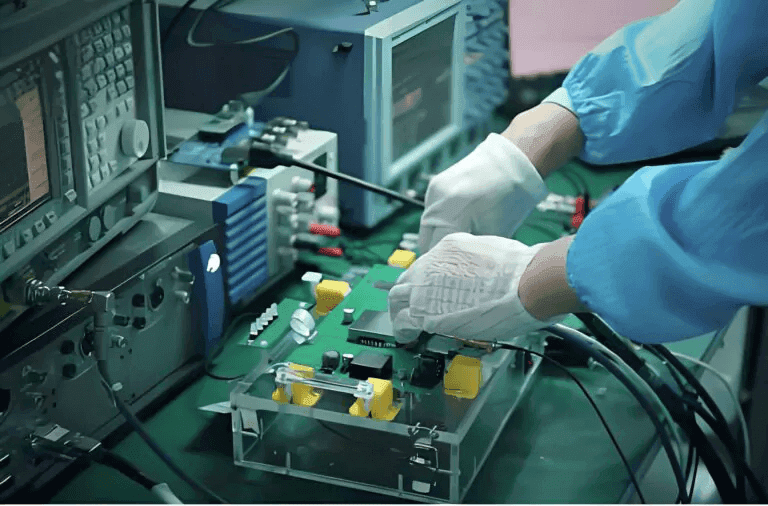
The functional test at the end of a box build is the last opportunity to catch a defect before shipping, and it should test the product as the customer will use it: powered, connected, and exercised through its interfaces. A test that only confirms that the unit powers up leaves the connectors, the sensors and the outputs unverified. Where the unit is sealed, the test has to happen before the enclosure is closed, which means the process sequence matters. The test result should be recorded against the serial number, and a unit that fails should be routed to a defined path rather than returned to the line without a record.
Keeping a Box Build Repeatable
A box build is repeatable when the instructions describe the product rather than the operator’s habits. That means a bill of materials at the box level as well as the board level, a work instruction with pictures at each step, a torque specification for every fastener, a defined test and a defined pack. It also means the fixtures and the tools are provided and maintained, since a torque driver that is out of calibration produces a whole lot of units with the wrong torque. Where the build is done by more than one operator or at more than one site, the instruction is what makes the results comparable.
Packaging and Shipping Preparation
The last step is the one most often improvised. The pack has to protect the unit through the distribution environment it will actually see, which for a heavy product with a connector may be different from the pack for a light one. Static sensitive items need a defined bag and a defined labelling, and any desiccant or humidity indicator has to be appropriate for the journey and the destination. The pack should be specified with the product and included in the work instruction, because a good product in an inadequate pack arrives as a damaged product.
Handling the Nonconformance
A unit that fails at the box build stage is a unit with a problem, and how it is routed decides whether the failure is a lesson or a liability. It should go to a defined rework or analysis path with the failure recorded against the serial number, and the cause should be established before the repair is made, because a unit that is repaired without a diagnosis may fail again. Where the same failure appears on several units, the process is at fault rather than the product, and the response belongs to the line rather than to the individual unit. Recording the failures by station is the data that shows where the build is weakest.
FAQ
What is box build? The assembly of the enclosure, harness, connectors and accessories around a finished board to produce a finished product.
Why is it a quality gate? Because after the enclosure is closed the board is inaccessible, so problems must be caught before assembly is completed.
What must be specified for wiring? The crimp tool and terminal, the strip length, the torque, the connector keying and the routing, all with numbers.
When should the functional test run? Before the unit is sealed, so that a failing unit can be repaired, and with the interfaces exercised.
What makes a box build repeatable? A box level bill of materials, a documented work instruction, calibrated tools and a defined test and pack.
Conclusion
Box build is where a board becomes a product, so specify the torque, the routing, the test and the pack rather than leaving them to habit. The last gate should be the strongest. Integration work belongs with PCB assembly, the board inside it comes from SMT PCB assembly, and the end of line test is part of PCBA testing. Box build readiness is normally planned during prototype PCB assembly in 2026.