Industrial Multilayer PCB Fabrication for Small Production Runs
Industrial control products are usually built in modest quantities and expected to work for a decade. That combination puts unusual pressure on fabrication: the volume is too low to justify a dedicated program, and the reliability expectation is closer to automotive than to consumer. Getting an industrial multilayer PCB built in these conditions is a matter of choosing the right process window rather than the lowest price.
The place to start is not the layer count. It is the set of performance requirements that the board has to hold over its life, because those decide the material, the copper, the hole structure and the test evidence that the purchase has to include.
What Industrial Boards Demand
Temperature is usually the first constraint. A controller in a cabinet may sit at elevated ambient for years, with local hotspots from regulators and power stages, and the resulting thermal cycling eventually tests every via and solder joint.
Electrical noise is the second. Contactors, relays, motor drives and long field wiring all inject disturbance, and the board has to maintain its measurement integrity and immunity without relying on perfect installation conditions.
Life cycle is the third. A product that remains in service for ten years cannot depend on a component, a laminate or a surface finish that will be unavailable in five. That requirement reaches all the way back to the material specification.
Planning the Stackup for a Long-Life Product
Stackup and impedance should be decided together with the fabricator, not inherited from a previous design. The dielectric thickness between reference planes sets the impedance, so a stackup change is an electrical change, and a stackup that is convenient for the shop may be inconvenient for the design.
For long-life products, the material specification should name a grade that is likely to remain available, with a plausible alternate recorded. A high performance laminate that is produced in small quantities may solve a signal integrity problem and create a supply risk that no redesign later can absorb cheaply.
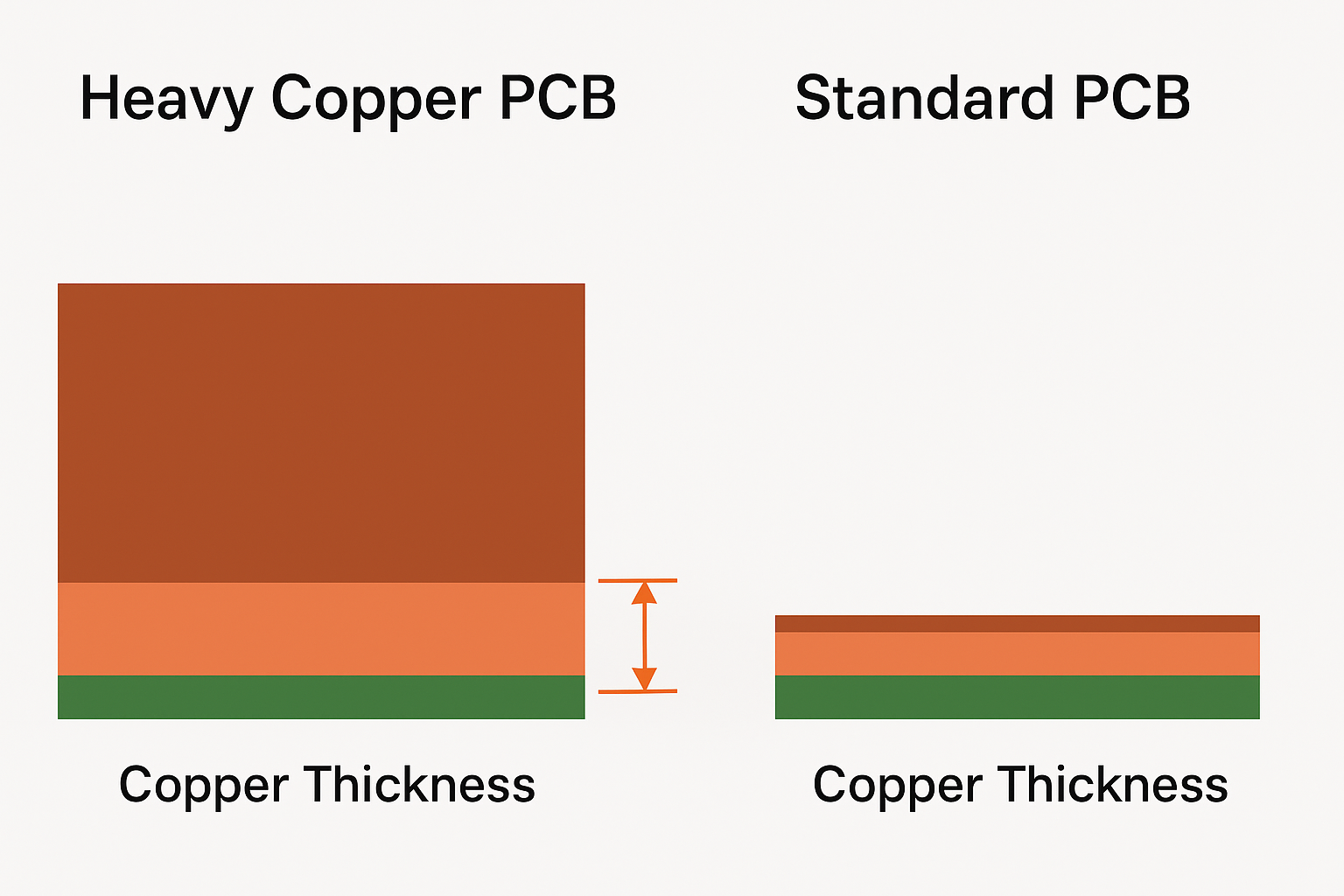
Copper weight deserves an explicit decision as well. A thick copper PCB improves current capacity, thermal spreading and mechanical robustness, and it makes fine-line etching more difficult on the same layer. Where a design needs both, the heavy copper should be placed on layers that do not carry the finest features, and the fabrication house should confirm that the combination is producible at the required yield.
Design Rules That Survive the Supplier Change
One of the practical difficulties in industrial work is that the same product may be built by different suppliers over its life. A design rule set that encodes the process window rather than one shop preference is therefore more valuable than a rule set tuned to a single factory.
Where the rules come from a design team that also works with industrial multilayer PCB production, they can be written as a range: minimum trace and space, annular ring, hole-to-copper distance, solder mask clearance and impedance tolerance, each with the reason it exists. That documentation is what allows a second source to be evaluated without repeating the entire qualification.
It also makes the acceptance criteria comparable. A quotation from a second supplier can only be judged against the first if both are answering the same rules and the same test requirements.

Small Runs and Panel Economics
In small production runs, panel utilisation has a disproportionate effect on price. The board size, the quantity and the panel format interact, and a design that leaves a large unused area may pay for it on every order.
That is worth discussing with the fabricator rather than assuming. Where the design allows, adjusting the panel arrangement, adding a breakaway rail or accepting a different panel size can reduce cost without touching the circuit. Where the boards are later assembled in-house, the panel also has to suit the printer and the placement machine, so the decision should involve whoever builds the boards.
The other lever is scheduling. A small run of a specialised build competes for press and drill time with larger orders, and a supplier that can group similar builds will often deliver a better lead time than one that treats every order independently.
Batch Consistency Across Reorders
Consistency is the requirement that distinguishes industrial purchasing from prototype buying. The second order has to behave like the first: same stackup, same material grade, same finish thickness, same impedance within tolerance.
Achieving that requires a record rather than a memory. The build file should carry the stackup revision, the material brand and grade, the copper weights, the drill schedule, the impedance targets and the measured coupon data. A supplier that retains that record can repeat the build; one that does not will reinterpret the drawing.
Where the process calls for verification that goes beyond electrical test, such as cross-sections for sequential builds or microsection data for thick copper, the sampling plan and the reporting format should be agreed at the purchase order stage rather than after the boards arrive.
Acceptance, Reports and Traceability
Industrial customers increasingly need to answer a question about a specific unit, which means the manufacturing record has to connect a delivered board to a batch and a revision. Panel identification, batch numbering and the retention period for records are part of the purchase, not administrative detail.
The same record supports the partner that handles assembly. A factory that runs industrial PCBA manufacturing and uses PCBA testing to verify the finished product can use the fabrication data as a baseline when something behaves unexpectedly, which is far cheaper than re-qualifying the board from scratch.
Working With the Fabricator on the First Order
The first order sets the pattern for everything that follows, so it is worth spending time on the review rather than on the negotiation. Send the complete data package, including the stackup with material designations, the impedance requirements with tolerances, the drill schedule, the surface finish and the acceptance criteria.
Then read the response carefully. A fabricator that returns questions about dielectric thickness, registration across the lamination cycle or the availability of the specified material is demonstrating that the board has been reviewed against the process. A quotation with no questions usually means the file was priced rather than engineered.
It is also worth agreeing how a deviation will be handled. If a measured impedance falls slightly outside the target, or a batch shows a registration trend, the decision to ship, rework or scrap should be governed by a rule agreed in advance, with the reporting that supports it.
Finally, keep the first build file as the reference. Every later order should either repeat it exactly or reference an approved change, and that single practice removes most of the variability that otherwise creeps into long-life industrial supply.
FAQ
How many layers should an industrial controller use? As many as the signal, power and EMC requirements demand, and no more. Extra layers add lamination cycles and cost without improving the product.
Is thick copper always better? No. It helps with current and heat and hurts fine-line capability. It should be specified per layer for a reason.
What should a reorder include? A reference to the original build file plus any approved change, so that the supplier repeats a known process rather than rebuilding from the drawing.
How is impedance verified in a small run? Usually with a coupon on the same panel, measured and reported, which is more reliable than testing finished boards destructively.
Summary
Industrial multilayer boards are bought on process, not on price per square metre. Agree the stackup and impedance with the fabricator, choose materials that will still exist in five years, decide where heavy copper is worth its cost, and require the batch record that makes the next order repeatable. A supplier that maintains that discipline through manufacturing process control turns a series of small orders into a predictable supply.