Circuit Design Partner for Production: Preparing a Requirements Brief
A team that needs a circuit design partner usually already knows what the product should do. What it often lacks is a document that another company can design against, and that document is what determines whether the project runs on a schedule or drifts through a series of revisions.
The distinction matters most for companies with a production date. A proof of concept can tolerate an open question; a product that has to be certified, tooled and built cannot, because every unresolved requirement becomes a change order later in the program.
What a Requirements Brief Has to Contain
A hardware requirements brief does not need to be long. It needs to answer the questions that change the architecture, and it needs to distinguish between what is fixed and what is a preference.
The functional core comes first: what the product does, how a user interacts with it, and which functions are essential rather than desirable. Then the interfaces, including input and output signals, communication protocols, and any external system the product has to work with.
Power architecture follows: the available supply, the required rails, the expected load, the battery or energy source, and any requirement for isolation or backup behaviour. These choices determine the topology of the design more than any other part of the brief.
Then the mechanical envelope: board dimensions, mounting, connector positions, height limits and the space available for heat dissipation. A design that ignores the enclosure produces a working board that cannot be assembled into the product.
Finally, the environmental and regulatory context: temperature range, humidity, vibration, ingress protection, EMC targets and any certification the product needs. These requirements influence component grade, protection strategy and layout rules, and they are the most expensive ones to add late.
Define What Will Be Delivered
The deliverable list is where misunderstandings begin, because the word design can mean anything from a schematic to a complete validated product.
A useful list states which of the following are included: the requirement review, the architecture and component selection, the schematic, the layout and fabrication data, the assembly and test data, firmware source and build environment, the prototype units, the validation reports and the production documentation.
It should also state the ownership of each item. Source files, library and footprints, firmware, test fixtures and documentation all have an owner, and the answer is cheaper to agree at the start than to negotiate after the work exists.
Where the partner will carry the design into prototype validation and production, the boundary between design and manufacturing should still be written down, because a clear boundary is what allows each stage to be accepted rather than absorbed.
Plan the Validation Before the Prototype Arrives
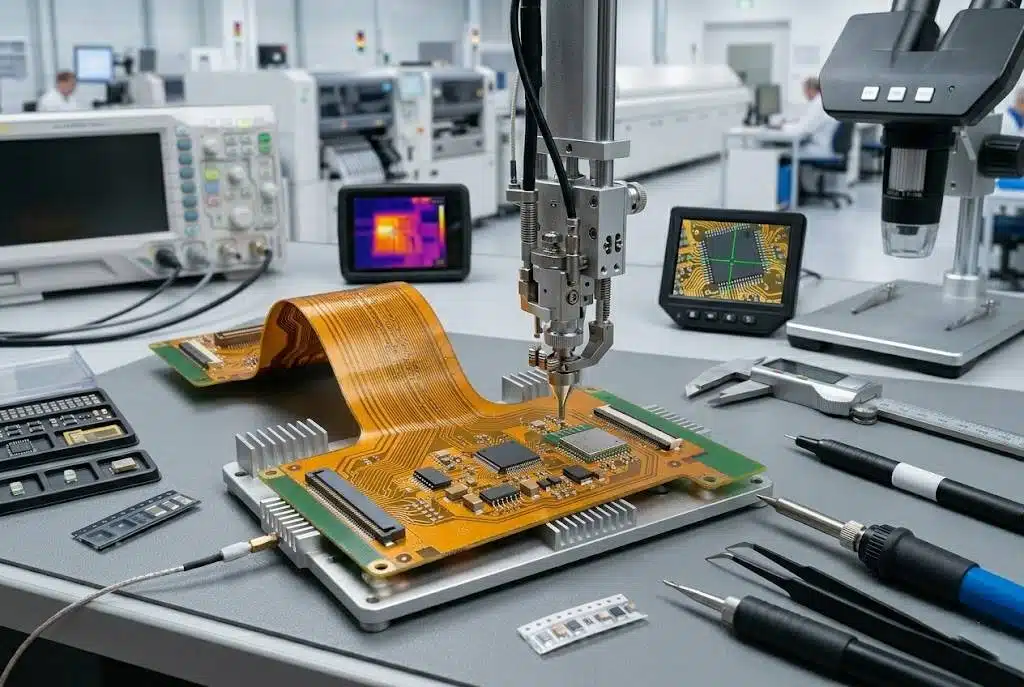
Validation is most effective when it is designed alongside the product rather than improvised after the first board is powered up.
The plan should state which parameters will be measured, under which conditions, with what pass criteria and what equipment. Those decisions determine which test points are needed, which signals must be accessible and which firmware diagnostics have to exist.
It also helps to define the failure path. If a measurement is outside its limit, who investigates, what evidence is collected and what constitutes a fix? A program that treats a failure as an unscheduled event loses the schedule; one that treats it as a planned branch of the process recovers in days.
A partner whose prototype validation is structured this way will usually raise those questions during the design review, which is a good sign that the validation will produce usable evidence rather than a working unit and a shrug.
<img src="https://www.gopcba.com/wp-content/uploads/2026/08/Automotive-PCB-Material.webp" alt="prototype validation before production” />
Agree the Manufacturing Handover in Advance
The manufacturing handover is the point where an otherwise successful development program is most often delayed. The design is complete, the prototype works, and the factory then asks questions that require a change: a footprint that does not suit the line, a part that cannot be placed reliably, a test point hidden under a connector.
Agreeing the handover in advance means deciding who reviews the design for manufacturability, which process will build it, what documentation is required and when the production data is frozen.
It also means deciding how the design will be treated if a component becomes unavailable at volume. An approved alternatives list with the critical parameters named, prepared during the design phase, is what turns a shortage into a routine substitution instead of a redesign.
Where the same organisation handles design and manufacturing, the handover is a review rather than a transfer of knowledge, which is why those programs tend to recover faster from late changes. Even when the manufacturing partner is separate, naming the interface and the owner is what keeps the handover predictable.
How to Compare Candidate Partners
The way a candidate responds to the brief is more informative than any portfolio. A partner that returns a set of clarifying questions, a list of assumptions and a staged plan is demonstrating how it will behave when the project is underway.
It is worth asking for the shape of a previous project of similar complexity: not the confidential details, but the stages, the review points, the types of issue that arose and how they were resolved. That conversation reveals more than a capability table.
Commercial terms should also be normalized. Two quotations can cover very different scopes, so the comparison should mark which stages, deliverables and support obligations are included and price the exclusions separately.
Then consider continuity. A partner that can also handle components procurement and assembly keeps one revision across design and production, and one owner for the questions that cross the boundary.
Information to Send Before the First Meeting
- The core function, the user and the environment the product will operate in.
- Available supply, required rails and any battery or energy constraints.
- Interfaces, protocols and external systems the product must support.
- Mechanical envelope, connector positions and thermal expectations.
- Certification and compliance targets, with the market they apply to.
- Prototype quantity, milestone dates and the expected production volume.
- The deliverables expected from the partner, including source files and firmware.
A brief containing these items allows a serious partner to reply with a scoped plan, and it allows the customer to compare the answers rather than the prices.
FAQ
Can a partner design without a complete brief? Yes, and part of the engagement can be writing the brief together. What cannot be left undefined is who owns each requirement and how a change is priced.
How many prototype rounds should be planned? For a new architecture, plan for two, with the second focused on manufacturing readiness rather than functionality.
What is the largest risk to the schedule? A requirement that changes after the layout is released, especially one that affects the mechanical envelope or the power architecture.
Should the design partner also build the product? Not always, but continuity removes a handover and keeps the documentation aligned with the hardware that is actually manufactured.
Summary
The quality of a circuit design partner engagement is largely decided before it starts. Write the hardware requirements brief, define the deliverables and their ownership, plan the validation with pass criteria, and agree the manufacturing handover while the design is still flexible. Those four documents are what make a production date realistic.