Volume Assembly of an Automotive Body Controller Board
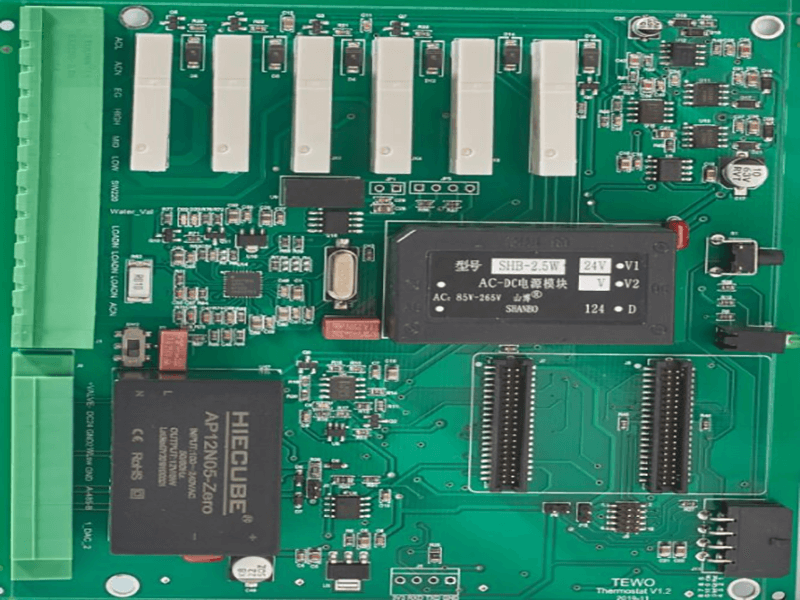
A body controller board carries a main controller, a communication transceiver, a protected supply circuit, relays and several connectors. When a project like this is prepared for volume, the useful conversation does not start with the date the line can run. It starts with the state the product has to be in when it is delivered: which hardware revision, which program written into it, which interface tests completed, and which batch information retained.
Turning those conditions into production documents and process requirements is what prevents the board being finished and then having its program added, its harness changed or its batches reidentified afterwards.
Define the Delivered State
The customer has to say whether the delivery is a board that has been assembled, or a finished unit that also includes through hole parts, programming and a functional test. The three states need different documents, different lead times and different inspection, and leaving the answer open means the last stage of the order is planned while it is running.
If a harness test is required, the supply conditions, the interface definitions, the communication method, the input and output items and the acceptance criteria come with the requirement. Where environmental or reliability acceptance is involved, the assessment follows the drawing, the standard and the test conditions the customer provides rather than a power-up check standing in for it.
The quantity and the date belong with the version information. A project delivered in several batches needs the quantity of each batch and a statement of which batch a hardware or program change takes effect from, because a change that is applied to the wrong batch is worse than a change that arrives late.
Build a Version Correspondence Table
The Gerber data, the bill of materials, the coordinates and the assembly drawing are the starting point. The controller, the communication device, the crystal, the power components and the connectors are specified by full part number, and the polarity and orientation are marked on the assembly data.
A repeat order cannot be produced from a file name. The current board, bill of materials, coordinates, stencil and machine programme are checked against each other, and the customer states whether anything has changed in the hardware, the material or the software relative to the previous batch. Where a substitution was approved previously, a formal record states the original part, the substitute, the reference designators affected and the batches it applies to. An approval given for one order does not carry into the next one by itself, because the reason for it may no longer exist.
Put the Critical Devices on the First Article List
The large connectors, the relays, the communication transceiver and the power devices on a body controller board determine whether the later tests can pass. After printing, the paste volume and offset are observed through paste inspection before placement and reflow are allowed to proceed.
After the first board, optical inspection covers the missing parts, the offset, the reversed parts and the visible joints, and the manual review concentrates on the connectors, the polarised devices and any substituted part, since those are where a substitution or a placement error is most likely to escape optical inspection. Whether a device with hidden joints needs a further examination follows the customer requirement.
The first article does not end with the visual check. Where programming and testing are part of the order, the program revision, the communication interface and the harness connection are confirmed as well, and together they form the release basis for the batch.
Containing a Production Anomaly
During volume assembly, a reference designator that raises repeated alarms stops the line while the stencil, the paste data, the placement coordinates, the component packaging and the reflow state are checked. If the test failures concentrate in one period of production, the material, programme and repair records for that period are used to narrow the range rather than the whole batch being questioned.
When material is added or the programme is adjusted mid-run, the point at which the change begins is stated. Boards awaiting review, boards that have been repaired and boards that have passed are kept in separate flows, and a repaired board repeats the full inspection before it is released. Looking only at the position that was repaired is not enough evidence that the board is sound.
After the run, the hardware revision, the programme and the test state are compiled to the customer’s requirement. Products with tall connectors and relays are packed in a layered antistatic arrangement so that the interfaces are not loaded in transit.
The work covers placement, through hole parts, programming and interface testing. Our automotive PCBA flow and the PCBA testing group handle this kind of order, and the records are held under quality management.
Preparing the Data Before the First Board Is Placed
`r`n
Most of the work that makes a volume order run smoothly happens before it starts. The bill of materials is checked line by line against the previous revision, and every line that has changed is marked with the reference designator, the old part, the new part and the reason. A line that has not changed is confirmed as unchanged rather than left to inference, because a file that carries the same name does not prove that the content is the same.
`r`n
The coordinate file is checked for the origin, the rotation convention and the separation of the top and bottom layers, and the assembly drawings are compared with the board so that a designator that has moved or a component that has changed orientation is visible before the programme is generated. Where the panel has changed, the stencil and the support tooling are re-evaluated, because a panel that has been rearranged produces a different print even when the board itself is untouched.
`r`n
The programme is then built against the current data rather than reused under a familiar name, and the first article is the point at which all of that is confirmed together: the paste, the placement, the orientation, the joints and, where the order includes them, the programme and the interface test.
`r`n
What a Batch Record Has to Contain
`r`n
A batch that cannot be explained afterwards is a liability, particularly where the product goes into a vehicle. The record states the hardware revision, the material lots that were consumed, the programme revision written into the boards, the test results and the disposition of every board that was repaired or set aside.
`r`n
Where a substitute was used, the record says which reference designators it affected and from which board or batch the change applies. That is what allows a question asked months later, about a unit in the field or a batch in the customer’s store, to be answered from the file instead of from memory.
FAQ
Why plan from the delivered state? Because the assembly, the programming and the test each change the documents, the lead time and the inspection, and deciding them at the end moves the delay into the last week of the order.
Does an approved substitute carry to the next order? No. The approval names the reference designators and the batches it covers, and it is renewed for a new order.
What is confirmed on the first article? The paste condition, the placement, the orientation, the joints, the programme and the interface test where it is part of the order.