Solution Development Across Medical, Automotive and Industrial Products
Experience in a domain is not a marketing claim; it changes what the first draft of a schematic looks like. A medical product, an automotive module, an industrial controller and a battery powered sensor share the same basic building blocks, and yet the technical route, the certification evidence, the cost structure and the supply chain around them are different in each case. A team that has built something similar before starts from the constraints, while a team starting from nothing discovers them one prototype at a time. The solution development work described here is organised by the domains in which the team has already delivered.
Medical Electronics
The project types range from the control boards inside laboratory instruments such as analysers, through home devices such as blood pressure monitors, glucose meters and heart rate monitors, to rehabilitation equipment and patient monitoring products.
A medical design begins with electrical safety and EMC rather than with features. Creepage and clearance distances, insulation requirements and protective circuits are decided at the schematic stage, because they are expensive to add later and impossible to add without disturbing the layout. The signal path then has to be accurate and repeatable, and the system has to behave in a defined way when something fails. Pre-compliance work against the EMC requirements is carried out alongside the design so that the certification test is a confirmation rather than a discovery.
Automotive Electronics
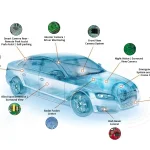
Typical projects include battery management systems covering measurement, balancing and communication, body control modules for lighting, windows and seats, in-vehicle accessories, and control boards for charging and energy storage.
Reliability is the organising principle. A wide operating temperature range, resistance to vibration and protection of the supply are baseline requirements rather than options. Components are selected with the automotive qualification in mind, and the design is reviewed against the high and low temperature, vibration and load dump conditions at the layout stage, so that corrective action happens on the screen instead of in a test report.
Industrial Control
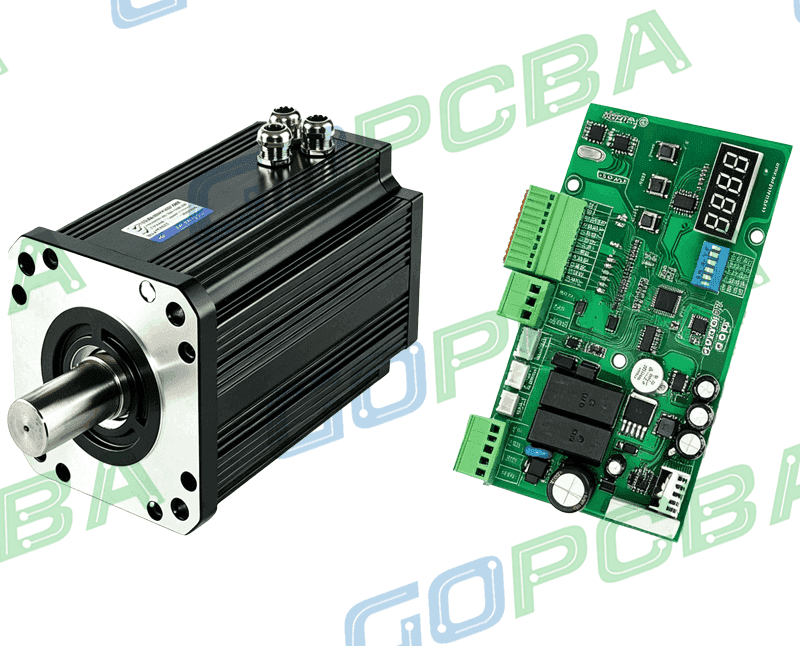
The work covers programmable logic controller boards, digital input and output modules, analog acquisition, servo and inverter support boards, sensor signal conditioning, and communication interfaces such as RS-485, CAN and Ethernet.
The environment is electrically noisy and mechanically demanding, so the attention goes to the power design, the protection of the interfaces and the electromagnetic performance. Industrial products also stay in production for a long time, which means component selection looks at availability and at a qualified alternative rather than only at the specification and the price.
Internet of Things Terminals
Projects include data acquisition terminals that accept a range of sensors, carrier designs for NB-IoT, LTE, WiFi and Bluetooth modules, gateways that process data locally and upload it to a server, and battery powered devices where every microamp matters.
The characteristics of this domain are the variety of communication routes, the demand for low power and the need to connect to a cloud platform. Power is optimised in two places at once: in the hardware, through device selection and the design of the supply, and in the firmware, through the way the radio and the processor are scheduled. Our IoT PCBA team takes these designs into production.
Consumer Products
Small appliance control boards, wearable and smart home products, charging and audio accessories, and gift and toy electronics make up the consumer side of the portfolio.
Here cost and manufacturability dominate. The bill of materials is reviewed for cost before the layout is frozen, and alternatives are qualified so that a supply problem does not stop the line. Decisions are taken with the assembly process in mind, because a design that is difficult to print, place or inspect carries a cost in yield that no purchase negotiation can recover. The SMT assembly and turnkey PCB assembly routes are set up for exactly that volume.
How the Work Is Organised
Hardware and firmware are developed by the same team, so there is no boundary between two suppliers to negotiate when a fault has to be traced. The component database and the supply relationships are applied during the solution stage, which is where a cost decision is still cheap to make. When the design is released, it moves into PCB fabrication, assembly and test along a single route, so the same people who chose the parts see the boards being built.
Every project has a named engineer who reports progress at fixed points and confirms the key decisions with the customer. The commercial arrangement is flexible: a project can be quoted as a package, as an engineering effort, or as a mixture of the two, depending on what the customer is actually asking for. Our PCB design and layout team and the embedded firmware group work inside the same structure, and the process page describes how the stages connect.
What a Domain Actually Changes in the Design
Two boards can carry the same processor and the same memory and still be designed in completely different ways, because the domain decides which requirement wins when two requirements conflict. In a medical product the conflict is usually between accuracy and safety, and the safety side wins: a measurement that is temporarily wrong is tolerable if the product announces it, while a measurement that is presented with false confidence is not.
In an automotive module the conflict is between cost and robustness, and the robustness side keeps a fixed share of the budget. A part that is cheaper and equally capable on paper is not automatically accepted, because the qualification behind it and the behaviour of the device across the temperature range matter more than the price difference.
In industrial control the trade is between performance and immunity. A faster interface that couples noise into a neighbouring channel is a worse choice than a slower one that survives a disturbance, and the protection networks around the connectors are part of the specification rather than a precaution added at the end.
In an Internet of Things terminal the trade is between features and battery life. Every radio transmission, every wake-up interval and every component that draws a standing current is a decision about runtime, and the decision is taken jointly by the hardware and the firmware because neither side can hold it alone.
In a consumer product the trade is between every other requirement and the target cost. The design is reviewed against a cost that has to be met at volume, and the alternatives that could replace an expensive part are qualified before the layout is frozen, not after the first production order has been placed.
The consequence is that domain experience is mostly experience of these trade-offs. It is not that a familiar team knows a secret component; it is that the team has already argued the conflict out on a previous project and knows where the line usually falls. That is why the same group works across all the domains above rather than separating into small silos, since the trade-off that decides an automotive board is often the trade-off that protects a medical one.
FAQ
Can a project be evaluated without a complete specification? Yes. The first step is usually a conversation that turns a rough requirement into a technical route, and the route is agreed before any commitment is made.
Are certification requirements handled? The design is prepared against the applicable safety and EMC requirements, and pre-compliance testing is used to reduce the risk of a failure at the formal test.
Which domains are covered? Medical, automotive, industrial control, Internet of Things terminals and consumer products, with the same engineering group handling hardware, firmware and the move into production.