Multiphysics Simulation in Automotive Electronics Design
There is an old division of labour in vehicle engineering: the mechanical engineer designs the machine, the electronics engineer designs the navigation system, and the civil engineer designs the road. Each discipline worked independently. That separation is no longer practical, because a modern product has to be analysed in its operating environment, where the electronics and the structure influence each other continuously.
Why the Two Disciplines Are Converging
An electronics engineer does not design an enclosure or a cooling fan, and does not need to. But the behaviour of every electronic component now depends on the mechanical system around it, and on the way the whole product behaves in service. The link between structure and electronics is therefore closer than it has ever been.
Automotive electronics is the clearest example of the opportunity, and also the most demanding. The programmes are long, the volumes are large, and the cost of a design error is measured in recalls. That combination makes analysis cheaper than iteration.
Multiphysics simulation is the practical response: instead of analysing thermal behaviour, mechanical stress, electrical performance and electromagnetic behaviour in separate studies with hand-carried boundary conditions, the interactions are solved together.
Heat Is the First Constraint
One of the central challenges in vehicle design is that components get hot. Electronics for automated driving, high-speed communication and infotainment must either tolerate the heat sources around them or be arranged so that they are not affected by them.
Because those electronics operate at high speed, electro-thermal simulation becomes critical. The objective is not elegance but durability: confirming that components will not fail or wear out before the warranty expires. Temperature affects electrical behaviour, and electrical behaviour generates heat, so a study that fixes one and solves the other misses the mechanism that causes the failure.
Electric vehicles make this more useful, not less. Because the platform is still relatively new, there is less accumulated design experience to fall back on, and digital optimisation through multiphysics system analysis lets a design be tuned against the requirements without waiting for every lesson to be learned on hardware.
Signal and Power Integrity Are Functional Requirements
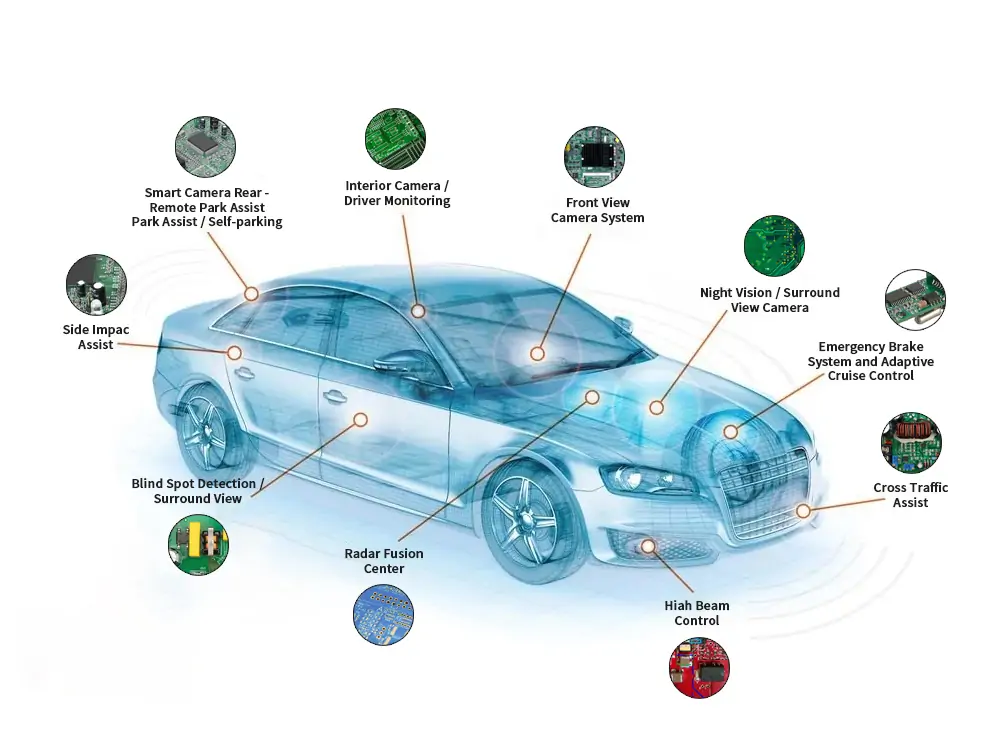
Many vehicle functions depend on signal integrity and power integrity in ways that are not optional: pedestrian detection, adaptive cruise control, blind spot monitoring, lane departure warning and automatic high beam all have to operate in a coordinated way. Since the functions are interdependent, their verification cannot be done function by function in isolation.
The scale is easy to underestimate. A vehicle generates many hundreds of electromagnetic signals and currents, and those signals must not interfere with or weaken each other. Contemporary vehicles carry more than a thousand chips; the majority serve infotainment, the second largest group serves automated driving and safety functions, and that second group is growing quickly.
There is also an inside/outside dimension. Some signals interact only with systems inside the vehicle, while others interact with external networks. Because the signals are mutually dependent, they need to be simulated together to confirm safe and reliable operation — including coexistence with the many other signals already present in the environment.
Efficiency, Range and Noise
For electric vehicles, range is the measure customers apply, so maximising distance per charge is a primary design objective. Efficiency matters just as much for combustion vehicles, where it affects consumption in the same way.
Noise, vibration and harshness are the other three factors that shape perceived quality. There is always something moving and vibrating in a vehicle, and reducing mass through new materials introduces new design challenges in exchange for the weight saved.
The acoustic problem is peculiar to electrification. With no engine noise to mask them, road noise and wind turbulence dominate the cabin. Wind noise from a door mirror, which no one would previously have noticed, becomes conspicuous; tyre noise becomes a quality issue rather than a background detail. Because these factors affect the customer’s perception of quality directly, the design has to be re-examined rather than inherited — which is exactly the kind of problem that requires structural and acoustic analysis to be performed alongside the electrical one.
<img src="https://www.gopcba.com/wp-content/uploads/2020/12/project_image_4.jpg" alt="electro-thermal analysis of a vehicle control unit” />
Radio Integration and Antennas
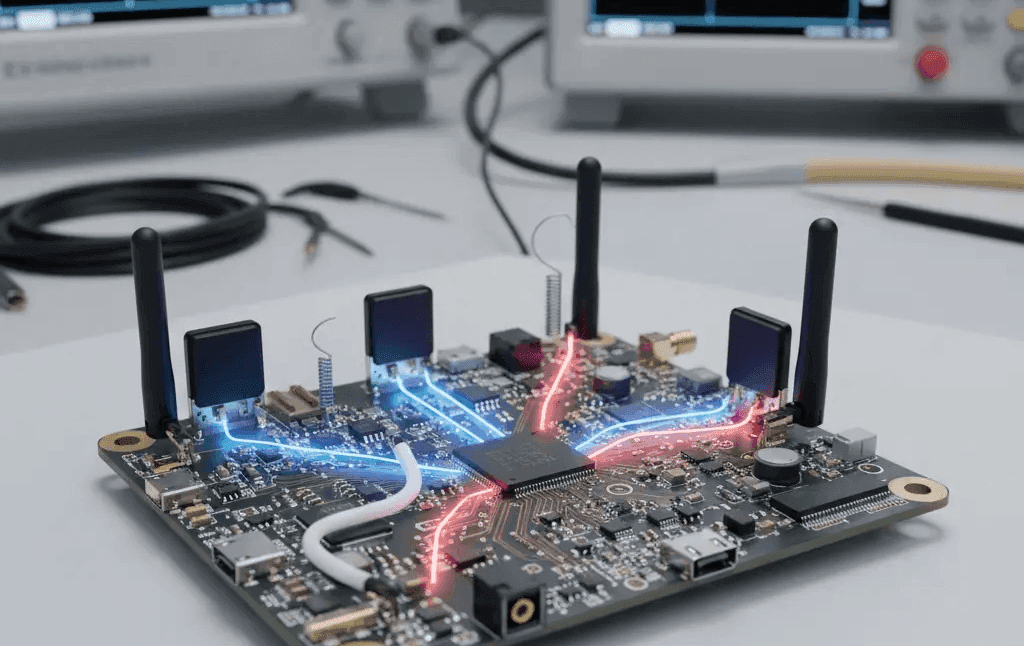
More and more products communicate with the outside world by radio, and radio is among the hardest parts of a design because nothing in it is independent.
The critical factor is not only the antenna’s shape. It includes every connector, every package pin, every trace on the board and the shape of the enclosure. It even extends to where people will be sitting when the radio is used, because the human body is part of the antenna’s environment.
Analysing a design like that means evaluating every aspect of it simultaneously, because each electronic component affects the others — and the mechanical assembly and enclosure affect the result just as much as the circuit does. Isolated simulations, run one at a time and stitched together afterwards, are not sufficient to predict whether the finished product will work.
The interaction between the antenna and the board it sits on is where this is most visible, and the layout measures that reduce unwanted coupling are described in this note on reducing RF effects on interconnects.
What This Means for the Design Process
The practical change is organisational before it is technical. Engineering leads have to break down the boundaries between teams, because the interfaces are where the risk lives.
The first casualty is the hand-off. A mechanical team cannot complete its work and pass it over to the electronics team and then disengage, because the assumptions it made — clearances, airflow paths, mounting points, material behaviour — are the constraints the electronics must live inside. When those assumptions change, the electrical design has to be re-evaluated, and neither team learns that from a document.
The second requirement is a shared model. If the mechanical team and the electrical team are analysing different geometries, their conclusions will not add up, and the discrepancy usually surfaces late.
The third is that the software team belongs in the same conversation. The behaviour of the product emerges from mechanics, electronics and algorithms together, so the three have to be developed in coordination across the whole vehicle rather than in sequence.
On the board itself, this shows up as a design that is specified for environments rather than for nominal conditions. Ground and power structures have to be planned as part of the thermal and electromagnetic solution rather than as a separate activity, as set out in this discussion of power and ground planning, and the wider constraints of vehicle electronics are covered in this overview of automotive ECU PCB design.
FAQ
Can thermal, electrical and mechanical behaviour be simulated separately? They can be, but the interactions are what usually cause the failure. Heat changes electrical behaviour, electrical behaviour generates heat, and the enclosure changes how much of it escapes. Solving them in isolation hides precisely the coupling that matters.
Why does an electric vehicle need different analysis from a combustion vehicle? Because the reference experience is thinner and the sensitivities are different. Without engine noise, wind and road noise dominate the perceived quality, and there is less inherited design knowledge to rely on for the electrical platform.
What is the biggest obstacle to multiphysics analysis? Team structure rather than tooling. When mechanical, electrical and software engineers work from separate models and separate assumptions, the analysis is only as good as the assumptions that were never reconciled.