Rapid PCB Prototyping and When It Is Worth It
Rapid prototyping is sold as a service, and it is worth understanding what is being sold. Nothing about the physics changes: the press cycle is still hours long and the plating still takes the time it takes. What changes is where the job sits in the queue and how much of the process is streamlined around it. Knowing that makes it possible to judge when the premium is worth paying.
What Makes Fabrication Fast
The steps of fabrication have a physical duration: imaging, lamination, drilling, plating, masking and finishing. None of them can be compressed arbitrarily, and a supplier who claims otherwise is describing queue position rather than process time.
What a rapid service actually provides is priority in that queue, a process set up for small quantities rather than for large panels, and staff available to move a job between steps without waiting for a batch to accumulate. Those three together produce the improvement, and each of them is a real cost to the supplier. Our PCB lead time article describes where the time actually goes.
The Queue Is the Variable
Ordinary fabrication runs in batches. A step is only economical when enough panels are ready to fill it, so a job waits for others to catch up. On a busy line that waiting dominates the schedule, and it is the reason a small job sometimes takes proportionally longer than a large one.
A rapid service removes the batching delay by dedicating capacity to small jobs. That is why rapid fabrication is priced per order rather than per panel, and why its advantage is largest when the shop is busy. When the line is quiet, ordinary fabrication is already fast and the premium buys nothing. Our board size notes describe how panel arrangement affects the same economics.
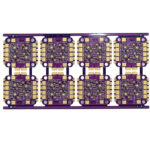
<img src="https://www.gopcba.com/wp-content/uploads/2025/09/厚铜板.jpg" alt="rapid PCB prototyping panel ready for first build” />
What Rapid Prototyping Is For
The purpose of a prototype is to answer a question, and rapid fabrication is worth paying for when the answer is on the critical path. A design change that has to be validated before the next revision can be released, a customer demonstration with a fixed date, or a schedule where a week of delay costs more than the premium all justify it.
It is not worth paying for when the question is not yet well formed. Building a board quickly to discover that the wrong thing was tested wastes both the premium and the opportunity, because the next build will need the same fast treatment.
Designing So the First Build Answers the Most
A prototype design should be arranged so that the first build yields the maximum information. That means including the options that might be needed, such as alternative component footprints, spare test points and provision for a modification.
It also means keeping the design inside the fabricator’s standard capability where the choice costs nothing. A non standard thickness or an unusual drill size adds days for no functional benefit, and those days are exactly what the rapid service was bought to save. Our design tolerances article describes the envelope that avoids that.
The Cost of a Rushed Design
Speed in fabrication does not help a design that contains avoidable errors. A board built in three days and found to have a footprint mistake costs a second cycle, and the second cycle is also on the critical path.
The checks that prevent this do not require a large investment of time: verifying footprints against the real parts, checking the drill file as a list, reviewing polarity markings and confirming the outline against the enclosure. Each takes minutes and each removes an entire round trip from the schedule. Our prototyping article lists the ones that cause the most rework.
Iteration and Its Limits
Fast prototyping encourages iteration, and iteration has diminishing returns. The first board typically answers the questions the designer knew about. The second answers the ones revealed by the first, and the third is often a refinement rather than a necessity.
Recognising when the iteration has stopped producing information is a cost control decision as much as an engineering one. A design that has passed its functional test and met its margins does not need another prototype cycle before the production build, even if small improvements remain available. Our design release notes describe how the transition is managed.
Working With a Rapid Supplier
The supplier should be told which of the requirements are flexible. A board whose stackup can be changed, whose surface finish is not critical and whose impedance tolerance can widen gives the fabricator room to use the constructions they have ready, and that is where most of the speed comes from.
Conversely, the requirements that genuinely matter should be stated clearly and early, because a question raised after the job is in progress costs more than one raised at quotation. Our stencil fabrication notes describe the equivalent information for the assembly tooling.
When Standard Lead Time Is the Right Answer
Where the schedule allows, standard fabrication is cheaper, uses less stressed processes and gives the fabricator time to do the work properly. Rushed processes skip nothing, but the monitoring and the rework time that a normal schedule absorbs may not be available.
For a production order, a normal schedule is therefore preferable even when a rapid service is available. The premium is best spent on the few builds where a delay would stop something else, rather than applied as a default to every order. Our PCB quality article describes what the extra time is used for.
Design Iteration and Its Cost
Each round of design iteration has a price: the layout time, the fabrication premium, the assembly, the test and the engineering hours spent evaluating the result. Where the iteration is answering a real question, that price is worth paying. Where it is polishing a design that already meets its specification, it is not.
The useful discipline is to write down, before the build, what the board is meant to establish. If the list is short and specific, one iteration is enough. If it contains items that could have been resolved on paper, the build is being used as a substitute for analysis, and that is the most expensive way to answer an easy question.
Reproducing the Prototype Result
A prototype that works on the bench has demonstrated that the design is capable of working, not that production will work. The difference lies in the tolerances: the prototype was built with extra attention, and production will run at the process’s normal spread.
Closing that gap is what the transition to production is for. The prototype result should be treated as the upper end of the expected range rather than the expected value, and the design margins should be large enough that the lower end still functions. Our component tolerance and reliability article describes how those margins are established.
FAQ
How fast can a board really be made? For a simple double sided board, a day is achievable at the fastest services. For a multilayer board with a non standard stackup, the process steps impose their own floor.
Does rapid fabrication mean lower quality? It should not, because the process steps are unchanged. Where quality suffers, it is usually because the monitoring steps were omitted rather than because the process ran faster.
Is it worth paying for rapid on every revision? No. It is worth paying when the result blocks something else. Where the schedule has slack, the standard service is cheaper and no worse.
How can a prototype be made cheaper? By keeping the design inside standard capability, combining revisions into one order and avoiding requirements that the product does not need.
Should prototyping use the production construction? Yes where possible, because a prototype built differently hides the problems the production construction would reveal.