PCB Solder Mask Color: Meaning and Limits
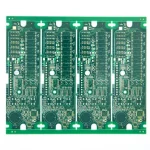
A green board, a blue board and a black board are the same board. The colour is the solder mask ink printed over the copper, and although the choice has real consequences for inspection and repair, it has almost none for the electrical behaviour of the circuit.
What the Colour Actually Is
The solder mask is a polymer layer printed over the copper and opened only where a joint has to be made. It protects the conductors from oxidation and from accidental bridges during assembly, and it isolates the surface electrically.
The pigment in that polymer is what the eye sees. The base resin, the glass fabric and the copper underneath are unchanged, so two boards that differ only in pigment are identical circuits with different appearances.
Why Green Became the Default
Green was not chosen for electrical reasons. It became standard because the early materials were easier to formulate in green, because the contrast between green mask and the copper or gold beneath it is easy for inspection equipment to resolve, and because the supply chain scaled around it.
Once every fabricator, every optical inspection library and every operator was familiar with green, the colour had a cost advantage as well. Alternatives exist and are widely available, but they are usually offered at a small premium because they run less often.
Does Colour Affect Performance or Heat
No measurable effect comes from the pigment. The mask is a thin layer of polymer, and its thermal resistance is negligible compared with the copper and the laminate beneath it, so the colour of the surface does not change how much heat leaves the board.
Where a design does run hot, the variables that matter are copper area, copper thickness, via count and the airflow over the assembly. Choosing a colour is not a thermal decision, and a claim to the contrary is a marketing statement.

Black Boards and Repair
Black does have one practical disadvantage. The traces beneath the mask are almost invisible, so a technician tracing a net, checking a pad or looking for a short has much less information than on a lighter board.
That is the reason many products moved away from black towards dark green, dark blue and dark brown. The darker colours still read as premium on a product photograph, while the conductors remain visible under the right light for the person who has to work on the board.
Reading a Board Through Its Mask
The legend printed on top of the mask carries the information that matters: reference designators, polarity marks, connector pin one, board revision and voltage warnings. A light background improves the contrast of that legend, which helps both the manual inspector and the camera.
A very glossy finish can reflect enough light to confuse an optical system, which is one more reason the choice of colour and finish is discussed with the assembly house rather than picked from a catalogue at the end of a project.

Gold, Silver and Organic Finishes
Copper oxidises quickly and an oxidised pad cannot be soldered reliably, so the exposed copper is covered with a surface finish. Gold, immersion silver, immersion tin and organic coatings all serve the same purpose: they keep the copper clean until the joint is made.
The finish also sets the storage life of the bare board and the conditions it needs. An organic coating is the cheapest and the shortest lived, while an electroless nickel immersion gold surface keeps its solderability far longer and costs more.
Why Precious Metal Does Not Lower Heat
Silver and gold have lower resistivity than copper, but the layer applied to a pad is thinner than a hundredth of a millimetre, and an organic finish has no metal thickness at all. The resistance of such a layer is negligible in either case.
Heat in a circuit is generated by the conductors that carry the current, whose cross section is set by the copper weight and the trace width. Plating a pad with gold changes the solderability of the surface, not the resistance of the net.
Storage and Shelf Life
A finished board has to be packed to survive the interval before assembly. Vacuum sealing with a desiccant keeps moisture and airborne contaminants away from the surface, and it is the reason a board can be stored for months and still solder correctly.
The customer should still check the surface before the panel goes onto the line. An incoming inspection that rejects oxidised boards is cheaper than a batch of cold joints, and the storage and packaging requirements are best written into the purchase specification.
Choosing a Colour in Practice
The choice should follow from the product and the process. A board that will be inspected optically and repaired by hand benefits from a light colour. A board that is assembled, tested and never touched again can be any colour the market likes.
Where a colour is chosen for appearance, the cost is a small premium and, occasionally, a longer lead time while the fabricator schedules the run. Both should be known before the specification is frozen rather than discovered at the order.
The Meaning Is in the Product
The idea that one colour indicates a better board comes from the products in which those boards appear. Manufacturers used black for premium products and lighter colours for cheaper ones, and the association was created by that pattern rather than by the material.
A well made board is recognised by its stackup, its finish, its tolerances and its storage conditions, none of which can be seen from the colour of the surface. The pigment is a decision about appearance and inspection, not about quality.
Colour and Automated Inspection
An optical inspection system decides whether a pad is present by looking at contrast between the joint and the background. The solder mask color therefore affects the settings the machine needs, and a change of color between two batches of the same design can force a new program.
A light background with a dark legend and bright pads is the easiest combination for machine vision. A dark background with a dark alloy and low contrast lighting is harder, and it is one reason an assembly house may ask for a specific color when a product moves into volume.
What to Write in the Specification
The color, the finish and the legend requirements belong in the fabrication drawing, because a fabricator will otherwise supply the default. The default is usually green, and a product that has been photographed in blue will arrive in green if the drawing says nothing about it.
The drawing should also state which surfaces are to remain solderable and which must be kept free of coating, since the color of the mask and the openings in it are decided together. A note that is ambiguous on this point is usually discovered at final inspection, which is the most expensive place to discover it.
FAQ
Does a black PCB run hotter than a green one? Not measurably. The mask is a thin polymer layer and the colour has a negligible effect on the thermal path, which is set by copper and airflow.
Is gold plating used to reduce resistance? No. The layer is far too thin to change the resistance of a net. It is applied to protect the pad from oxidation, as described under immersion silver and similar finishes.
Why does the finish matter for storage? Because it decides how long the pad stays solderable and how it has to be packed. The nickel barrier under a gold surface is controlled in the same way as any other electroless nickel deposit.