PCB Coupon Design Guide
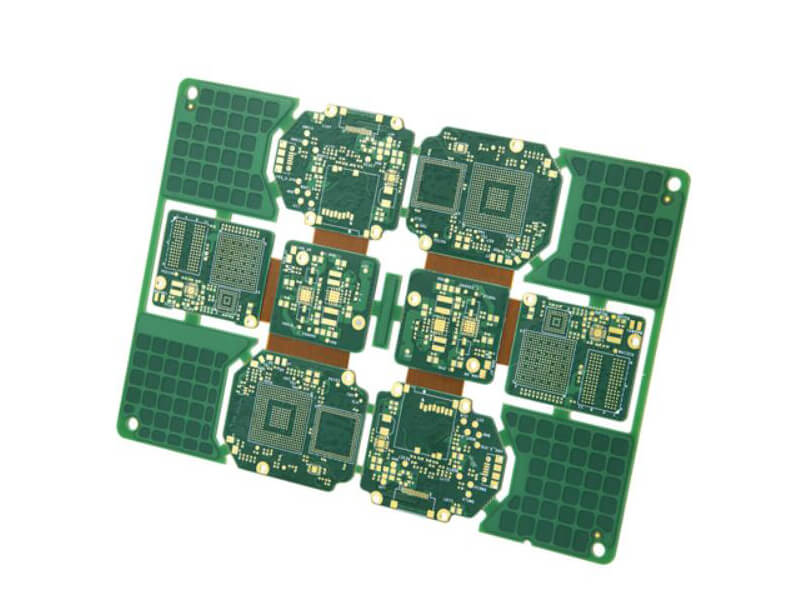
A pcb coupon is a structure that is built onto the production panel but is not part of the product. It exists so that something can be measured, cut, or cycled without destroying a board. A panel without a coupon is a panel whose process can only be judged by the appearance of the product, and appearance is a poor substitute for a measurement.
What a Coupon Is For
The coupon carries the same features as the product, built at the same time and in the same conditions, so that a measurement on the coupon describes the product.
It allows a destructive test to be performed without losing a board, and it allows a measurement that needs a special launch or a probe pattern that the product does not have.
It also acts as a record. A section or a measurement that is kept with the panel documentation can be consulted years later when a field failure is being investigated.
The coupon material and the flying probe method are the two ends of the same subject, since a coupon is what makes a repeatable measurement possible.
Impedance and Loss Coupons
An impedance coupon carries single ended and differential traces of the same geometry as the product, on every controlled layer, with a launch that a probe can reach.
The traces are usually short, because the impedance is read from the flat part of a time domain profile and a short line is enough. The coupon should include a microstrip and a stripline where the product uses both.
A loss coupon carries a longer line, sometimes several lengths of the same trace, so that the attenuation per unit length can be extracted from the difference between them.
The coupon for a loss measurement is often built with the same pair of lengths repeated on more than one layer, so that the layer to layer variation can be compared. That comparison is what shows whether a change in the process has affected one layer more than another.
The launch is the critical feature. A coupon without a ground signal ground launch cannot be measured accurately, and the error appears as an apparent impedance change at the beginning of the line.

Daisy Chains and Thermal Cycling
A daisy chain coupon connects many vias or many joints in series, so that a single resistance measurement monitors all of them at once.
The chain is used in a thermal cycling test, where the resistance is monitored continuously and a rise indicates that a link has cracked. The number of vias in the chain sets the sensitivity.
The chain can also be used on an assembled board to monitor the joints of a ball grid array, if the package is a daisy chain version and the board is designed to match it.
The chain resistance is a small number for a long chain, so the measurement has to be made with a four wire method to remove the resistance of the probes and the leads. A two wire measurement on a chain of a few ohms is dominated by the lead resistance and shows nothing.
The coupon has to be designed with its test in mind, so the number of links, the pad and the monitoring points are chosen before the panel is laid out.
Process Coupons
A process coupon is used to check the fabrication rather than the electrical performance. It typically carries a variety of hole sizes, a variety of trace widths and a section of the stackup.
The hole coupon is sectioned to measure the plating thickness, which is the measurement that cannot be made on the product without destroying it.
A thermal coupon can be used to check the flatness of the panel after the press and after a simulated soldering cycle. It is a simple structure, but it is the one that shows whether a batch will run through the printer without a problem.
A solderability coupon is used to check the finish, and it is measured before the board is assembled so that a problem is found at the right stage.
The coupon set is usually defined by the fabricator, and the design should confirm that the set covers the features that the product depends on.
Placement on the Panel
The coupon is placed in the unused area of the panel, usually at the edge, and it must not reduce the number of boards that fit.
It has to be positioned so that it sees the same conditions as the product. A coupon at the very edge of a panel can see a different plating current distribution and a different etch, so the result may not represent the boards in the middle.
The coupon is usually removed before assembly, so it does not need to survive the assembly process. Where it is used for a thermal cycling test, it can be a separate panel built from the same data.
The coupon also has to be separable without damaging the features that are to be measured. A coupon that is cut with a saw through a trace is a coupon that has to be redesigned, and the breakaway detail belongs on the same drawing as the coupon itself.
The coupon should be marked so that it can be identified after it is separated, since a set of loose coupons without labels is a set of measurements that cannot be traced.
Measurement and Records
The measurement method matters as much as the coupon. The instrument, the probe, the rise time and the calibration reference have to be recorded with the result.
The acceptance criteria should be stated on the fabrication drawing, so that the shop knows what is being measured and what value is acceptable.
The results should be kept with the panel documentation and with the design revision, so that a drift over time can be seen rather than discovered.
A trend is also more informative than a single value, because the measurement includes the instrument and the operator as well as the board. Two results taken the same way can be compared, and a result taken differently cannot.
A coupon that is measured once and never again is a coupon that only proves the first panel. The value of the practice comes from the repetition.
Practical Rules
Decide what will be measured, then design the coupon that makes the measurement possible, rather than adding a coupon at the end of the layout.
Include a launch for every controlled layer, and keep the coupon geometry identical to the product geometry.
Place the coupon where it sees the same process conditions as the product, and check that it does not reduce the panel utilisation.
Record the measurement with the instrument and the method, and keep the result as part of the quality record and the fabrication notes.
FAQ
Does a coupon have to be on every panel? It should be on the panel where the impedance or the plating is critical. On a routine product, a coupon on a sample basis is usually enough.
Why does the coupon need a special launch? Because the launch is where the measurement starts, and a probe with a long ground lead adds an inductance that distorts the result.
Can a coupon be used for a thermal cycling test? Yes. A daisy chain coupon built on the same stackup is the standard structure for measuring via fatigue.