
Labour Productivity in PCB Manufacturing
Labour productivity is the output a shop achieves per hour of labour, and it is a useful measure only when the output is defined carefully. Counting panels per hour rewards the shop for making simple boards and penalises it for difficult ones, which is the opposite of what a business needs. The useful version of the measure compares the labour content of the work actually produced against the labour the shop consumed, and it requires the work content to be understood before the ratio means anything.
Defining Output Honestly
Output should be measured in something that reflects the work content, such as standard hours, panel area or a weighted unit that accounts for layer count and complexity. A simple count of panels or orders is easy to collect and misleading, because it treats a two layer board and a ten layer board as equal. The weighting does not have to be perfect, only consistent and understood by the people who are measured by it, because a measure that is disputed produces arguments instead of improvement.
The measure should also be reviewed when the product mix changes significantly. A shop that moves toward more complex work will see its units per hour fall while its actual efficiency improves, and a measure that cannot distinguish the two will generate a false alarm and a set of unnecessary actions. Explaining the effect of mix to the team prevents a great deal of confusion.
Output Per Hour and Its Limits
Output per hour is the simplest expression of labour productivity and it has a well known limitation: it can be raised by postponing work that does not appear in the count. Deferring maintenance, skipping a check or leaving rework for the next shift all improve the ratio in the current period and damage it later. The measure therefore needs to be read together with quality and delivery figures rather than on its own.
It also improves automatically as volume rises, because fixed labour such as supervision, stores and planning is spread over more output. A shop that is quiet will always look less productive, and the comparison should be made at comparable volumes or against a flexible measure that separates fixed from variable labour. Without that adjustment, the measure will mostly reflect how busy the shop was.
Work Measurement
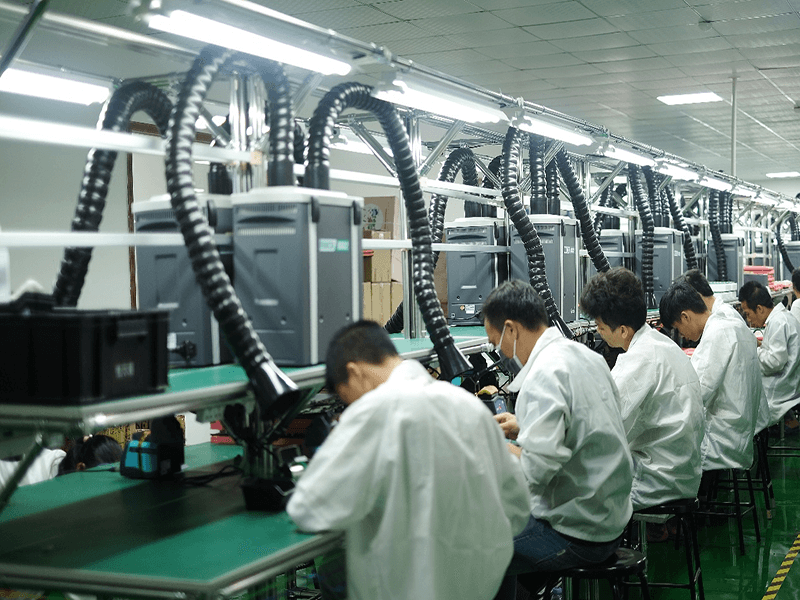
Work measurement establishes how long a task should take, and it is the basis of any meaningful productivity comparison. The methods range from a full time study with rating to a simple agreement with the people who do the work about a reasonable time for a defined task. The elaborate methods are more precise and less popular, while the simple ones are less precise and considerably more likely to be accepted.
Whichever method is used, the standard should be visible to the people performing the task and should be revised when the method changes. An unstated standard produces disputes about whether a rate is fair, and a standard that is never revised becomes irrelevant as the process improves. The purpose is to have an agreed basis for improvement rather than a number to be enforced.
Staffing Levels and Flexibility
Staffing levels should be set from the work content at each process step and from the variation in the load, not from a headcount target. A step with a variable load needs some spare capacity to absorb it, and moving that capacity to another area is usually better than adding it. This is where multi skilling pays for itself, because a trained pool of people can move to where the work is.
The measure of success is the ability to change the staffing of an area quickly in response to the load, without loss of quality. That flexibility can be built deliberately by training people across adjacent areas and by documenting the tasks well enough that a person can pick them up. Both are investments in the same direction as productivity improvement, and both take time to build.
Efficiency Improvement That Lasts
Efficiency improvement that lasts is usually the removal of work rather than the speeding up of it. Eliminating a duplicate check, combining two handling steps, reducing the distance material travels and simplifying a form all improve productivity permanently, because the work no longer exists. Asking people to work faster has a shorter effect and a higher cost in quality.
The ideas for this kind of improvement come from the people doing the work, and they arrive readily when the measures are known and the responses are quick. A shop that publishes its productivity measure at the area level and acts on suggestions will find more improvement than a shop that studies the process from outside, because the details of the work are known locally. That knowledge is the most underused resource in most factories.
Avoiding the Traps
The common traps are measuring individual performance, comparing areas with different work content and using productivity as an argument against investment. The first damages the data, the second damages morale and the third confuses a ratio with a business case. Labour productivity is a diagnostic measure, and like any diagnostic it should be interpreted with care and not used as a target.
It is also worth remembering that labour is often a small proportion of the total cost of a board. Material and process time usually dominate, and a productivity programme that improves the labour ratio while raising scrap has made the shop poorer. The measure should be read beside the cost of quality, and improvements should be judged by their effect on both, since the two move together more often than the separate reports suggest.
Practical Rules
Define the output in a way that reflects work content, review the definition when the mix changes, and read productivity beside the quality and delivery figures. Establish a standard everyone accepts, revise it when the method changes, and build flexibility through multi skilling.
Look for work to remove rather than time to compress, and involve the people who do the work in finding it. Record the changes with the production records so that the quality and cost effects can be reviewed together, because labour productivity is only an improvement when the boards that come out the other end are still good.
Process Control and Verification
On a design of this kind, labour productivity is the item that decides how the rest of the board is arranged. A stack-up that is drawn rather than described removes most of the ambiguity from a quotation, and it lets the fabricator price the board against the dielectric and copper weights that will actually be used. Where the requirement is not written down, the shop supplies its own default, and the default is chosen for the process rather than for the design.
FAQ
What is a good productivity measure? One that reflects work content, such as standard hours or weighted panel area, rather than a simple count of panels or orders.
Why can productivity improve while costs rise? Because labour is a small part of board cost. A gain in labour can be outweighed by an increase in scrap or rework.
Should individuals be measured? Usually not. Measuring individuals bends the data and damages morale. Measure the area and the process.