Cleanroom Requirements for PCB Manufacturing
Not every step of board manufacture needs a cleanroom, and the mistake most shops make is either to build one where it is unnecessary or to run a sensitive process in an open area. Particle contamination matters most where a small defect is reproduced many times: imaging, solder mask application and any process where a particle masks or scatters light. Understanding where those steps are, and what class of cleanliness they need, is more useful than a general ambition to make the whole plant clean.
Where Cleanliness Matters
The photolithographic steps are the most sensitive. A particle on a panel before exposure blocks the light and produces a defect in the pattern, and the same particle on a phototool produces the same defect on every panel that uses it. Solder mask application and via filling have similar sensitivities, because a particle trapped under the mask becomes a permanent feature of the board.
Other steps are less sensitive and often need dust control rather than a classified area. Lamination needs a clean environment for the prepreg and the copper surfaces, but the tolerance for particles is much higher than in imaging. Assembly has its own requirements, particularly for fine pitch placement, and they are different again from those of the wet process area.
The right approach is to define what has to be protected at each step and then choose the simplest arrangement that achieves it. Often that is a filtered enclosure or a laminar flow bench rather than a whole room, and the smaller solution is both cheaper to build and cheaper to run, because the filtered volume is much smaller.
Class Ratings Explained
A cleanroom class describes the maximum number of particles of a given size permitted per unit volume of air. The old federal standard classes are still used in conversation, while the ISO classifications are the modern reference, and the two are often quoted together. The number matters less than the particle size it refers to, which is why a class quoted without a size is not a specification.
For board manufacturing, the photo areas are typically run between ISO class 7 and class 8, which corresponds to a controlled but not extreme environment, while the most critical operations may use a laminar flow bench at class 5 or better. Assembly areas for fine pitch work often sit around class 7. The exact requirement should come from the smallest feature being produced, because the defect that matters is the one that is comparable in size to the feature.
A class rating is a design target rather than an operating state. A room that was commissioned at a class can drift away from it as filters load, as door discipline slips and as equipment is added. Periodic particle counting is what confirms that the room is still performing, and it should be done at the points where the work happens rather than only at the supply diffuser.
Air Filtration and Airflow
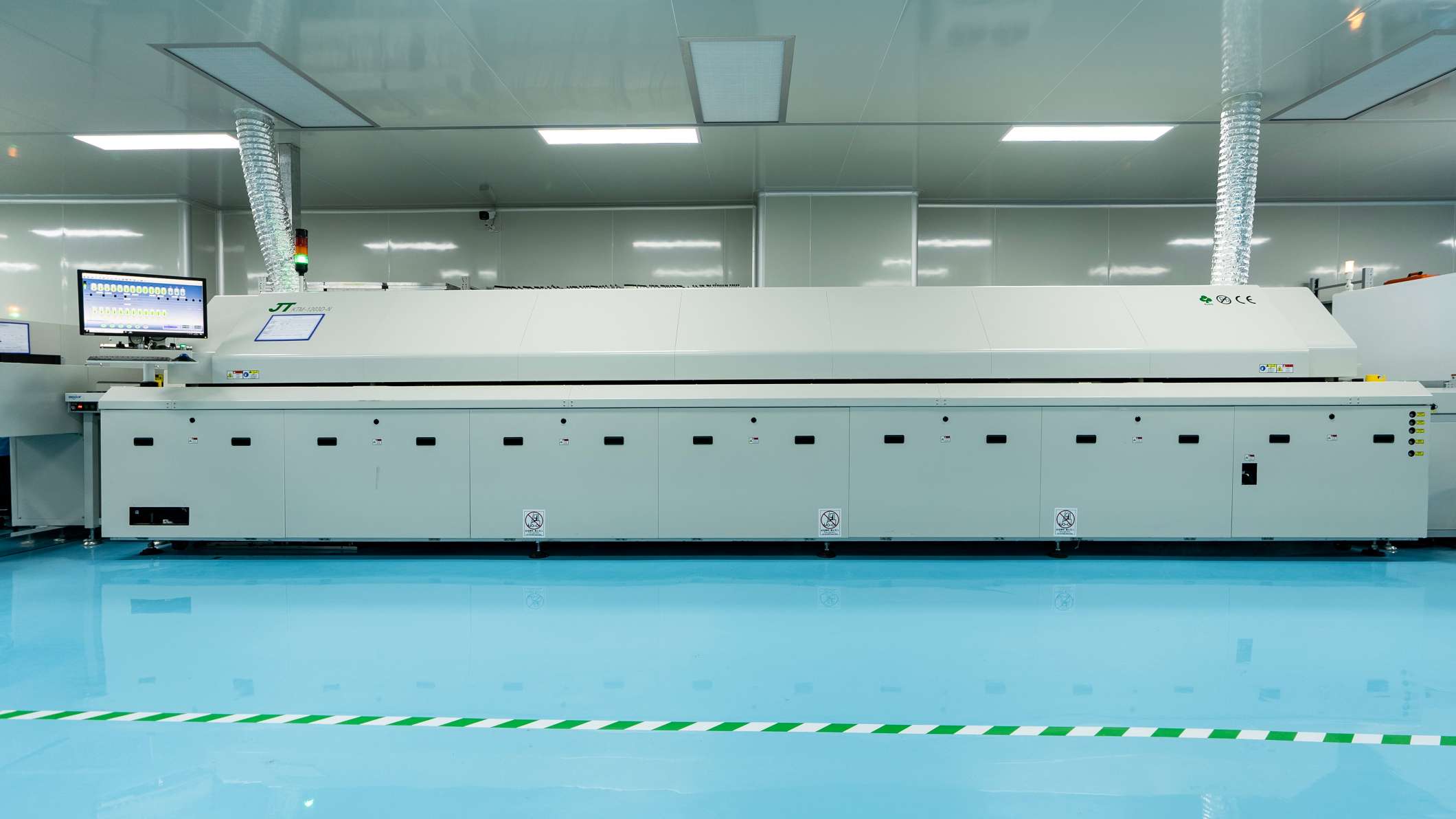
Filtration is usually staged: a coarse prefilter removes the bulk of the dust, a secondary filter protects the final stage and a high efficiency final filter removes the particles that matter. The final filter does the work and the prefilters protect it, which is why changing the prefilters on schedule extends the life of the expensive stage and keeps the pressure drop within range.
Airflow design decides how well the filtration performs. A unidirectional or laminar flow moves clean air across the work surface and carries particles away, while a turbulent arrangement mixes the air and lets particles circulate. The choice depends on the process: a laminar bench over an exposure unit is often more effective than a larger class rated room with poor airflow over the panel.
Pressure differentials keep contamination out of the clean area. The clean room should be at a higher pressure than the surrounding space, so that any leakage moves outward, and the differential should be monitored. A door held open for convenience removes the protection that the pressure cascade provides, which is why airlocks, self closing doors and a short entry procedure matter more than the filter specification.
Contamination Sources
People are the largest source of particles in a clean area. Skin flakes, hair, clothing fibres and cosmetics are all shed continuously, and the ordinary cleanroom responses are gowning, gloves, hair covering and restrictions on movement. The gowning procedure is worth the two minutes it takes, because the alternative is a room that is cleaned continuously and still fails its particle counts.
Equipment and materials are the second source. Cardboard, paper, wooden pallets and unsealed packaging all shed particles, which is why clean areas use plastic totes, sealed containers and dedicated trolleys. Bringing a cardboard box into an imaging area is one of the most common and most easily avoided sources of contamination in a board shop.
The process itself generates particles as well. Drilling produces dust, routing produces debris and any abrasive operation creates material that must be extracted at the source rather than allowed to spread. Local extraction at the point of generation is far more effective than increasing the general air change rate to compensate.
Operating the Clean Area
A clean area needs a defined entry procedure, a gowning discipline, a cleaning schedule and a rule about what may be taken inside. The cleaning should use the correct wipes and solutions, because a cleaning method that leaves lint or residue has made the problem worse. The schedule should cover the surfaces that matter, including the equipment, not only the floor.
Monitoring closes the loop. Particle counts at defined locations, pressure differentials between rooms and temperature and humidity readings together describe whether the area is performing. The readings should be recorded and trended, and a drifting pressure differential is often the first sign that a filter is loading or that a door is being left open somewhere.
Temperature and humidity belong in the same monitoring. The photo processes are sensitive to humidity, which affects the resist and the static charge on the film, and a room that is clean but at the wrong humidity will still produce defects. The target range should come from the process rather than from comfort, and it should be maintained by control rather than by adjustment.
Cost and Justification
Cleanroom operation costs money continuously: energy for the fans and the conditioning, filter replacements, gowning consumables and the labour of the procedures. The justification therefore has to come from yield, and the calculation should be made on the shop’s own defect data. Counting the defects that are attributable to particles before and after a change is what turns the investment from a preference into a decision.
It also helps to consider the smaller options first. A laminar flow bench at the exposure unit, a filtered enclosure over the solder mask coating station, a covered storage rack for panels between steps and a disciplined gowning procedure can all be implemented without building a room, and together they often remove the majority of particle defects. A full room can follow if the data still supports it.
Practical Rules
Identify the steps where a particle produces a defect, choose the simplest arrangement that protects them, and specify the cleanliness with a particle size attached to the class. Stage the filtration, control the airflow and maintain the pressure cascade.
Control the sources: gown the people, exclude cardboard and unsealed packaging, and extract dust at the point where it is generated. Monitor the particle counts, the pressure differentials and the humidity, and record them with the process records so that the effect on the quality data can be seen rather than assumed.
Additional Considerations for This Build
Practical attention to particle control pays for itself here, because it decides whether the finished board behaves as the drawing intended. Where the requirement is not stated on the fabrication drawing or in the assembly notes, the shop has to assume a default, and that default is rarely the value the design was simulated with. Stating particle control explicitly, together with the tolerance that applies, removes the assumption and keeps the result predictable from batch to batch.
Related reading: our fabrication notes, board quality and design release notes cover the same ground.
FAQ
Does every PCB process need a cleanroom? No. Imaging, solder mask and lamination are the sensitive steps. Others need dust control rather than a classified room.
What class is typical for PCB photo areas? Usually around ISO class 7 to 8, with laminar flow benches at class 5 or better for the most critical operations.
What is the biggest contamination source? People. Gowning, gloves and movement discipline have more effect than most equipment upgrades.