Unit Serialization and Traceability in PCB Assembly
Traceability is the ability to answer a question about a board months after it was built: which laminate, which paste batch, which machine, which oven profile, which operator. It is required by customers in several industries and it is useful to everyone, because the alternative to a records system is a containment action that covers everything ever shipped. Serialization is the mechanism that makes the answer possible.
Why Traceability Is Required
The formal drivers are the regulated industries, since medical devices, automotive and aerospace all require a documented link between a product and the processes that made it. The practical driver is the containment exercise, where a suspect batch of components or a machine fault means that a defined group of boards has to be identified.
Without unit level records, containment becomes a decision about a whole production period rather than about a specific batch. The difference between a contained batch and a recall of a year of production is the reason the investment is made.
What a Unit Identifier Has to Survive
The identifier has to survive the whole process, which includes aqueous cleaning, flux, reflow, handling and any coating or potting. It also has to be readable by a machine rather than only by a person, because the volume of records makes manual entry impractical.
Where the board will be coated, potted or overmoulded, the marking has to be applied at a point in the flow where it will not be covered, or the data has to be recorded before that step. That constraint is often discovered late, which is why marking should be considered at the design stage.
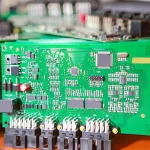
<img src="https://www.gopcba.com/wp-content/uploads/2024/10/op1.jpg" alt="Laser marked data matrix code on a PCB beside the board serial number” />
Serialization Methods and Their Limits
The common methods are a printed label, a laser marked code on the surface, a code etched into copper and a code programmed into a memory device on the board. Each has a different life: a label can fall off, a laser mark can be damaged by handling, and a programmed device needs a reader and a powered board.
The choice depends on the environment the product will see. A board that will be coated is usually marked with a laser on a defined area, while a board carrying a memory device can hold far more information than a printed code and can be updated as it moves through the line.
Data Matrix Codes and Reading Reliability
A two dimensional code packs far more information into a small area than a barcode, and it can be read at a lower contrast. That is what allows a small mark to be placed on a crowded board without taking space from the circuit itself.
Reading reliability depends on contrast, on the size of the modules and on the lighting of the reader. A code marked on solder mask has low contrast and needs a dedicated reader, while one marked on bare laminate reads more easily but occupies a keep out area.

Building the Genealogy Record
The record for a unit is built from events rather than written at the end. Each station reports the identifier and the data it holds: the paste batch and the stencil at printing, the machine and the feeder at placement, the profile and the oven at reflow, and the test result and operator at inspection.
Those events are joined by the identifier into a genealogy that can be queried from either direction. Given a board, the system shows its history, and given a suspect material batch, it lists every board that contained it.
Linking Materials, Machines and Process Data
Material linkage starts at receiving, where every incoming batch is given a unique internal reference and its certificate of conformity is stored against it. The reference is then scanned when the material is issued to a job, which is what creates the link to the unit.
Machine and process data come from the equipment itself. A modern placement machine, oven and printer can each export a record of what they did and when, and storing those records against the same identifier is far more reliable than asking an operator to transcribe settings.
Managing a Recall or a Containment
The real test of a traceability system is how quickly it answers a containment question. A well built system produces a list of affected units, their locations and their ship dates within a shift, while a poor one produces a project.
The response also depends on the records being current. If data is uploaded weekly rather than continuously, a containment exercise will always be behind the production line, and the search window will have to be widened to cover the gap.
Practical Implementation on the Line
Implementation is usually staged. The first stage is the identifier and the reading stations, the second is the material linkage, and the third is the machine data. Each stage delivers value on its own, which keeps the project affordable and allows the production line to keep running.
Operator involvement decides whether the system works. If scanning a code adds time to every board and the benefit is not visible at the bench, the scans will eventually be missed; if the same scan removes a manual entry elsewhere, it will be welcomed.
Records, Retention and Audit
Retention periods are set by the customer, by regulation and by the life of the product, and they can run to years. The storage format matters as much as the period, because data held in a proprietary format from a discontinued system may satisfy nobody.
An audit looks for two things: that the records exist and that they match the physical product, which is the same discipline that a quality assessment applies to the bare board. A quick internal audit, taking a finished board and tracing it back through every stage, is the most useful check, and it should be run before a customer asks for one.
FAQ
Does every product need unit level traceability? Not every product, but any product where a containment action is possible benefits from it. The cost of a modest system is usually less than the cost of one uncontrolled recall.
What is the difference between traceability and serialization? Serialization is the mechanism that gives each unit a unique identity, while traceability is the ability to use that identity to recover the history of the unit. One is a tool and the other is the outcome.
Can a laser mark damage the board? A correctly set laser removes only the surface layer of mask or laminate and leaves the copper and the dielectric untouched. The parameters should be qualified on the actual material rather than assumed to transfer from another product.