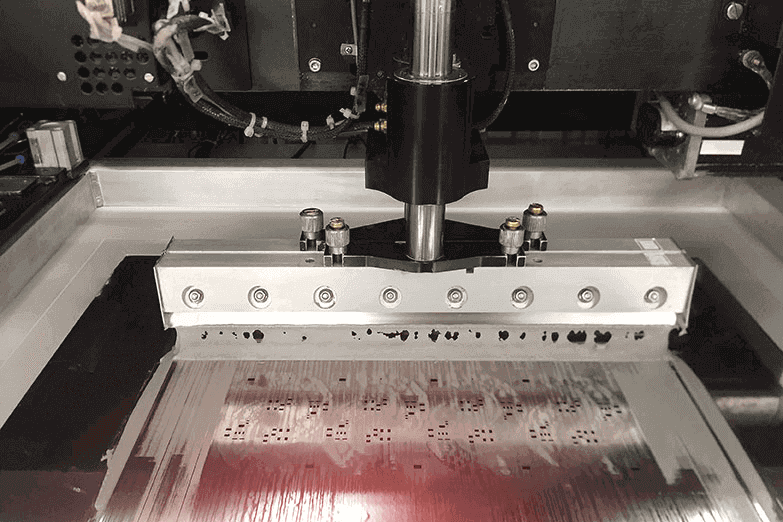
Print Speed: Preparation, Placement and Process Control
Print speed, squeegee pressure and separation speed are the three printer settings that operators adjust most often and understand least. Each of them changes the way the paste behaves in the aperture, and the three interact.
A setting that works for one aperture size may starve another, which is why the values should be chosen for the smallest aperture on the board and then verified on the largest.
What the Squeegee Is Doing
The squeegee rolls the paste ahead of the edge and pushes it into the apertures under pressure. The paste behaves as a fluid under shear, so its viscosity falls as the speed rises, and it recovers when the shear stops.
The behaviour is what allows the paste to fill an aperture and then stay there. A speed that is too high does not give the paste time to fill, while one that is too low allows it to slump back out of the aperture.
Squeegee Pressure
The pressure has to be enough to keep the edge in contact with the stencil across the whole board, and no more. Excess pressure wears the squeegee, damages the foil and forces paste under the stencil.
The correct pressure is the minimum that produces a clean wipe, and it should be established by increasing from a low value rather than by reducing from a high one.
Print Speed
The speed determines the shear rate at the aperture, and therefore the viscosity the paste presents. A faster print produces a lower viscosity and better filling, up to the point where the paste cannot follow the squeegee.
The useful range is narrow, and it should be established with a paste volume measurement across the range of apertures rather than by observation of a single footprint.
Separation Speed
The separation of the board from the stencil is when the paste transfers, and the speed of that separation determines whether the deposit stays on the pad or is drawn back into the aperture. Separation that is too fast tears the deposit, and too slow draws it back.
Many printers separate in two stages, with a slow initial movement and a faster finish. The parameter is often left at a default and should be tuned for the paste and the aperture.
Squeegee Material and Angle
Metal squeegees are rigid and hold an angle, while polyurethane ones conform to an uneven stencil. The hardness and the angle change the pressure distribution and the amount of paste left behind.
The angle should be set for the paste, and the wear that changes it should be monitored. A worn squeegee behaves like a change of pressure without any setting changing, as described in the discussion of printing defect causes.
Paste Roll Management
The roll diameter affects the pressure distribution, so a roll that is too small leaves the paste without enough volume ahead of the squeegee. The roll should be maintained within a range during the run.
The roll also dries as it is exposed, so its behaviour changes over a shift. Replenishing and removing the dried edges are part of the operator’s routine.
Verification
The effect of a setting change should be measured as a volume, not judged by eye. The measurement described for paste volume measurement is the practical tool.
Where the settings are optimised, they should be recorded per product and locked, so that the improvement is not lost at the next changeover.
Records
The parameters should be recorded with the squeegee life and the paste lot, since both change the behaviour. A record without them cannot explain a change in the print.
They belong with the process evidence described for manufacturing processes.
Process Control and Verification
Where the requirement is not written down, the shop supplies its own default, and the default is chosen for the process rather than for the design. The measurements that matter are the repeatable ones: conductor width and spacing, annular ring, finished hole size, plating thickness and surface finish are all verifiable on a coupon that travels with the panel.
Running a first article through the same checks as the production panel confirms that the two agree, and that comparison is the cheapest form of process control available at prototype stage. Keeping a sample from the panel turns a dispute into a measurement, because the same coupon can be re-examined by both parties without rebuilding the batch.
Reviewing the design before the data is released is cheaper than correcting it after the panel is in the tank, because every step downstream inherits the decision made at the front end.
Checks Before Release
The checks that matter are the ones performed on the product rather than on a sample kept for the purpose, because a coupon that travels with the panel is the only evidence about that panel. Where a requirement can be measured, it should be measured at the point of manufacture and recorded against the board or the lot it applies to.
A parameter that is set once and never re verified drifts, and the drift is usually discovered by a defect rather than by the record. The tooling, the material and the profile form one system, and a change to any of them should be assessed against the other two before it is released.
Where the process window is narrow, the measurement resolution has to be better than the window, or the data cannot distinguish a good part from a marginal one.
FAQ
Is more squeegee pressure always safer? No. Excess pressure forces paste under the stencil and wears both the squeegee and the foil.
Why does print quality change during a shift? The paste dries and the roll changes, so the settings that were correct at the start no longer are.
How should the settings be established? By measuring the deposit volume across the range of apertures, not by judging a single part.
Does separation speed matter? It determines whether the deposit transfers cleanly, and it is often left at a default that was never verified.