Placement Program: Pick and Place Programming and Optimization
A pick and place machine is only as good as its program. The hardware can place a component to within tens of micrometres, but the machine will only do so if it knows where the board is, which nozzle carries the part and how the placements should be ordered. Programming is where mechanical capability becomes production output, and the difference between a good and a poor program is measured in cycle time and in defect rate.
What the Program Contains
The program holds the board definition, the fiducial references, the component data, the feeder assignments and the placement sequence. Each of those has its own optimisation problem, and they interact: changing a feeder position changes the travel distance, and changing the sequence changes which nozzles are used.
The component data is the foundation. Nozzle type, placement speed, force and vision requirements all come from it, and an error in a component record propagates into every board built with that program.
Fiducials and Board Registration
The machine locates the board through fiducials, so their number and placement decide how well the panel is registered. Two diagonal fiducials handle translation and rotation, and a third removes the ambiguity of a symmetrical array. On a large panel, additional local fiducials near fine pitch devices correct for the stretch that occurs across the panel.
Fiducial quality matters as much as their number. A mark with poor contrast cannot be recognised reliably, and a mark placed where a nozzle or a feeder shadow falls will be read inconsistently. The design rules are the same as for any vision target, and they belong in the fabrication drawing.
Nozzle Selection
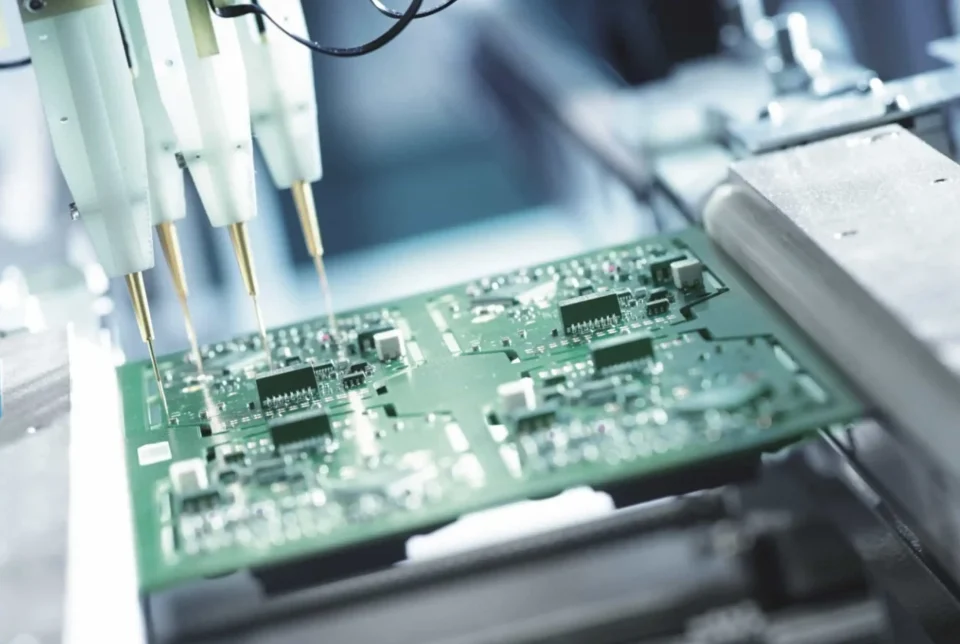
The nozzle has to pick the component reliably and release it cleanly. Size, tip shape and material all matter, and the choice is constrained by the machine, the feeder and the component. A nozzle that is too small grips on the edge of the body and places it at an angle; one that is too large fouls adjacent components during placement.
Nozzle wear changes the behaviour. A worn tip loses the seal that holds the part, and the machine compensates by increasing vacuum, which then fails to release cleanly. Recording nozzle life and replacing on a schedule prevents a failure mode that is otherwise attributed to the component.
Feeder Setup
Feeders determine where the machine travels and whether a reel runs out mid panel. Assigning reels so that the frequently used parts sit close to the placement area reduces travel, and grouping parts by nozzle type reduces nozzle changes. The result is a measurable cycle time improvement that costs nothing but planning.
Feeder accuracy also sets the pickup tolerance. A tape pocket that is not centred under the pickup point makes the machine adjust at every pick, which slows the cycle and can cause a mispick. Feeder calibration belongs in the setup routine, not in a repair visit.
Sequence Optimisation
The placement sequence decides how far the head travels. Optimisation software groups placements by feeder position and by nozzle, and the best sequences reduce travel dramatically on boards with many repeated parts. On a dense board the difference between a first attempt and an optimised sequence can be tens of seconds per panel.
Speed settings are part of the same trade. A machine can place at its maximum rate only on parts that tolerate it, and slowing a few difficult parts may allow the rest to run faster without reducing the total. The balance is found by measuring, which is why cycle time studies are worth the effort.
Placement Verification
Verification starts with the first article. Offset measurements across the board show whether the fiducial model is correct and whether the machine is drifting, and the capability analysis described in our note on placement accuracy turns those measurements into a number.
Vision systems add their own checks. A part that fails vision is rejected, and a part that passes with a marginal score is a warning that the nozzle or the feeder is drifting. Tracking the vision failure rate by component gives an early indication of a setup problem.
Handling Program Changes
Every program change is a potential defect introduction. A revision control system that records what changed, who changed it and when is the only way to trace a defect that appears after a change, and a first article check after every change is the cheapest insurance available.
Component data should be shared between programs where possible, so that an improvement to one product benefits the others. Where each product has its own private data, errors accumulate and the same mistake is repeated on every board. The wider discipline around component records is described in our article on component selection beyond the datasheet.
Process Control and Verification
The measurements that matter are the repeatable ones: conductor width and spacing, annular ring, finished hole size, plating thickness and surface finish are all verifiable on a coupon that travels with the panel. Running a first article through the same checks as the production panel confirms that the two agree, and that comparison is the cheapest form of process control available at prototype stage.
Keeping a sample from the panel turns a dispute into a measurement, because the same coupon can be re-examined by both parties without rebuilding the batch.
Related reading: our fabrication notes, board quality and design release notes cover the same ground.
FAQ
Does optimisation risk quality? Not if the constraints on speed and force are kept. Optimisation changes the order, not the placement parameters, and both should be validated on a first article.
How many fiducials are needed? Two for a small panel and three for a large one, plus local fiducials near fine pitch devices on a panel that stretches.
Why does placement drift during a shift? Usually thermal. The machine, the feeders and the board all expand as the room warms, and periodic re-checking with the first article offsets catches it before the defect rate rises.