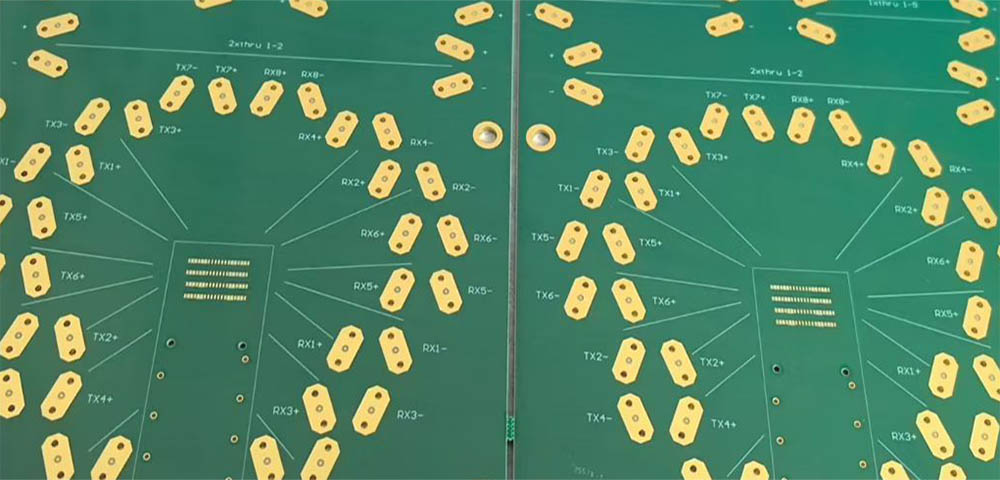
Press Cooling Under Pressure: 5 Steps for Stable Laminates
Press cooling under pressure is the part of the lamination cycle that most shops treat as waiting time. Resin is still mobile while the stack is warm, and the way it cools decides how much the panel shrinks, how evenly it does so and whether stress is frozen into the board. Panels released from the press too hot often look acceptable and then fail at drill or at reflow.

What Happens During Press Cooling
After the resin gels, the laminate still holds heat and continues to contract as it cools. Cooling under pressure keeps the layers constrained while that contraction happens, so the panel shrinks evenly rather than warping to relieve stress.
Releasing the press early removes that constraint while the material is still warm and marginally mobile. The stack then cools unrestrained, and the result is warp, twist and a dimensional change that no downstream step can correct.
Cooling Rate Control and Cycle Time
Cooling rate control balances quality against throughput. Fast cooling shortens the cycle but increases thermal gradients through the book, so the outer layers cool before the center. Slow cooling evens the gradient at the cost of press time.
Set a rate rather than a fixed cooling time, and verify with a thermocouple in the middle of a production book. The center of a tall stack always lags, and the rate that matters is the one the center experiences, not the one the platen controller displays.
Where the press has separate heating and cooling circuits, confirm that the cooling medium actually reaches the platen surface at the expected temperature. A partly blocked cooling channel lengthens the cycle and creates a temperature gradient across the platen that no recipe can compensate for. Record the cooling medium inlet temperature with the cycle data, because a slow change there explains many otherwise mysterious shifts in cycle time.
Hold Time and Release Temperature
Hold time should continue until the stack is cool enough that the resin is no longer mobile. Release temperature is the practical criterion: measure the center of the book and release only below the value the material supplier recommends.
Post the limit at the press and record the measured value for every cycle. Operators under pressure to increase throughput will release early if the criterion is not written down and checked, because the difference is not visible on the panels at that moment.
Where a press runs several products, publish the release temperature per construction rather than a single plant value. Thick stacks and high copper content need longer, and a single number that suits the easiest product will release the hardest one far too hot.
Tooling, Plates and Stack Behaviour
Plates and separators store heat and release it into the panel during cooling. Heavy, matched plates help distribute heat evenly, while a mixed set with different masses creates cold and warm zones. Plate condition belongs to the same discussion as the cooling recipe.
Warped plates also distort the constraint the press applies, so pressure is not uniform while the panel contracts. Related checks are described in our guide to press plate flatness, and plate condition should be confirmed before the cooling profile is changed.
Pressure Profile During Cooling
Pressure during cooling does not need to equal the lamination pressure, but it must be high enough to keep the stack flat and low enough to avoid crushing the edges. Dropping pressure completely during cooling is a common shortcut that shows up later as thickness variation.
Where the press supports a staged profile, reduce to a holding pressure once the resin has gelled and maintain it through cooldown. Record the profile with the cycle so that a change by a different operator is visible in the data.
Check the cooling valves and controls during planned maintenance. A valve that does not fully open lengthens cooling, and the effect grows so slowly that it is usually noticed only when the cycle time is reviewed against last year records.
Dimensional Stability and Shrink Prediction
Laminate dimensional stability is the outcome that matters for registration. Measure a set of features on a sample panel before and after the press cycle, and publish the typical shrink for each construction. Those numbers feed artwork scaling.
Where shrink varies between cycles of the same product, the cooling profile is a prime suspect. Compare the records before changing the artwork compensation, because a tooling change made to correct an unstable process will need to be undone later.
Where shrink varies between presses on the same product, treat the presses as separate processes until the profiles match. Assigning one compensation value to both guarantees that one of them will run outside tolerance on registration. Rewrite the shrink table whenever a press is rebuilt, since a new heating or cooling component changes the cycle the panel experiences.
Warp, Twist and Thickness Spread
Warp and twist appear when the two sides of a panel cool differently or when the copper distribution is unbalanced. Thickness spread appears when pressure is released before the resin has set, letting the stack relax unevenly.
Measure both after cooling on a flat surface, and record the results per press position. A panel that is flat when measured immediately can bow later as it equalises with room humidity. A defect that always appears in the same position points to the press or the plates rather than to the material.
Records and Cycle Review
Press cycle records should include the cooling rate, the release temperature, the pressure profile and the plate set used. Review them monthly against dimensional and warpage data, since cooling problems develop slowly and only the record shows the change.
Void data belongs in the same review, as covered in our guide to lamination voids, because cooling and vacuum hold interact. Material condition is the third input, and the checks in laminate moisture content control explain much of the variation that gets attributed to the press.
Troubleshooting Warp and Registration Drift
Warp that appears only on one side of the book points to uneven cooling. Registration drift that grows with distance from the panel center points to a scale change, which is a shrink difference rather than a positional error. Both are answered by measuring rather than by adjusting the artwork first.
Confirm the cooling profile on a production book before making tooling changes, and repeat the measurement after the correction to prove the effect. Acceptance criteria for laminate quality from IPC give the discussion an objective reference, and they help when a customer questions warp or thickness results.
FAQ
Why does cooling under pressure matter if the resin has already cured? Resin remains warm and partly mobile until the stack cools, so the panel continues to shrink. Holding pressure during that period keeps the shrinkage even and prevents warp from being frozen into the board.
How is release temperature determined? From the material supplier recommendation and from measurements in the center of the book, not from the platen display. Record the measured value every cycle so early release becomes visible before panels fail downstream.
Can cooling rate cause registration drift? Yes. Uneven or fast cooling changes shrink, which moves inner layers relative to each other. Measure shrink before changing artwork compensation, or the correction will have to be reversed later.