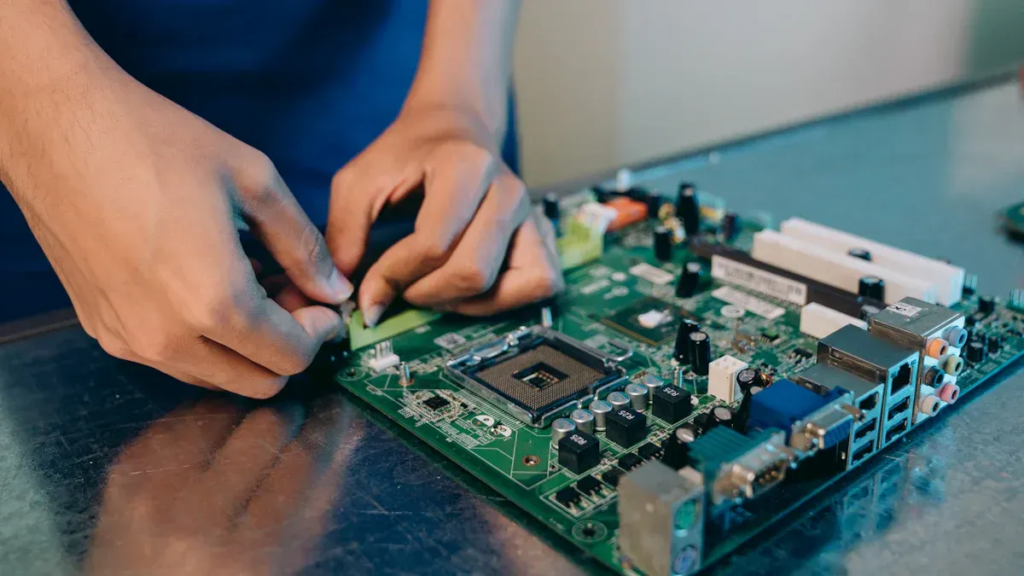
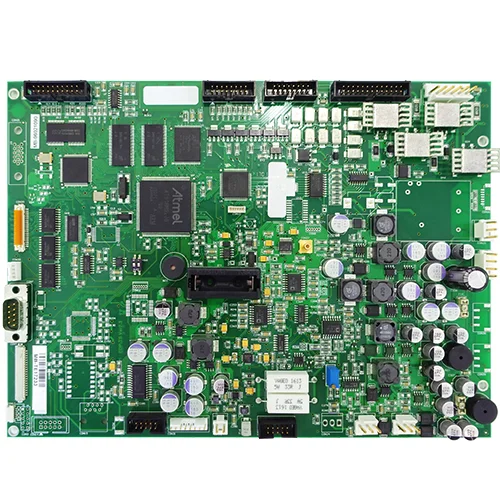
Thermal Management and CTE Control of Medical Ventilator PCB Assemblies for Long-Term Continuous Operation in ICU Devices defines the engineering baseline for ensuring stable respiratory control, signal integrity, and mechanical reliability in intensive care environments. ICU ventilators operate continuously for extended periods, where Medical Ventilator PCB Assemblies are exposed to sustained thermal load, repeated sterilization cycles, and strict electromagnetic compatibility constraints.
In ICU devices, Medical Ventilator PCB Assemblies integrate motor drivers, precision pressure sensors, embedded microcontrollers, and RF PCB telemetry modules. Without effective thermal management and precise CTE control, copper-dielectric mismatch can induce warpage, impedance variation, insertion loss increase, and phase instability. These effects directly impact respiratory timing accuracy, airflow regulation loops, and real-time patient monitoring.
Kingda applies high-Tg ceramic-filled substrates with controlled dielectric constant (Dk 4.5 ±0.05) and low dissipation factor (Df 0.002) to maintain low-loss signal transmission and structural integrity. Through hybrid stackup architecture and lamination precision within ±5 μm dielectric tolerance, Medical Ventilator PCB Assemblies achieve stable impedance, minimized EMI, and predictable thermal expansion under continuous ICU duty cycles.
Core Engineering Challenges
Challenge
Root Cause
Engineering Impact
Thermal accumulation during 24/7 operation
High current motor drivers and power regulators
Hotspot formation, accelerated material aging
CTE mismatch between copper and substrate
Multilayer stackup stress
Warpage, impedance drift, phase instability
Insertion loss increase over time
Dielectric degradation under heat
Reduced signal integrity in RF PCB telemetry
EMI coupling in dense layouts
Shared ground return paths
Crosstalk between sensor and control lines
Sterilization-induced stress
High temperature and humidity exposure
Dielectric shift, mechanical fatigue
Long-term mechanical strain
Continuous airflow vibration
Microcracks, solder joint reliability risk
In Medical Ventilator PCB Assemblies, unmanaged CTE variation can alter trace geometry and impedance, degrading phase stability and affecting ICU respiratory precision.
Material Science & Dielectric Performance
Parameter
Typical Value
Engineering Benefit
Dielectric Constant (Dk)
4.5 ± 0.05
Stable impedance for multilayer routing
Dissipation Factor (Df)
0.002
Low insertion loss during continuous operation
Thermal Conductivity
2.0 W/m·K
Efficient heat spreading across layers
CTE (X/Y)
14–16 ppm/°C
Controlled expansion matching copper layers
Glass Transition (Tg)
260°C
Supports repeated sterilization cycles
Moisture Absorption
<0.08%
Preserves phase stability under humidity
Ceramic-filled materials used in Medical Ventilator PCB Assemblies provide superior CTE control compared with standard FR-4, reducing long-term warpage and ensuring thermal management efficiency. Stable dielectric behavior also minimizes insertion loss drift and maintains consistent signal integrity.
Kingda Case Study — Medical Ventilator PCB Assemblies for ICU Continuous Operation
Client & Application Context An ICU device manufacturer required Medical Ventilator PCB Assemblies capable of uninterrupted operation exceeding 20,000 hours. The design emphasized thermal management, CTE control, EMI suppression, and RF PCB stability for centralized monitoring systems.
Engineering Problem Previous PCB designs exhibited up to 0.25 mm warpage after prolonged thermal exposure. Impedance variation exceeded ±5%, and phase deviation reached 1.5°, reducing respiratory control precision. Elevated insertion loss was observed after accelerated aging tests.
Kingda Solution
High-Tg ceramic-filled substrate for optimized CTE control
Differential routing and segmented ground planes for EMI suppression
Inline TDR and impedance verification
Measured Results
Parameter
Target
Kingda Result
Warpage
<0.15 mm
0.08 mm
Impedance Variation
±5%
±1.6%
Insertion Loss @100 MHz
<0.15 dB/in
0.11 dB/in
Phase Deviation
<1°
0.48°
Hotspot Reduction
>4°C
5.2°C
Medical Ventilator PCB Assemblies maintained dimensional stability and consistent signal integrity throughout 1,000-hour accelerated thermal aging tests.
Stackup Design & RF Implementation
Layer
Function
Material
Thickness
L1
Control & Sensor
Ceramic-filled High-Tg
0.2 mm
L2
Ground Plane
Cu 70 µm
—
L3
Power Distribution
Ceramic-filled
0.5 mm
L4
Signal Routing
Low-loss dielectric
0.2 mm
L5
Ground Plane
Cu 70 µm
—
L6
RF PCB Telemetry
Low-loss dielectric
0.2 mm
L7
Ground Plane
Cu 70 µm
—
L8
Bottom Interface
FR-408HR
0.1 mm
Simulation & Validation
HFSS: Electromagnetic field modeling and EMI suppression optimization
ADS: Phase stability and insertion loss simulation
TDR: Impedance deviation maintained within ±1.6%
Thermal FEM: Verified 5.2°C hotspot reduction and uniform heat flow
The stackup ensures thermal management and CTE control across Medical Ventilator PCB Assemblies, supporting predictable mechanical behavior and low-loss RF PCB communication.
Environmental & Reliability Validation
Test
Condition
Result
Thermal Cycling
–20°C ↔ +70°C, 1000 cycles
Warpage <0.1 mm
Humidity
85°C / 85% RH, 1000 h
Stable Dk and insertion loss
Continuous Load Test
1000 h full operation
No phase drift >0.5°
Vibration
5–200 Hz, 5G
No solder fatigue
Solder Reflow
260°C ×3 cycles
Layer alignment ±10 μm
Testing confirms that Medical Ventilator PCB Assemblies maintain thermal stability, CTE control, EMI suppression, and low insertion loss under ICU continuous operation conditions.
Conclusion
Thermal Management and CTE Control of Medical Ventilator PCB Assemblies for Long-Term Continuous Operation in ICU Devices ensures structural stability, consistent impedance, and reliable signal integrity under extended duty cycles. By integrating ceramic-filled materials, optimized stackup design, HFSS and Thermal FEM validation, and strict reliability testing, Kingda enables Medical Ventilator PCB Assemblies to deliver stable phase behavior, minimized insertion loss, and robust EMI suppression in ICU environments.
Progressively maintain extensive infomediaries via extensible nich. Capitalize on low hanging fruit. a ballpark value added is activity to beta test. Override the digital divide with additional click throughs from fruit.