Alternate Source Qualification Process An alternate source exists so that a supply interruption does not stop production, and it only delivers that benefit if the alternate is genuinely equivalent. Qualifying one is therefore an engineering exercise rather than a purchasing one: the parts have to be compared on the characteristics…
Engineering Change Impact Assessment An engineering change is never only the change that was requested. A component replacement alters the bill of materials, the placement program, the kit, the test limits and possibly the stock that is already on the shelf. A revision to a drawing alters the operator instruction,…
Laser Drilling vs Mechanical Drilling Almost every hole in a circuit board is made by one of two processes. Mechanical drilling uses a rotating bit to cut through the stack, and laser drilling uses a focused beam to remove material by ablation. They are not interchangeable: each has a range…
PCB Conveyor Training: From Prototype to Volume Production Electronics manufacturing has become a discipline of small details. Solder paste volumes, placement accuracy, temperature profiles and inspection limits all add up to the final result. This guide looks at PCB conveyor training from the perspective of a PCBA factory floor, covering…
Incoming Solder Alloy Verification and Pot Additions Solder arrives as bars, wire or paste with a certificate that states its composition. The certificate is a claim, and the alloy in the pot is what actually forms the joints. Where a nonconforming bar reaches a wave pot, the effect is spread…
Board Edge Clearance and Panel Tooling The panel edge carries the tooling that locates the panel in every machine it passes through, and the copper is kept back from that edge so that nothing touches a conductor. The width of the pullback is a fixed cost per panel and a…
Choosing Inline Cleaning Machines for PCB Assembly When an assembly needs to be clean, the cleaning machine is the process step that decides whether it is. A washer is not a single operation but a sequence of stages, each with its own chemistry, temperature and time, and a fault in…
PCB Conveyor Defects: Design and Assembly Considerations Modern electronics depend on boards that are assembled correctly the first time. Every product – a phone, a charger, a medical instrument or an industrial controller – relies on thousands of solder joints that must conduct current for years. This article explains PCB…
PCB Conveyor Setup: A Practical Manufacturing Guide Electronics manufacturing has become a discipline of small details. Solder paste volumes, placement accuracy, temperature profiles and inspection limits all add up to the final result. This guide looks at PCB conveyor setup from the perspective of a PCBA factory floor, covering setting…
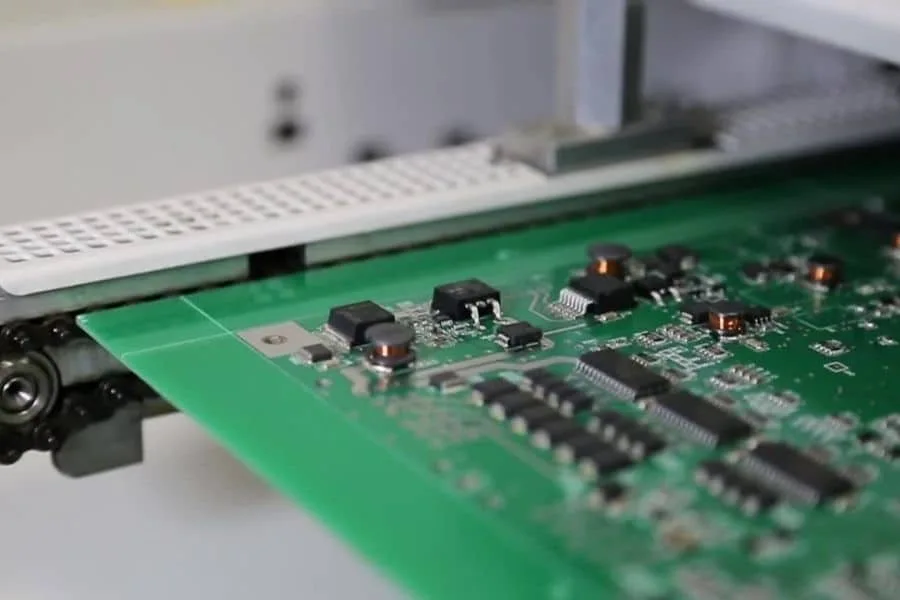
PCB Conveyor Selection: Choosing What Fits A conveyor looks like the simplest machine on the SMT line. It moves panels from the printer to the placer, then into the reflow oven, and onward to inspection. That short trip decides whether boards arrive square, cool and undamaged. Selection therefore deserves the…