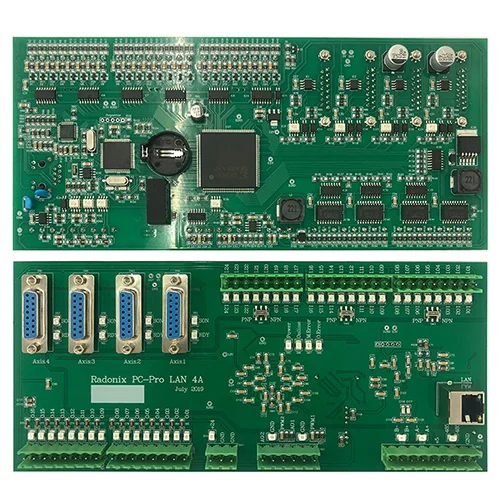
Industrial automation systems rely heavily on control electronics to operate machinery, robotics, sensors, and production lines with precision and stability. At the heart of these systems are industrial control PCBs that manage data communication, power regulation, and signal processing across complex automation architectures.
As industrial equipment becomes more compact and powerful, heat generation from processors, power components, and communication modules increases significantly. Without proper thermal management design, excessive heat can degrade signal integrity, shorten component lifespan, and compromise system reliability. Therefore, thermal management has become a critical engineering requirement in industrial automation control PCBs.
Engineering Context
Industrial automation control boards are used in programmable logic controllers, robotics control systems, motion control drivers, industrial communication gateways, and factory automation modules. These systems often operate continuously in demanding environments such as manufacturing plants, logistics hubs, and smart factories.
Industrial PCBs must maintain stable operation under heavy workloads, high current conditions, and elevated ambient temperatures. Thermal management design ensures that electronic components operate within safe temperature ranges while maintaining signal integrity and power efficiency.
What Is Industrial Automation Control PCB
An industrial automation control PCB is a printed circuit board used in industrial electronic control systems to manage sensors, actuators, communication interfaces, and processing units. These PCBs coordinate machine operations and data flow within automation equipment.
Unlike consumer electronics, industrial control PCBs must withstand harsh operating conditions including high temperatures, vibration, electrical noise, and long operational cycles. Reliable PCB design and assembly ensure consistent performance and minimal downtime in industrial production environments.
Key Technical Requirements
Thermal Management
Effective thermal management is essential for industrial control PCBs. Power regulators, microcontrollers, and communication processors generate significant heat during operation. Thermal vias, copper planes, and heat-spreading layouts help dissipate heat efficiently.
Signal Integrity and EMI Control
Industrial environments contain significant electrical noise from motors and switching devices. Proper grounding, shielding, and controlled impedance routing help maintain signal integrity and suppress electromagnetic interference.
Power Integrity
Stable power distribution networks ensure reliable operation of processors and communication modules. Power planes and decoupling capacitors are carefully designed to minimize voltage fluctuations.
High Density SMT Assembly
Industrial automation control boards often integrate multiple processors, communication interfaces, and I/O modules. Precision SMT placement is required to ensure reliable component integration and compact board layouts.
Mechanical Stability
Industrial electronics must withstand vibration and mechanical stress. Multilayer PCB structures and reinforced designs improve durability and long-term reliability.
PCB Materials and Stackup Design
Material selection plays an important role in thermal performance. Industrial control PCBs typically use high Tg FR4 laminates, Megtron materials, or hybrid stackups that combine high-speed signal layers with power distribution layers.
Multilayer stackups allow engineers to separate signal layers, ground planes, and power planes to optimize thermal dissipation and electromagnetic shielding. Thick copper layers and thermal vias are often used to spread heat away from high-power components.
Proper stackup design also supports controlled impedance routing for industrial communication protocols such as Ethernet, CAN, and fieldbus networks.
PCB Assembly Process
Engineering Review and DFM Analysis
Before manufacturing begins, engineering teams review design files to evaluate manufacturability, thermal performance, and component placement. DFM analysis helps identify potential thermal hotspots and assembly risks.
SMT Assembly
Automated pick-and-place systems install surface-mount components including processors, power modules, memory chips, and communication ICs. Precision placement ensures reliable solder joints and proper thermal contact.
Reflow Soldering
Controlled temperature profiles are used during reflow soldering to ensure consistent solder quality while protecting heat-sensitive components.
Inspection and Quality Verification
Automated optical inspection and X-ray inspection verify solder joint quality and component placement accuracy. Electrical testing ensures proper functionality of the assembled control board.
Final Assembly
After PCB assembly, connectors, shielding structures, and protective housings are installed to complete the industrial control module.
System Architecture Design
Industrial automation control systems typically include processors, communication controllers, power management circuits, and sensor interfaces. These subsystems operate together to control machinery and automation equipment.
Thermal management design is integrated into the architecture through strategic component placement, copper heat spreading, and airflow considerations within the enclosure. This ensures stable performance even during continuous industrial operation.
Reliability and Environmental Testing
Industrial control PCBs must undergo extensive environmental and reliability testing to ensure long-term stability.
Testing typically includes thermal cycling, humidity exposure, vibration testing, solder reflow reliability validation, and burn-in functional testing. These tests verify that the PCB assembly can withstand harsh industrial environments and continuous operation.
Manufacturers follow IPC standards and ISO quality systems to maintain consistent production quality and reliability.
Applications
Industrial automation control PCBs are widely used in many advanced electronic systems, including programmable logic controllers, robotics control units, industrial communication gateways, motion control drivers, factory automation equipment, smart manufacturing systems, AI-driven industrial inspection systems, and automated logistics platforms.
These systems rely on reliable PCB assembly and thermal management to maintain stable performance in demanding environments.
Advantages of Professional PCB Assembly Services
Professional PCB assembly providers offer engineering expertise, advanced SMT equipment, and strict quality control processes. This ensures stable production of industrial control PCBs with high reliability.
Advanced assembly capabilities support controlled impedance designs, high-density component placement, thermal optimization, and comprehensive testing. Experienced manufacturers also provide supply chain support and scalable production capacity for industrial electronics programs.
How to Choose an Industrial PCB Assembly Manufacturer
When selecting a PCB assembly partner for industrial automation projects, companies should evaluate engineering capabilities, SMT technology, quality certifications, manufacturing experience, and supply chain stability.
A reliable manufacturer should offer DFM support, thermal design expertise, controlled impedance manufacturing, and robust testing procedures to ensure consistent product performance.
Conclusion
Thermal management design plays a crucial role in the performance and reliability of industrial automation control PCBs. By combining optimized PCB materials, advanced stackup structures, precise SMT assembly, and rigorous reliability testing, manufacturers can ensure stable operation in demanding industrial environments.
Partnering with an experienced PCB assembly provider helps companies achieve high-quality industrial electronics manufacturing while maintaining performance, durability, and long-term operational reliability.
If you are developing industrial automation electronics and require reliable industrial automation PCB assembly services, our engineering team provides professional support including thermal management design, controlled impedance PCB manufacturing, and high density SMT assembly for complex control systems. We support projects from prototype development to mass production while ensuring stable manufacturing quality and industrial reliability standards. Contact us to discuss your industrial automation PCB project or request a quotation for your next control system application.
Progressively maintain extensive infomediaries via extensible nich. Capitalize on low hanging fruit. a ballpark value added is activity to beta test. Override the digital divide with additional click throughs from fruit.