Quick Turn PCB Prototyping: How to Choose a Fast and Reliable PCB Manufacturer
What Is Quick Turn PCB Prototyping?
Quick turn PCB prototyping is a PCB manufacturing service designed to shorten the time required to transform an electronic design into a physical prototype. Instead of following the longer production cycle typically associated with volume manufacturing, quick-turn processes prioritize engineering review, production scheduling, manufacturing efficiency, and logistics coordination.
For electronics companies, startups, engineering teams, universities, and research organizations, prototype speed can directly affect product development efficiency. A faster prototype allows engineers to assemble boards, test circuit functionality, identify design problems, and implement revisions sooner.
However, fast delivery should not come at the expense of PCB quality. A useful prototype must accurately represent the intended electrical, mechanical, and manufacturing characteristics of the design.
Therefore, choosing a fast PCB prototype manufacturer requires evaluating both turnaround capability and technical competence.
Why Quick Turn PCB Prototyping Matters
The development of an electronic product rarely follows a single design cycle.
A typical process may look like:
PCB Design → Prototype → Assembly → Testing → Design Revision → New Prototype → Pilot Production → Mass Production
Every additional prototype iteration can add time to the development schedule.
If a PCB manufacturer requires a long production cycle for every revision, even a relatively simple design change can delay the entire project.
Quick-turn PCB prototyping helps reduce this development bottleneck by allowing engineers to receive physical boards sooner and move more quickly from design assumptions to real-world validation.
Faster prototypes can help engineering teams:
- Verify circuit functionality
- Test component placement
- Evaluate signal integrity
- Confirm mechanical dimensions
- Identify manufacturing problems
- Validate thermal behavior
- Test power delivery
- Evaluate EMI/EMC-related design considerations
- Reduce unnecessary design iterations
- Accelerate product launch schedules
The goal is not simply to manufacture a PCB faster. The real objective is to shorten the engineering feedback loop.
How Does a Quick Turn PCB Prototype Process Work?
A professional quick-turn PCB manufacturer should have a streamlined workflow from design submission to delivery.
1. PCB Design File Submission
The customer normally provides manufacturing data such as Gerber files, NC drill files, stackup information, fabrication drawings, and special process requirements.
For assembled prototypes, additional files such as the BOM and pick-and-place data may be required.
Complete documentation helps engineers begin the review process without unnecessary clarification.
2. Engineering and DFM Review
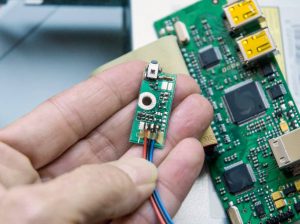
Before production begins, the manufacturer should evaluate the PCB data for manufacturability.
A DFM review may examine:
- Trace width and spacing
- Hole sizes
- Annular rings
- Copper thickness
- Solder mask clearance
- Board outline
- Layer alignment
- Via structures
- Surface finish
- Impedance requirements
- Material selection
This stage is especially important for fast-turn orders because discovering a fabrication problem after production begins can eliminate the time saved through expedited manufacturing.
A strong PCB design and layout engineering process can identify potential problems before fabrication and help engineers make practical changes early. PCB Design & Layout Engineering
3. Material and Process Confirmation
After engineering review, the manufacturer confirms the required material and manufacturing process.
Common considerations include:
- PCB layer count
- Board thickness
- Copper weight
- Dielectric material
- Surface finish
- Solder mask
- Via technology
- Controlled impedance
- Special mechanical features
For conventional boards, standard FR-4 may provide an appropriate balance of cost and performance.
For more demanding designs, engineers may select high-Tg, high-speed, high-frequency, metal-core, flexible, or rigid-flex materials depending on application requirements.
Material selection should therefore be based on the electrical, thermal, mechanical, and reliability requirements of the finished product.
Speed Does Not Mean Simplified PCB Manufacturing
One common misconception is that quick-turn PCB manufacturing simply uses a simplified production process.
In reality, the manufacturer still needs to complete the major PCB fabrication stages required by the board construction.
Depending on the PCB type, these may include:
- Material preparation
- Inner-layer imaging and etching
- Layer registration
- Lamination
- Mechanical or laser drilling
- Hole preparation and copper plating
- Outer-layer imaging
- Etching
- Solder mask application
- Surface finishing
- Silkscreen
- Profiling
- Electrical testing
- Final inspection
The difference is primarily in how efficiently these processes are organized and scheduled.
A capable manufacturer can shorten waiting time through optimized production planning, dedicated prototype capacity, efficient engineering workflows, and coordinated logistics.
Supporting Advanced PCB Technologies
A fast prototype service is much more valuable when it can support the actual technology required by the design.
Modern electronic products increasingly use advanced PCB structures rather than simple two-layer boards.
Multilayer PCB Prototypes
Multilayer boards allow engineers to accommodate more complex routing and power distribution within a limited board area.
They are widely used in computing, industrial electronics, telecommunications, automotive systems, and other applications requiring higher circuit density.
For complex projects, a supplier with established multilayer PCB manufacturing capabilities can provide a more reliable path from prototype to production. Multilayer PCB Manufacturing
HDI PCB Prototypes
HDI technology uses structures such as microvias and fine-line features to increase routing density.
HDI prototypes are useful for compact electronics where conventional through-hole via structures would consume too much board space.
High-Speed PCB Prototypes
High-speed designs require careful control of transmission-line geometry and stackup parameters.
Important factors include:
- Dielectric thickness
- Dielectric constant
- Trace width
- Copper thickness
- Copper roughness
- Reference-plane configuration
- Via structures
- Impedance tolerance
The prototype should represent the intended electrical construction closely enough to make testing results meaningful.
High-Frequency PCB Prototypes
RF and microwave designs can be particularly sensitive to material properties and manufacturing variation.
Material selection, dielectric properties, copper characteristics, layer geometry, and dimensional control all influence high-frequency performance.
A manufacturer with experience in high-frequency PCB fabrication can therefore be valuable when developing RF, wireless communication, radar, antenna, or other high-frequency electronics.
Special PCB Processes for Prototype Development
Some engineering projects require fabrication processes beyond standard PCB production.
Depending on the design, quick-turn prototype services may need to support:
- Blind vias
- Buried vias
- Microvias
- Via-in-pad
- Resin-filled vias
- Plugged vias
- Heavy copper
- Metalized half-holes
- Edge plating
- Controlled-depth routing
- Castellated features
- Rigid-flex construction
These processes require additional engineering and manufacturing controls.
For example, via-in-pad structures may require appropriate filling and planarization processes, while metalized half-holes require precise routing and plated-hole construction.
A manufacturer should therefore evaluate special processes during engineering review rather than treating them as simple add-on options.
Quality Control for Quick Turn PCB Prototypes
Fast delivery is useful only when the prototype is reliable enough for engineering validation.
Quality control should therefore remain integrated throughout the quick-turn manufacturing process.
Incoming Material Control
Materials should be checked against the specified construction before production.
This can include verification of:
- Material type
- Board thickness
- Copper weight
- Manufacturer or material grade
- Lot information
Manufacturing Process Control
Important production stages should be monitored for consistency.
Typical controls include:
- Drilling
- Plating
- Etching
- Layer registration
- Solder mask
- Surface finish
- Board dimensions
Electrical Testing
Electrical testing can detect opens, shorts, and other connectivity problems before boards are shipped.
For prototype development, this is important because a defective board could otherwise be mistaken for a problem in the customer’s circuit design.
Final Inspection
Final inspection may include visual examination, dimensional verification, surface-finish inspection, and electrical testing.
For demanding applications, additional testing or documentation may be appropriate based on the customer’s requirements.
Quick Turn PCB Prototyping and DFM
DFM is particularly important when speed is a priority.
A design that contains manufacturing risks can cause delays regardless of how fast the manufacturer’s normal production process is.
For example, insufficient clearance, unsuitable hole dimensions, difficult copper distribution, or an inappropriate stackup may require engineering clarification before fabrication.
A comprehensive DFM review can help identify these issues before the production order is released.
This makes DFM more than a quality-control procedure. It becomes a time-saving engineering tool.
The earlier a manufacturing problem is identified, the less expensive it is to correct.
Prototype PCB Assembly After Fabrication
The bare PCB is often only the first step in prototype validation.
Engineers generally need an assembled board to evaluate the complete electronic system.
Prototype assembly may include:
- SMT assembly
- Through-hole assembly
- Mixed-technology assembly
- Component placement
- Reflow soldering
- Selective soldering
- AOI inspection
- X-ray inspection where appropriate
- Functional testing
Using the same supplier for PCB fabrication and prototype assembly can reduce coordination between vendors.
GOPCBA provides prototype PCB assembly services for engineering validation, allowing customers to move from bare-board fabrication to assembled prototypes through a more integrated workflow. Prototype PCB Assembly
How to Make PCB Prototyping Faster
Customers can also improve prototype turnaround by preparing complete and accurate manufacturing information.
Provide Complete PCB Files
Incomplete or inconsistent production files can create unnecessary engineering questions.
Before submission, verify:
- Gerber layers
- Drill files
- Board outline
- Stackup
- Copper requirements
- Surface finish
- Material
- Special processes
Clearly Define Critical Requirements
If the board requires controlled impedance, special materials, tight mechanical tolerances, or specific via structures, these requirements should be clearly documented.
Respond Quickly to Engineering Questions
Fast communication can be just as important as fast manufacturing.
If the manufacturer identifies an issue and needs clarification, a delayed response can extend the total turnaround time.
Use a Repeatable Prototype Process
For products requiring multiple design revisions, maintaining consistent manufacturing specifications can make prototype comparisons more meaningful.
What Should You Consider When Choosing a Quick Turn PCB Manufacturer?
Not every manufacturer offering “24-hour” or “48-hour” PCB service is suitable for every project.
Before selecting a supplier, evaluate several factors.
Manufacturing Capability
Can the supplier manufacture the PCB structure required by your project?
Engineering Support
Does the supplier perform DFM reviews and provide practical engineering feedback?
Material Selection
Can the supplier support the materials required for your electrical and thermal requirements?
Quality System
Are inspection and testing procedures clearly defined?
Prototype Flexibility
Can the supplier handle small quantities and multiple design revisions?
Production Scalability
Can the same supplier support pilot production and mass manufacturing after the prototype is approved?
Communication
Can technical questions be answered quickly by an experienced engineering team?
A manufacturer that performs well across these categories is generally a better long-term partner than a supplier selected solely on advertised turnaround time.
Quick Turn PCB Prototyping vs. Mass Production
Prototype and mass-production manufacturing have different priorities.
| Factor | Quick Turn Prototyping | Mass Production |
|---|---|---|
| Primary objective | Fast design validation | Stable volume production |
| Quantity | Small | Medium to large |
| Main priority | Speed and flexibility | Cost, consistency, capacity |
| Engineering changes | Frequent | Controlled |
| Production setup | Flexible | Highly optimized |
| Design revisions | Common | Less frequent |
| Supplier requirement | Fast response | Long-term scalability |
A strong PCB manufacturer should understand both environments.
The prototype process should also be designed with future production in mind. Otherwise, a prototype that works successfully in the laboratory may require significant redesign before it can be manufactured efficiently at scale.
From Rapid Prototype to Production
The ideal PCB manufacturing partner supports the entire product lifecycle.
A typical development path is:
Engineering Design
↓
Quick Turn PCB Prototype
↓
Prototype Assembly
↓
Functional and Reliability Testing
↓
Design Optimization
↓
Pilot Production
↓
Mass Production
This integrated approach reduces supplier transitions and helps preserve manufacturing knowledge throughout the product lifecycle.
For customers who need a complete manufacturing supply chain, GOPCBA also provides turnkey PCB assembly services covering PCB fabrication, component sourcing, assembly, inspection, and related production processes. Turnkey PCB Assembly Services
Applications of Quick Turn PCB Prototyping
Quick-turn PCB services are useful across many electronics industries.
Consumer Electronics
Rapid prototypes allow product teams to test compact circuit designs and quickly implement hardware revisions.
Industrial Electronics
Industrial control products often require multiple development cycles before finalizing hardware architecture.
Automotive Electronics
Automotive electronics require careful validation of electrical, mechanical, thermal, and reliability requirements.
Medical Electronics
Medical product development places strong emphasis on manufacturing consistency and documentation.
Telecommunications
High-speed and high-frequency prototype PCBs help engineers validate signal integrity and RF performance.
Power Electronics
Power-related designs may require specialized copper structures, thermal solutions, and materials.
The prototype manufacturer’s technical range should match the requirements of the intended application.
Why Choose GOPCBA for Quick Turn PCB Prototyping?
For a successful prototype program, speed should be combined with engineering capability and manufacturing reliability.
GOPCBA supports PCB projects from design engineering and fabrication through prototype assembly and production. This integrated approach helps customers reduce communication gaps between different suppliers and move more efficiently through the product development cycle.
Its rapid PCB prototyping capability is designed to help engineering teams validate designs quickly while maintaining the manufacturing controls required for reliable prototype boards. Rapid PCB Prototyping Services
More importantly, the objective is not simply to deliver a PCB quickly. The goal is to provide a prototype that engineers can confidently use for functional testing, design verification, and the next stage of product development.
Conclusion
Quick turn PCB prototyping plays an important role in accelerating modern electronics development. By shortening the time between PCB design and physical validation, it allows engineering teams to identify problems earlier, make design revisions faster, and move products toward production more efficiently.
However, prototype speed should never be evaluated separately from manufacturing quality.
The right fast PCB prototype manufacturer should combine:
- Rapid engineering response
- Efficient production scheduling
- Strong DFM capabilities
- Broad PCB technology support
- Appropriate material selection
- Reliable quality control
- Electrical testing
- Prototype assembly capabilities
- Production scalability
When these capabilities are combined, quick-turn PCB prototyping becomes more than an expedited fabrication service. It becomes an important part of a reliable product development strategy—from the first prototype through pilot production and eventual mass manufacturing.