Motor Control PCB Guide: Design, Applications and Cost
Electric motors move the modern world. They spin the fans in data centers, drive the wheels of electric vehicles, position the arms of factory robots, and wash the clothes in smart appliances. Behind every controlled motor sits a specialized circuit board that decides how smoothly it starts, how precisely it runs, and how efficiently it uses power. That board is the motor control PCB. Unlike generic electronics boards, it combines power electronics, a microcontroller, safety protection, and feedback systems in one package. This guide explains what a motor control PCB is, how it works, what it costs, and how to design and source one that survives years of industrial duty.
What Is a Motor Control PCB?
A motor control PCB is a circuit board designed specifically to regulate and manage an electric motor. It integrates power devices, control logic, protection circuits, and sensor interfaces so the motor can start, stop, accelerate, and decelerate under command. In effect, the board is both the brain and the energy manager of the motor system, translating high-level commands from a car ECU or factory PLC into the precise voltages and waveforms the motor needs.
The difference from an ordinary PCB starts with the power stage. Motor currents can reach tens of amps, so the board carries thick copper, power transistors, and heat-dissipating structures that ordinary signal boards never need. The difference continues with the control loop: a microcontroller reads sensor feedback and adjusts switching hundreds or thousands of times per second. Designing these two worlds, high power and fast logic, on one board is the core discipline of motor control electronics.
Main Functions of a Motor Control Board
A motor control PCB performs several critical jobs. Power regulation and distribution deliver stable voltage and current to the motor windings. Speed and torque control keeps the motor running accurately under changing loads, whether it is a conveyor carrying uneven boxes or a drone fighting wind. Direction control and braking manage forward and reverse rotation and bring the motor to a safe stop. Fault detection and protection guard against overcurrent, overheating, and short circuits before they damage the motor or the equipment around it.
Together these functions make motors more efficient, more stable, and much longer-lived. A well-designed control board also simplifies the rest of the system, replacing bulky mechanical contactors and relays with compact solid-state switching.
Core Components of a Motor Control PCB
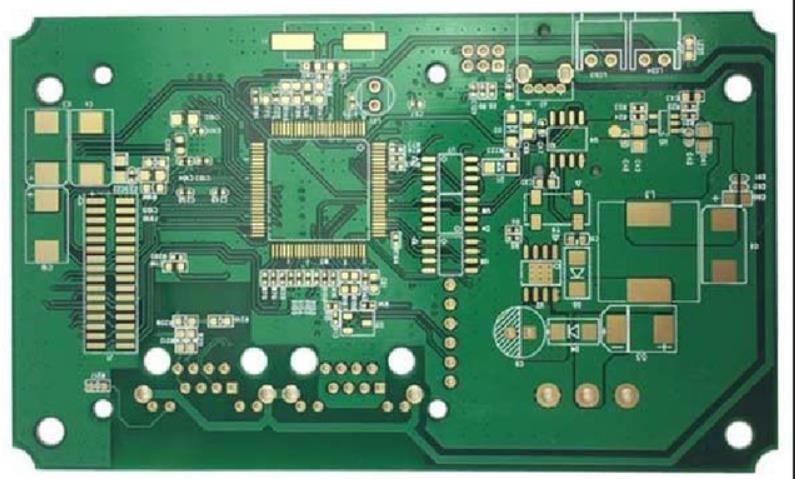
High-performance motor control designs share a recognizable component architecture. The microcontroller executes the control algorithm and communicates with the outside system. Driver chips and power transistors, typically MOSFETs or IGBTs, handle high-voltage and high-current switching. Current and position sensors provide the real-time feedback that makes closed-loop control accurate. Protection circuits add fuses, diodes, and temperature monitoring that keep the power stage inside its safe operating area.
Every component must be selected with both electrical and thermal margins. A MOSFET running near its rating fails early; a sensor placed too close to the switching node reads noise instead of current. Component selection and placement on the board are therefore engineering decisions, not assembly details.
How a Motor Control PCB Works
Motor control follows a three-step loop. Signal input arrives first, from sources such as a vehicle ECU, a factory PLC, or a user pressing a button. Power conversion comes second: the board regulates DC or AC input into the voltage and waveform the motor needs, using pulse-width modulation to shape the drive signal. Feedback correction comes third, with sensors monitoring speed, current, and position while the controller automatically adjusts its output to match the command.
This closed-loop architecture is what makes modern motors efficient. Instead of wasting energy as heat in a resistive speed control, the board switches power at high frequency and delivers only what the motor demands at each moment. The same loop provides soft start, which reduces mechanical stress and prolongs the life of the motor and the machinery it drives.
Types of Motor Control PCBs
Different motors need different control boards. AC motor control boards are widely used in industrial pumps and compressors. DC motor control boards appear in toys, power tools, and small appliances. Stepper motor control boards drive CNC machines, 3D printers, and positioning stages. Brushless DC, or BLDC, motor control boards power drones, electric vehicles, and high-performance fans that need efficiency and quiet operation.
Each type has its own architecture. Stepper boards emphasize precise current regulation per phase; BLDC boards need sensorless back-EMF detection or Hall sensor interfaces and six-step or field-oriented commutation. Choosing the right board family at the start of a project saves both engineering time and cost.
Applications of Motor Control PCBs
Motor control boards appear in almost every industry. In industrial automation they run conveyor belts, robotic arms, packaging equipment, and machine tools. In electric vehicles they control the traction motor, cooling fans, and coolant pumps. In home appliances they drive washing machines, refrigerators, and fans with inverter technology. In robotics and drones they provide the precise motion control that keeps a robot arm stable or a quadcopter hovering.
The breadth of applications explains why motor control is one of the fastest-growing segments of PCB design. Every efficiency regulation, every electrification program, and every automation project adds demand for boards that can switch power cleanly and control motors precisely.
Benefits of a Quality Motor Control PCB
Investing in a well-engineered motor control board pays back in operation. Energy efficiency is the headline benefit, lowering electricity consumption and running costs across the product’s life. Compact design replaces bulky mechanical controllers, freeing space in modern equipment. Safety improves because built-in protection reduces the risk of faults and fire. Precision performance keeps motors running smoothly with fast response, which matters for quality in manufacturing and comfort in appliances.
For businesses, these benefits translate into lower maintenance costs and higher production uptime. A motor controller that fails on a production line stops output and costs far more than the board itself, which is why industrial buyers rarely choose motor control boards on price alone.
Design Considerations for Motor Control Boards
Motor control PCB design demands attention to forces that signal boards never face. Thermal management comes first: power components generate serious heat, so designs use thermal vias, heatsink pads, and heavy copper pours to spread it. Signal integrity matters around the sensitive current-sense and gate-drive circuits, where correct routing and grounding suppress electromagnetic interference from fast switching. Material selection usually starts with FR-4 and moves to high-Tg or high-power composite laminates for demanding applications. Cost and performance must be balanced, because over-specifying material raises price without adding value while under-specifying invites field failures.
Gate drive layout deserves special care: long or poorly routed gate traces cause ringing and false switching. Current sense traces should use Kelvin connections to the sense resistor for accurate measurement. The board’s power and ground planes must be sized for the peak currents, not the average. These are exactly the details a good DFM review with the factory catches before expensive prototypes are built.
Manufacturing Challenges in Motor Control Boards
Producing motor control boards is harder than standard boards in predictable ways. High-power handling requires thicker copper and wider traces that stress etching and drilling processes. Miniaturization forces complex functionality into compact layouts. Thermal stability demands materials and processes that survive high operating temperatures. Production consistency matters because motor control boards are often made in large volumes, and yield loss in one step multiplies across thousands of units.
Testing adds another layer. Beyond electrical test, power boards benefit from in-circuit verification of the switching stages and thermal screening of assembled units. A manufacturer with experience in power electronics will run the right tests and document them properly, supported by PCBA testing services that cover AOI, X-ray, and functional verification.
Motor Control PCB Price and Cost Factors
Motor control PCB cost depends mainly on design complexity, materials, and volume. Simple DC motor control boards typically run $15 to $50 each. Advanced brushless motor control boards for electric vehicles or drones range from $100 to $500 each because they add powerful microcontrollers, high-current drivers, and complex sensing. High-conductivity copper layers, high-temperature substrates, and custom features all push the price upward, while quantity discounts pull it down.
Cost reduction follows familiar rules. Order in volume, simplify the layout, remove unnecessary layers, and use standardized components rather than scarce custom chips. Working with a qualified manufacturer also reduces hidden cost, because fewer defects and better DFM support lower the total project expense.
Future Trends in Motor Control PCB Technology
Motor control technology is advancing on several fronts. AI-based control enables predictive maintenance and adaptive tuning that optimize motors as they age. IoT integration supports remote monitoring and intelligent diagnostics from the factory floor or the cloud. Eco-friendly materials and higher efficiency are reducing carbon footprints across appliance and vehicle fleets. Further miniaturization is pushing motor control into wearables, medical pumps, and portable robotics.
For design teams, these trends mean the motor control board is becoming more software-defined and more connected. Choosing a manufacturing partner that can build dense, power-capable boards with fine-pitch assembly and full testing is essential for keeping pace. Partners that combine fabrication and PCB assembly, like the gopcb team, streamline the path from schematic to shipped module.
Sourcing a Motor Control PCB Manufacturer
When sourcing motor control boards, evaluate suppliers on power-electronics experience, not just general capability. Ask about heavy copper processing, high-Tg materials, and thermal test competence. Confirm quality systems such as ISO 9001 and IPC standards, and review the documented PCB capabilities and quality management processes. Compare delivery times and volume pricing, and request production samples rather than engineering samples before committing to large orders.
A transparent partner provides itemized quotations covering materials, fabrication, testing, and logistics, so the comparison is honest. With the right manufacturer, motor control boards arrive reliable, documented, and ready to run, protecting both the equipment and the reputation of the company that ships it.
Frequently Asked Questions
Q1. How much does a motor control PCB cost? Simple DC motor boards range from $15 to $50, while advanced BLDC boards for vehicles and drones run $100 to $500.
Q2. Can motor control PCBs be customized? Yes, most manufacturers offer full custom design and manufacturing tailored to the motor and application.
Q3. Which industries rely most on motor control PCBs? Automotive, consumer appliances, robotics, and industrial automation are the largest users.
Q4. How long does a motor control PCB last? With proper cooling and protection, five to ten years is typical, with industrial designs often lasting longer.
Q5. What is the difference between a driver board and a control PCB? A driver board focuses on power switching, while a control PCB integrates the microcontroller and feedback loop that make the motor intelligent.
Conclusion
The motor control PCB is far more than a circuit board; it is the core that keeps motors efficient, safe, and precise. From industrial automation and electric vehicles to home appliances and robotics, these boards power the motion around us. As AI, IoT, and green design reshape the field, motor control boards will become smarter, more efficient, and more essential. Teams that master their design and choose capable manufacturing partners will lead the next generation of motion control.