Smart Water Meter PCB: Design, Materials and Cost Guide
What Is a Smart Water Meter PCB?
A smart water meter PCB is the control board inside a modern water meter that turns raw flow measurement into usable data. It reads the sensor, calculates consumption, stores history, drives a display and talks to the network, all while running from a small battery for years. The board replaces the purely mechanical register of traditional meters and is what makes remote reading, leak alarms, usage analytics and cloud management possible.
Smart meter boards appear in residential communities, industrial parks, commercial buildings, municipal water supply and smart city projects. Because the meter sits outdoors or in wet pits, the PCB must work reliably in humidity, temperature extremes and electromagnetic noise while consuming almost no power. That combination of constraints makes the smart water meter PCB a genuinely demanding design.
This guide covers how the board works, its main subsystems, design rules, materials, stack-up choices, manufacturing flow, testing and realistic costs.
How a Smart Water Meter Board Works
The operating sequence is straightforward. The flow sensor detects the motion of water and produces pulses or ultrasonic measurements. The microcontroller reads those signals and calculates cumulative consumption, stores the history in non-volatile memory, and periodically wakes the radio to transmit data to a cloud platform. A display shows current usage and status, and the power management block keeps the whole system in deep sleep between transmissions.
Every part of that loop is designed around battery life. The board must wake, measure, transmit and sleep with microamp level current in standby, because a typical meter is expected to run eight to fifteen years on one battery. Low power design is not an optimization here; it is the product specification.
Main Subsystems on the Board
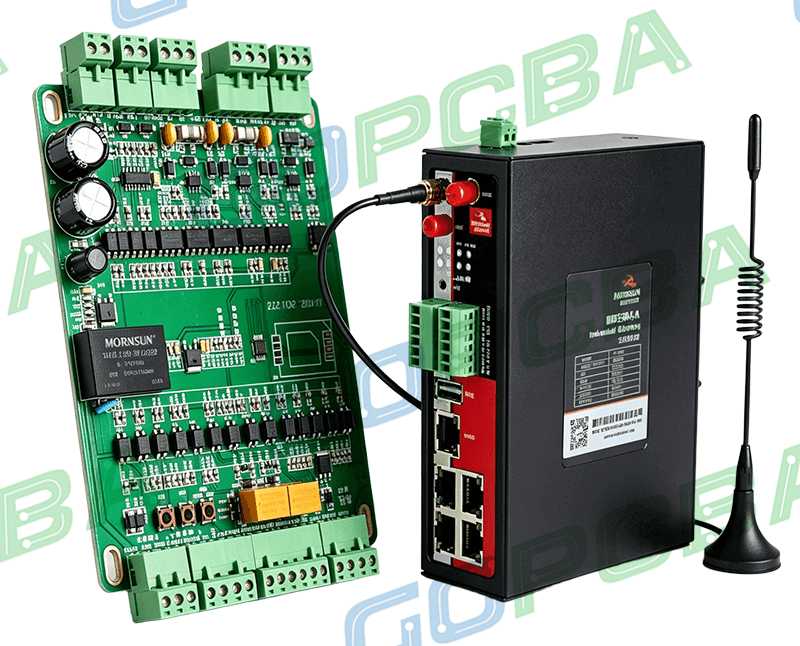
The heart of the board is the microcontroller, typically an STM32, MSP430, NXP, Nordic or Silicon Labs part chosen for low sleep current and flexible wake-up. The flow measurement front end depends on the meter type: Hall effect, ultrasonic, magnetic or electromagnetic sensors, with ultrasonic designs growing fastest because they offer higher accuracy and longer life. The radio module is selected from NB-IoT, LoRaWAN, LTE-M, Zigbee, Bluetooth or Wireless M-Bus according to the deployment network.
Around those blocks sit the power management circuit with efficient DC-DC conversion and battery voltage monitoring, EEPROM, Flash or FRAM storage for consumption records and alarms, and the LCD interface for local display. Each subsystem must share clean ground and filtered power with the radio, which is where board layout decides success or failure.
Design Requirements That Matter Most
Three requirements dominate smart meter board design. Low power is first: sleep current should sit below 5 microamps and active current below 50 milliamps so the battery target is reachable. Miniaturization is second, with typical boards at 40 by 40, 50 by 50 or 60 by 80 millimeters while integration keeps rising. Electromagnetic compatibility is third, because the radio must transmit reliably next to switching converters and sensor wires, which demands complete ground planes, RF zone isolation, power filtering and controlled impedance.
Environmental protection is the fourth requirement hiding in the datasheets. Meters live in wet, hot or freezing locations, so conformal coating, waterproof connectors, moisture-resistant packaging and high quality solder mask are part of the standard build rather than optional extras.

Materials for a Smart Meter Board
Standard FR-4 is perfectly adequate for residential and general IoT meters, offering low cost, mature processing and stable performance. High Tg FR-4 steps up for industrial grade meters and hot environments with better heat resistance, mechanical strength and dimensional stability. Boards that integrate NB-IoT, LTE or other wireless modules can benefit from low loss laminates such as Rogers, Taconic or Isola where the antenna feed and RF paths need the lowest possible loss.
For most designs, a hybrid approach works best: standard FR-4 for the bulk of the board with controlled impedance structures on the RF nets. Material selection should follow the operating temperature, the radio budget and the target cost rather than a generic preference.
Recommended Layer Stack-Ups
Two layer boards suit simple residential meters where cost and lead time dominate. Four layers become the standard for NB-IoT and LoRa meters because a solid ground plane and clean power plane dramatically improve EMC and signal integrity. Six layers serve industrial meters and multi-radio systems where several wireless interfaces and dense routing coexist.
The general rule is to pay for layers only when the radio, the density or the EMC requirement demands them, and to simulate the stack before the first prototype.
Manufacturing and Assembly Flow
A smart water meter board follows the standard high reliability flow: DFM review, material cutting, inner layer imaging, etching, lamination, CNC drilling, hole plating, AOI, solder mask, surface finish, silkscreen, electrical test and final inspection before vacuum packaging. Assembly adds SMT placement, reflow, through hole insertion and wave soldering, followed by AOI, X-ray, ICT and functional test, firmware programming, burn-in and conformal coating where required.
For surface finish, ENIG is the most widely used choice on smart meter boards because it gives flat, corrosion resistant, solderable pads for fine pitch ICs. Immersion silver suits RF-heavy designs, and HASL remains the economical option for cost sensitive products.
Testing and Quality Control
Long life products need long life validation. Beyond AOI, flying probe, ICT and functional testing, smart meter boards commonly pass temperature and humidity cycling, high and low temperature storage, salt spray and drop tests, plus burn-in. These tests simulate years of outdoor service in weeks and catch the failures that would otherwise surface as field returns across an entire deployed fleet.
IPC Standards
Production follows the IPC framework: IPC-A-600 for appearance, IPC-6012 for rigid board performance, IPC-A-610 for assembly acceptance, IPC-2221 and IPC-2222 for design, and IPC-7711 and IPC-7721 for any rework or repair. Working to these standards gives the meter manufacturer consistent quality, traceable acceptance and confidence for multi-year supply contracts.
DFM Advice for Smart Meter Boards
Good DFM starts with sensible line width and spacing, planned via count and standard hole sizes, early panelization, consistent component orientation, ICT test points, RF and digital separation, balanced copper and verified impedance. Each of these choices reduces a failure mode: test points catch assembly faults, copper balance limits warp, and RF isolation protects the radio. Running a DFM review before release is the fastest way to shorten the development cycle and stabilize production yields.
2026 Cost Reference
Pricing for smart water meter boards depends on board size, layers, materials, quantity, finish, component selection, test depth and assembly complexity. As a 2026 reference, prototypes of one to ten assembled boards typically cost 80 to 300 US dollars per project. Small batches of one hundred to one thousand PCBA units generally land between 3 and 12 dollars per assembled board. Above ten thousand units, automated production typically brings the price to 0.8 to 5.5 dollars per board.
The biggest cost factors are layer count, material class, the wireless module, finish and the test program. Simplifying the stack and testing smartly usually reduces cost more than any sourcing negotiation.
FAQ
Why do smart meter boards need such low power? The meter runs on one battery for eight to fifteen years, so sleep current must stay below about 5 microamps and active current below 50 milliamps.
Which surface finish is best for a water meter PCB? ENIG is the most common because it is flat, corrosion resistant and reliable for fine pitch assembly; immersion silver suits RF designs and HASL suits cost sensitive products.
Can one board support several communication protocols? Yes. Multi-radio meters use higher layer counts and careful RF isolation, often with six layers, to keep NB-IoT or LoRa links clean beside other interfaces.
Building Smart Meter Boards With the Right Partner
A meter board is only as reliable as the weakest manufacturing step, so choose a supplier with experience in low power IoT products and full testing capability. gopcb provides high reliability PCB manufacturing, SMT assembly, conformal coating, firmware-friendly testing and DFM engineering support under IPC Class 2 and Class 3 programs for smart utility and IoT products. Send your schematic, BOM and stack-up for a free DFM review and a smart water meter PCB quotation from prototype through volume production.