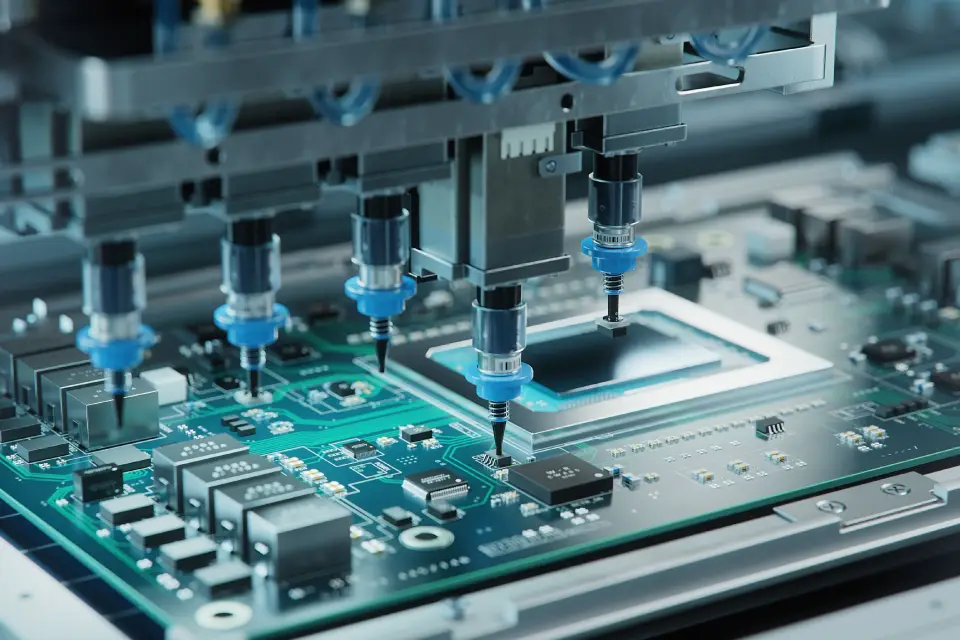
Black FR4 PCB: Material, Solder Mask and Manufacturing Notes
What Black FR4 Actually Means
Black FR4 is an ordinary glass-reinforced epoxy board wearing a black solder mask. The laminate underneath is the same FR-4 that green boards use, and the electrical performance of the two is essentially identical. The colour comes from the solder mask ink, not from the core.
This is worth stating plainly because the confusion is common. A designer who specifies a black board is choosing an appearance and a set of process consequences, not a new dielectric material. Only a small number of products use a genuinely dark core material, and those are usually high-end applications where the laminate itself has been selected for other reasons.
The practical implication is that everything known about FR-4 applies unchanged: glass transition temperature, dielectric constant, loss factor, mechanical strength, and the way the material behaves during lamination and drilling.
Core Material and Solder Mask
The substrate is a woven glass cloth bonded with epoxy resin and treated with a flame retardant, which is where the FR designation comes from. It provides mechanical support, electrical insulation, and dimensional stability through the lamination cycle.
The solder mask is a thin polymer coating printed over the copper, opened at the pads. It prevents solder from bridging between adjacent conductors, keeps the copper from oxidising, and mechanically protects the traces. Pigment is added to the mask resin, and that pigment is what turns a board black.
Because the mask is applied last in the imaging sequence, printing is where a black board differs from a green one. The ink has to be pigmented heavily enough to hide the copper beneath it, and the exposure energy must be set for that particular ink, or fine features print with ragged edges or fail to develop cleanly.

How the Laminate Behaves
Standard FR-4 has a glass transition temperature between roughly 130 and 140 degrees Celsius, and high-Tg grades reach 170 to 180. Above the transition temperature the resin softens, the coefficient of thermal expansion rises sharply, and the board becomes more sensitive to the thermal excursion of assembly. Multilayer products and boards that see repeated reflow generally specify a high-Tg grade.
The dielectric constant of FR-4 sits around 4.2 to 4.8 and the loss factor around 0.015 to 0.02, which suits digital circuits, power control, and moderate-speed signals. It does not suit millimetre-wave or very high-speed differential links, where a low-loss laminate is required regardless of the board colour.
Mechanically, FR-4 is strong and stable, which is why black boards are produced in 8, 12, and 16 layers without difficulty. Thermal conductivity is modest, roughly 0.3 watts per metre-kelvin, so heat spreading depends on copper area rather than on the laminate.
Why Products Choose Black
Appearance is the honest answer. Black boards read as premium in gaming hardware, high-end consumer electronics, and enthusiast motherboards, and a dark board inside a product with a transparent panel looks deliberate. Industrial and automotive products also use black boards where the equipment is expected to look technical and where a dark coating is a familiar convention.
The choice is not electrical. Where a product genuinely needs better thermal behaviour, lower loss, or higher reliability, those come from the laminate and the copper, not from the mask colour.
Where the Dark Mask Complicates Manufacturing
Automated optical inspection is the first casualty. AOI systems rely on contrast between the copper features, the mask, and the laminate, and a black mask absorbs much of the light that a green mask reflects. Inspection recipes must be retuned, sometimes with different lighting angles, and the resulting images can be noisier, so marginal defects are harder to classify automatically.
Rework is the second. Operators locate traces and pads visually during touch-up, and a black surface makes that harder under normal lighting. Microscopes with stronger illumination are usually required, and the temptation to work faster than the inspection allows is a real source of escaped defects.
Heat absorption is a smaller but genuine effect. A black surface absorbs more radiant heat, which matters when boards pass through a reflow oven or are infrared-cured rather than convection-heated. It changes nothing about the laminate’s properties, but it can shift the temperature profile slightly, so the profile is usually re-verified on the first articles.
How a Black Board Is Fabricated
Fabrication starts with laminate selection: thickness, copper weight, and Tg grade. Inner layers are imaged with dry film resist and etched, then the layers are laminated under heat and pressure. Drilling produces the through, blind, and buried vias, and copper is electroplated through the holes.
The outer layers are then patterned, the black solder mask is printed and cured, and the legend is applied. Surface finish is deposited next, followed by electrical test and final inspection. The mask is the step where the colour choice shows up as a process difference, because the printing, exposure, and development parameters are ink-specific.
Stackups, Thickness and Copper
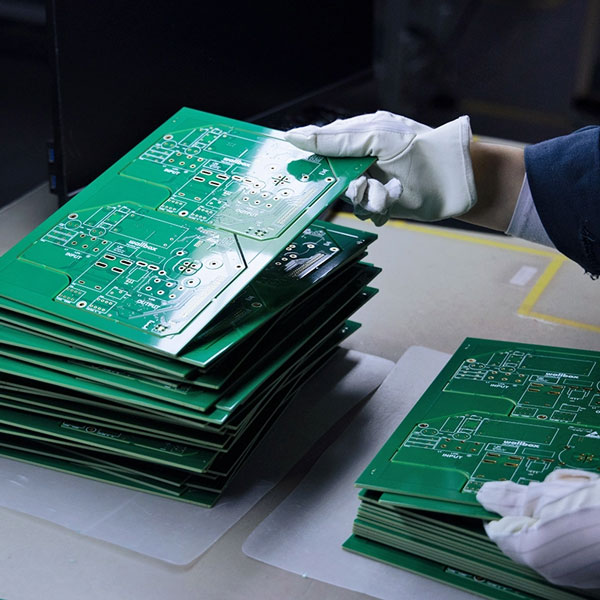
Black FR4 boards are built in the same range as any FR-4 product: two-layer boards for simple designs, four and six layers for most control and computing hardware, eight or more for dense products, and twelve or higher where routing or power delivery demands it.
Total thickness commonly runs from 0.8 millimetres to 2.0 millimetres, with 1.6 millimetres the default for general work. Copper weight starts at one ounce and rises to two or three ounces for power distribution, with the heavier weights also determining how finely the outer layers can be etched.
Where Black Boards Are Used
Gaming hardware is the highest-profile application, with graphics cards and motherboards using black boards for both appearance and, in the case of cards, thermal management through large copper areas. Consumer electronics, wearables, automotive control modules, and infotainment systems also use them.
Industrial equipment uses black boards for controllers, automation hardware, and power modules, where the same fabrication process as a green board keeps qualification simple.
Black and Green Compared
Electrically, the two are equivalent when the laminate and stackup match. The differences are practical: black gives a premium look, offers less contrast for optical inspection, and costs slightly more because the ink is more expensive and the process is less forgiving. Green remains the default for high-volume production because it is the cheapest and the easiest to inspect, and no specification calls for a different colour unless the product has one.
What Drives the Price
Colour adds little on its own; the drivers are the same as for any FR-4 board. Layer count has the largest effect, followed by board size, surface finish, copper weight, and quantity. A two-layer black prototype is inexpensive, while a twelve-layer board with tight impedance control and a heavy copper plane costs proportionally more.
Ordering in panel quantities, keeping the design inside standard capabilities, and matching the surface finish to the assembly schedule all reduce cost without changing the board’s function. Where black is chosen only for appearance, it is worth confirming that the visual benefit justifies the small inspection premium, which is where a supplier able to discuss both PCB capabilities and quality management earns its place.
FAQ
Is black FR4 a different material? No. The laminate is standard FR-4; the colour comes from the solder mask, so the electrical properties are the same as a green board built on the same laminate.
Does a black board run hotter? The surface absorbs slightly more radiant heat, which can shift an infrared reflow profile. The laminate itself conducts heat no differently.
Why is black harder to inspect? Low reflectivity reduces contrast in automated optical inspection and makes traces harder to see during manual rework, so recipes and lighting have to be adjusted.
Can black boards be built in many layers? Yes. FR-4 handles eight, twelve, and sixteen layers routinely, and the mask colour has no effect on the stackup.
Is black more expensive than green? Slightly. The ink costs more and the process window is narrower, but the difference is small next to the effect of layer count and board size.
Conclusion
Black FR4 is a familiar laminate with a different coat of paint, and treating it that way avoids both the myths and the surprises. Choose the colour for the product, keep the laminate and stackup decisions based on electrical and thermal needs, and plan for the extra care that optical inspection and rework require. For the surrounding process, see our notes on PCB manufacturing and PCB assembly.