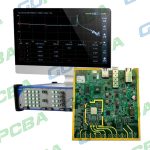
ABS Control Module PCB Assembly
A Safety System With a Board Inside
An anti-lock braking system has to decide, several times a second, whether a wheel is about to lock and how to release pressure without losing braking force. The control module that makes that decision combines wheel speed input, real time processing and hydraulic solenoid drive in a single enclosure mounted in the engine bay. It is a safety system, and its electronics are treated accordingly.
The board inside that module faces a combination of stresses that is unusual even for automotive work: wide temperature swings, continuous vibration, the electrical noise of a hydraulic pump and the consequence of a malfunction. That is what makes ABS assembly a distinct engineering discipline rather than a general automotive build.
What the Module Does
The electronics acquire and filter the wheel speed sensor signals, run the real time control algorithm on a microcontroller or digital signal processor, communicate with the rest of the vehicle over a bus, and drive the solenoid valves and the pump that modulate the brake pressure. Every one of those functions has a direct effect on vehicle behaviour, so the design has to keep working while being disturbed.
Because the module is mounted in the engine bay, all of this has to survive the environment the brake system itself lives in.
Design Priorities
Functional safety drives the design. Analog and digital sections are partitioned so that the sensitive sensor inputs are not disturbed by the switching currents of the drivers, the supply and ground structure is designed for the large transients the solenoids produce, and electromagnetic compatibility is treated as a requirement rather than a test that is attempted at the end.
The wheel speed signal is often a small alternating waveform from a variable reluctance or magnetoresistive sensor, so the input filtering and the grounding around it deserve particular attention. A misread speed signal is interpreted by the algorithm as a wheel event, which is why a layout mistake can become a braking anomaly.
Materials and Stack-Up
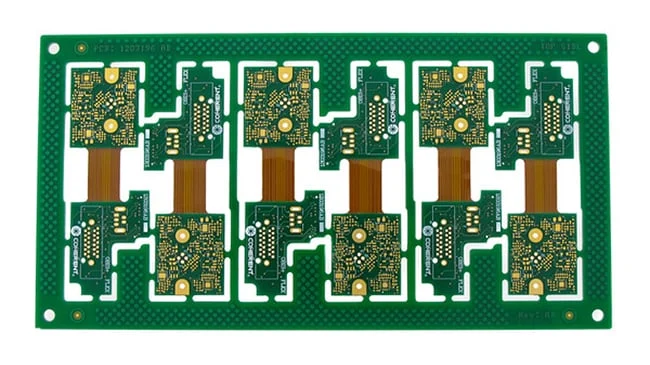
The module operates over a wide temperature range, so higher glass transition temperature laminate or an automotive qualified material is used rather than standard FR-4. Heavier copper is used on the power and driver layers to carry the solenoid current and to spread heat, and the multilayer structure provides the ground and power planes needed to isolate the sensitive inputs from the drivers.
A stack-up that separates the high current paths, the analog inputs and the digital section gives the design a chance of meeting its emission and immunity limits without adding filtering later.
Assembly Challenges
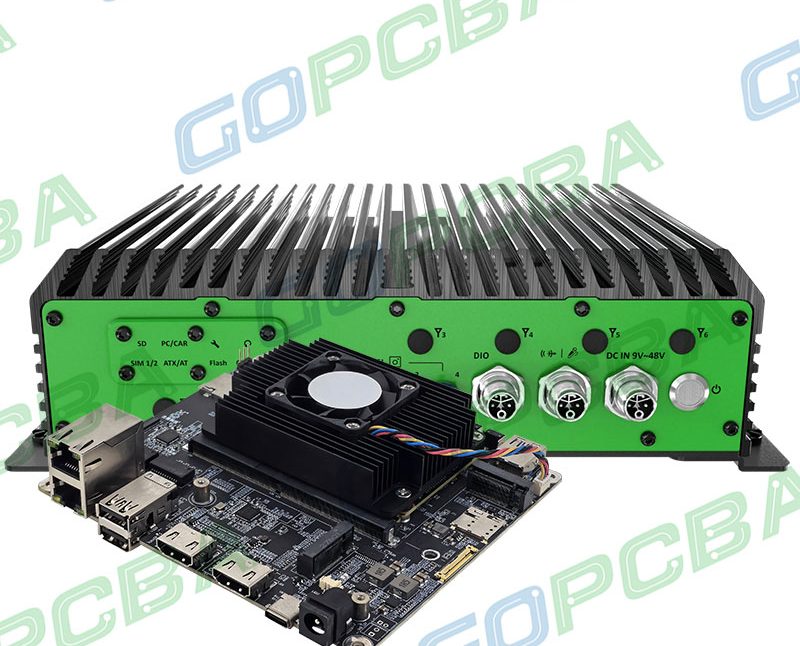
ABS modules combine surface mount and through hole assembly on the same board. The microcontroller and the passive components are surface mount, while the power devices and the connector that interfaces with the hydraulic unit are through hole parts that carry significant current and mechanical load. The through hole joints are also structural, because the connector and the power devices are subjected to vibration for the life of the vehicle.
The reflow profile has to be developed for the mix of a dense microcontroller, large thermal mass devices and small passives, and where selective soldering is used for the through hole parts, the thermal exposure of the already soldered surface mount components has to be controlled. Our PCB assembly group runs both processes.
Process Flow and In Process Control
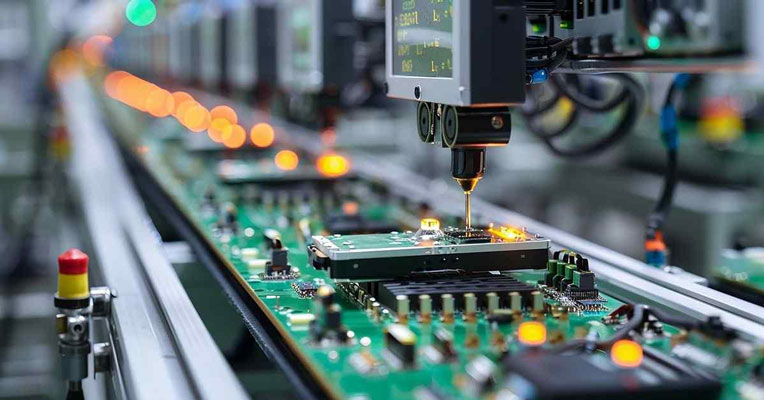
A typical build runs through solder paste printing, high precision surface mount placement, reflow, selective or wave soldering for the through hole parts, and then a cleaning step whose requirements depend on the coating and encapsulation used. In process monitoring at each stage is what holds the yield, because a defect in a safety board cannot be caught later by inspection alone.
Where the environment demands it, conformal coating or potting is applied over the finished assembly to protect it from moisture, salt spray and hydraulic fluid.
Test and Validation
Testing is not negotiable in this application. Automated optical inspection and X-ray verify the joints that cannot be seen, in circuit testing confirms the assembled values and catches placement errors, and a functional test simulates braking conditions through the sensor inputs and the driver outputs.
The tests are carried out over temperature where the specification requires it, because some faults only appear when the board is hot or cold. Our notes on PCBA testing describe how the coverage is planned.
Standards and Compliance
Because the module is safety related, the evidence that accompanies it matters as much as the hardware. Design and process validation, the traceability record for each unit and the control of any change to a component or a process are all part of the deliverable, and they are reviewed by the customer and by the vehicle programme rather than being left to the supplier to hold internally.
Automotive electronics operate under a quality management system such as IATF 16949, with component qualification to the AEC-Q standards and the process control that goes with volume vehicle production. The functional safety requirements of the vehicle programme flow down to the module and influence both the design and the evidence that has to be produced.
For a supplier, this means documented process control, traceability from component batch to finished module and a change management process that does not allow a silent substitution. Our notes on quality management describe the system in place.
New Product Introduction
In the development phase, manufacturability and assembly review before the design is frozen has the largest effect on the eventual yield. Prototype builds verify the assembly process and the functional test coverage, and a pilot run before full production exposes the process issues that a small prototype build hides.
Early engineering involvement also allows the test strategy to be developed alongside the board, which is important because an ABS module needs more test coverage than a typical consumer assembly. Our industrial and automotive PCBA capability covers this path from prototype to volume.
Cost Structure
The cost of an ABS module assembly is set by the board specification, the component content, the assembly density and the depth of testing, with the automotive qualification and documentation adding a fixed element that does not scale away with volume. Prototype quantities are relatively expensive because that fixed work is spread over few units, while volume production reduces the unit cost considerably.
Scale-Up Requirements
The difference between a working prototype and a production programme is consistency. Stable process parameters, automated equipment and a reliable component supply chain determine whether the module can be delivered in volume with the same performance as the first article. Because automotive programmes run for years, the supply chain and the change control process are as important as the manufacturing capability itself.
FAQ
Why is automotive grade assembly required? Because the module is a safety component operating for years in the engine bay, which is beyond what a standard industrial assembly specification covers.
Which standards apply? An IATF 16949 quality system, AEC-Q qualified components and the functional safety requirements of the vehicle programme.
What tests are performed? Automated optical inspection, X-ray, in circuit testing and a functional test that simulates braking operation, with temperature testing where required.
How long does a build take? Prototypes typically take a few weeks including the test development, with volume production scheduled according to the vehicle programme.
Conclusion
An ABS control module is a safety system that happens to be assembled like a power board. Wide temperature materials, a stack-up that separates the sensitive inputs from the solenoid drivers, robust mixed technology joints, thorough testing and an automotive quality system are what allow the module to be trusted with a braking decision.