Small Batch SMT Assembly: Why Changeover Time Sets the Schedule
R&D teams comparing small batch SMT assembly suppliers usually compare price per placement. The number that actually decides whether the batch arrives on time is changeover time: how long the line takes to stop making one product and start making the next one correctly.
Large factories optimise for long runs, and their changeover cost is measured in hours. A pilot order that takes half a day to set up cannot be delivered quickly at any price, which is why the suppliers that serve prototype and pilot production well are the ones that have redesigned the setup step rather than the placement step.
Why Changeover Dominates the Cost of a Small Order
A small batch spends proportionally more of its time in setup than in production. Feeding, programming, stencil mounting, paste verification and first article inspection each consume a fixed amount of effort, and that effort is spread over only a few hundred placements.
When changeover takes hours, the supplier has two unattractive options: refuse small orders, or schedule them in gaps between large ones and accept a long lead time. When changeover takes minutes, small orders fit into the same day as other work and the lead time drops accordingly.
That is the whole mechanism behind the difference between a week and a day for the same board, and it is why asking how the line is set up is more informative than asking for a delivery promise.
What Makes a Fast Changeover Possible
Several engineering decisions reduce setup time. Modular feeder carts allow a product’s material to be prepared offline and rolled onto the machine as a unit. Offline programming and simulation allow the placement program to be verified without occupying the machine. Quick-release stencil frames and pre-set paste parameters remove adjustment from the critical path.
The common theme is that work moves off the machine. Every task performed while the line is stopped appears directly in the lead time, and every task prepared in advance does not.
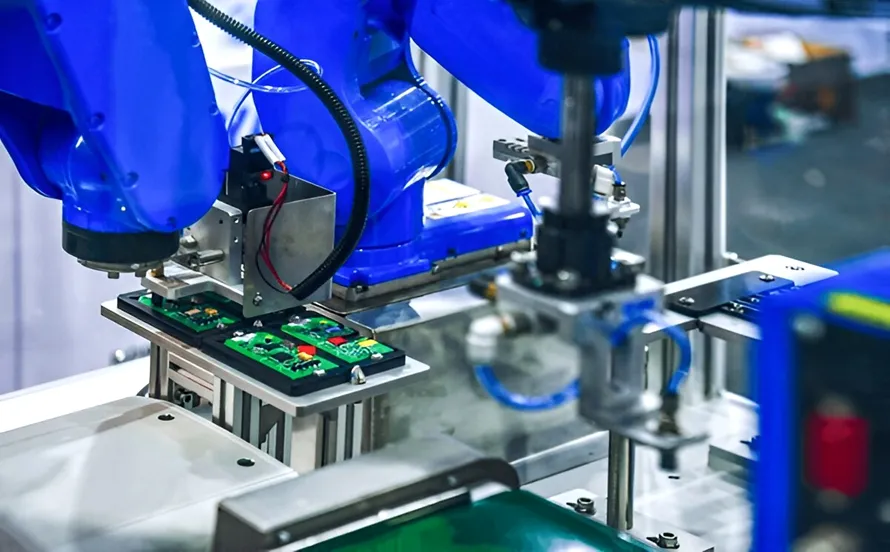
Small batch SMT assembly also benefits from a first article process that uses vision rather than patience. Automated first article inspection, which compares a photograph of the assembled board against the design data, reduces the check from a manual review of hundreds of positions to a short exception review.
Material Kitting for Many Small Orders
Material readiness is the second constraint, and it is the one most likely to be outside the supplier’s control. A pilot build can be stopped by a single missing part even when everything else is ready.
Two practices reduce that risk. The first is a stocked component library covering the common passives, so that routine parts do not have to be purchased for every batch. The second is disciplined components procurement, where part numbers are checked against the design, lifecycles are reviewed and substitutes are proposed with a rationale before the line is scheduled.
Where the customer consigns material, the kit should be checked on arrival rather than on the day of production, because a shortage discovered early is an inconvenience and a shortage discovered late is a missed date.
Engineering Review Before the Line Starts
The review that matters most in pilot production is the one that finds a problem while it is still free. Frequent BOM changes, substitutions in progress and footprint mismatches are normal in R&D, and each one is a candidate for stopping the machine.
A practical review checks the bill of materials against what is physically in stock, compares the parts to the footprints in the design data, confirms the placement coordinates against the current revision, and reviews polarity conventions for the parts that can be installed in more than one orientation.
It also reviews the mechanical side: panel format, fiducials, tooling holes, and whether any component sits where the conveyor or the nozzle path cannot reach it. Those issues are cheap to solve on a drawing and expensive to solve on a stopped line.
First Article Inspection and Verification
First article inspection is where a pilot build proves that the process works, and it should produce a record rather than a verbal confirmation. The record identifies the part, the position, the orientation and the revision, and it becomes the baseline for the next batch.
Repeatability is the point of the exercise. A prototype that was hand assembled proves that the design can work; a pilot build that has been assembled, inspected and PCBA testing verified under a documented process proves that the product can be manufactured.
From Pilot to Volume Without Losing the Recipe
Pilot production exists to de-risk the step into volume. That only works if the pilot data is carried forward: the panel, the stencil, the program, the furnace profile, the inspection settings and the test coverage.
When the pilot build runs on the same SMT PCB assembly process that will handle the later high volume PCB assembly order, the transition is a change of quantity rather than a change of process. When it does not, the qualification work starts again with a new supplier, which is exactly the delay the pilot was meant to remove.
What to Ask a Supplier
- How long a changeover takes on a comparable product, and what is done offline.
- Whether the first article inspection is automated and what the record contains.
- Which components are held in stock and how shortages are reported.
- How the program, stencil and profile are released once the design changes.
- Whether the process can be transferred to volume without re-qualification.
Measure the Setup Effort, Not the Promise
A supplier that answers the turnaround question with a date has told you nothing about how it will be met. A supplier that answers with a description of the setup sequence has told you something that can be checked.
The useful measurement is the line changeover time for a comparable product, broken into its parts: how long the feeder carts take to change, whether the program is prepared offline or on the machine, how the stencil is mounted and verified, and how the paste parameters are confirmed. If those steps are not separated, the total is a guess.
It is also worth asking what happens to the schedule when something is out of place. Material missing, a footprint mismatch, a placement coordinate that does not match the revision: each of these can stop the line, and the difference between a supplier that resolves them the same day and one that resolves them after the next large order is not the price per placement.
A supplier whose process has been designed around short runs will usually also have designed the reporting around them. Changeover steps are prepared in advance, the first article is verified by vision against the design data, and the production record identifies the revision that was built. That combination is what turns a small order from an interruption into a routine job, and it is measurable before the order is placed.
FAQ
What quantity counts as a small batch? It depends on the product, but the defining characteristic is that setup is a significant fraction of the total effort, which is typically the case up to a few hundred boards.
Why does the same board cost more per unit in a small order? Because the fixed setup effort is spread over fewer placements. The comparison that matters is total cost and time to a working product.
Can a pilot build use the production test fixture? It should, wherever the fixture exists or can be built economically, so that the pilot verifies the same criteria as volume.
What most often delays a small batch? A missing or incorrect component discovered late, followed by a design file that changed after the kit was prepared.
Summary
Small batch SMT assembly is a setup problem before it is a placement problem. Ask how the line is changed over, how material readiness is verified, how the first article is confirmed and how the process is carried into volume, and compare those answers with low volume PCB assembly experience rather than with a unit price. The batch that arrives on time is usually the one whose supplier spent the effort before the machine started.