Design for Manufacturability Review: Before Production, Not After
Most of the money lost in electronics manufacturing is lost in the gap between a design that passes a functional test and a design that can be built repeatedly. That gap is what a design for manufacturability review exists to close, and the reason it is often skipped is that its benefits are invisible when it works.
A design that is reviewed before production produces no dramatic story. There is no rework, no batch of boards that has to be re-kitted, no argument about whether a defect belongs to the design or the process. The value shows up as an absence, which is exactly why it needs to be a scheduled step rather than a favour.
What a DFM Analysis Actually Examines
A useful DFM analysis is not a single pass over the layout. It is a structured comparison between the design and the processes that will build it, and it covers several distinct areas that are usually owned by different people.
The first is fabrication compatibility. Minimum trace and space, annular ring, hole size against board thickness, copper weight, solder mask clearance and silkscreen rules are checked against the real process window of the factory that will produce the board, not a generic capability table.
The second is assembly compatibility. Footprint accuracy against the purchased parts, pad geometry for the reflow process, thermal relief on pads connected to planes, component spacing for the nozzle and the rework tool, and the clearance between tall components and the placement head.
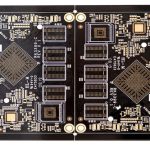
The third is tooling and panelisation. Whether the panel is efficient, whether fiducials are placed where the machine can see them, whether the board can be depanelised without stressing components, and whether the stencil aperture design will deliver the paste volume each pad needs.
The fourth is test and inspection access. Test points that a fixture can reach, programming access that survives assembly, and the ability of the optical or X-ray system to see the joints that matter.

Why the Review Has to Happen Before Tooling
Almost every finding in a DFM review is cheap before tooling and expensive afterwards. A solder mask clearance that is too small costs a line in a file before the panels are made and a new set of panels afterwards.
The same is true of the stencil. Aperture design is the single largest influence on paste volume, and paste volume is the largest single influence on joint quality. Correcting an aperture after the stencil is cut means a new stencil and a re-run of the first article.
Then there is the material question. A review that starts before the kit is ordered can propose a part that places reliably and is available; the same review after the order has been placed can only report the problem.
Reviews also protect the schedule in a less obvious way. Every question raised during the review is answered before production starts, which means the line does not stop when an answer is needed. A stopped line costs more per hour than the engineering time that would have avoided the stop.
Assembly Risk Is Not Only About Placement
Assembly risk is usually discussed in terms of fine-pitch devices and solder defects, and the more common risks are quieter than that.
A connector that has to be hand soldered after reflow adds a manual step, a second inspection and a person-shaped variability. A component that is only available in a tray slows the line and increases handling. A part that must be baked before use adds a process step that is easy to forget and hard to detect.
Thermal mass is another quiet risk. A large ground plane connected directly to a pad draws heat out of the joint during reflow, and the result is a joint that looks acceptable and is not. Thermal relief and pad geometry are design decisions that the assembly team is best placed to comment on.
Even the choice of finish influences risk. A finish that is appropriate for fine-pitch assembly and one that is appropriate for a board that will be hand-modified are not always the same, and the decision should be made with the assembly process in view.
<img src="https://www.gopcba.com/wp-content/uploads/2020/12/site_image_21.jpg" alt="stencil and panel design check” />
Stencil and Panel Design Belong in the Same Conversation
Stencil and panel design are often treated as purchasing details, and they are engineering decisions that affect yield.
The panel has to fit the printer, the placement machine and the oven, carry fiducials that the vision system can register reliably, and provide enough material around each board for the conveyor. Where components sit close to the board edge, the panel design may determine whether special tooling is needed.
The stencil has to deliver the right paste volume to each pad. That means considering the area ratio for small apertures, step-downs or step-ups for connectors and heat sinks, and the treatment of large thermal pads where the paste tends to slump.
When the same partner handles PCB manufacturing and SMT PCB assembly, the panel and the stencil can be designed together with the board, which removes a class of problems that otherwise appears on the first build.
Production Readiness Is More Than a Checklist
Production readiness means that the whole path from data to shipped unit has been thought through: the material plan, the tooling, the process parameters, the inspection plan, the test coverage and the packing.
That is why a DFM review should end with a list of decisions and owners rather than with a score. A finding that is not assigned to anyone is not closed, and an unclosed finding reappears at the least convenient moment.
The list also becomes the agenda for the pilot build. Each item is verified against a real board rather than a drawing, and the evidence is recorded against the revision that was built. Working with a partner that also provides PCBA testing makes that verification measurable instead of visual.
What the Review Should Produce
- A written list of findings, each with a recommendation and an owner.
- Confirmation that the design rules match the process window of the chosen factory.
- Footprint and part verification for the actual bill of materials.
- Stencil and panel design, with the paste volume assumptions stated.
- Thermal and rework considerations for the parts that need them.
- Test and programming access confirmed against the fixture plan.
- A record of what was changed and why, attached to the design revision.
FAQ
When should the review happen? After the layout is complete and before tooling is released. Reviewing an unfinished layout produces findings that will be invalidated by the next change.
Can a design with an imperfect DFM result still be built? Usually yes, with process adjustments and a yield penalty. The review describes the cost rather than forbidding the design.
Is the review the same as an engineering change? No. It produces recommendations; the design owner decides which to adopt and records the decision.
Who should run it? The party that will build the product, ideally with the designer present, so that the reasoning behind a constraint is available.
Summary
A design for manufacturability review is the cheapest engineering work in a program. It turns fabrication, assembly risk, stencil and panel design and test access into explicit decisions before anything is tooled, and it leaves a production readiness record that the pilot build can verify. Skipping it does not remove the problems, it only moves them downstream where they cost more.