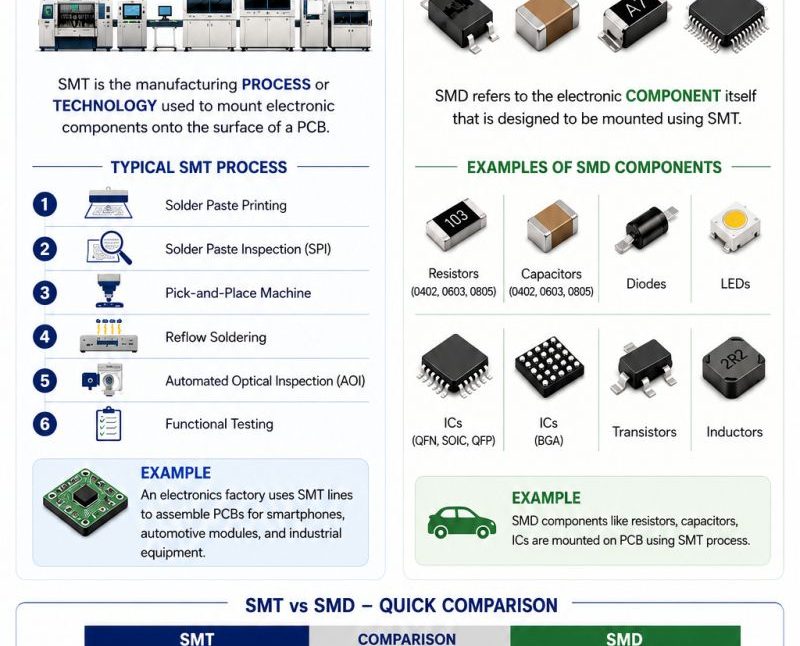
Piece Price Versus Real Cost in Small-Batch SMT
Quotations for small assembly orders are usually compared on one number: the price for each placement. It is a convenient way to compare two suppliers, and on a large, unchanging order it is not far from the truth. On a small order it is misleading, because a large part of the work is not proportional to the number of components at all.
Understanding what sits behind a piece price is what allows two quotations to be compared honestly, and it also shows which changes would reduce the cost and which would not.
What the Figure Contains
A placement price covers the machine time for placing the devices. What it does not cover is everything that has to happen before the first board can be placed: the review of the data, the preparation of the stencil, the creation of the placement programme, the collection and verification of the material, the fitting of the feeders and the verification of the first article.
On a large order, those costs are spread over so many units that they disappear into the price. On a small order they dominate it, which is why two suppliers can quote very different figures for the same board and both be reasonable. One may have the product’s programme and stencil already in place from an earlier order; the other may be building both from scratch.
Material behaves the same way. A reel has a minimum quantity, and if the order needs a fraction of it, the remainder still has to be bought. The difference between the two quotations may lie entirely in how that surplus was treated.
Setup, Programme and the First Article
Setup is the part of the cost that a customer can influence. Where the board arrives with clear data, a defined material list and a settled revision, the preparation is a defined amount of work. Where the data changes during the quotation, or the material arrives in parts, the same preparation is repeated and the cost rises.
The first article belongs in the same category, and it should not be treated as an optional extra. Verifying the device positions, the orientation and the joints before the batch is run is the cheapest form of quality control available on a small order, and the alternative is a batch built with the same error repeated.
This is why a quotation that itemises the material, the preparation and the placement is more useful than a single figure. The itemisation shows where the money goes and what would change it: a larger quantity, a second order for the same product, a customer-supplied stencil or an extended schedule that allows the work to be fitted around a busy line.

What a Fault Costs on a Small Batch
The second omission in a price comparison is the cost of a fault. It does not appear on a quotation, and on a small order it is often larger than the assembly cost itself.
The boards in a first batch are usually the ones used for software work, for the mechanical fit and for the customer’s own demonstration. A board with a cracked joint or an incorrectly oriented component that passes a quick check can send an engineering team in the wrong direction for a week, and that time is more expensive than the difference between two quotations.
At a larger quantity the same question becomes a question of scrap and rework. Where a fault is discovered after the batch is built, the choice is between repairing units and building again, and both are costs that a lower initial price will not offset.
The relevant comparison is therefore not the price of building the boards but the total cost of obtaining boards that work. An engineering review that finds a footprint mismatch, an ambiguous orientation or a part that cannot be sourced is worth more than the small saving it might appear to cost.
Material, Surplus and Attrition in the Figure
Material is where a quotation is most often unclear, and where the differences between two offers usually originate. The relevant questions are simple: is the material supplied by the customer or purchased, and if purchased, at what allowance for attrition and with what treatment of the surplus.
A device with a minimum order quantity is the clearest case. If a reel contains several thousand pieces and the order requires two hundred, the supplier has to buy the reel and account for the remainder. Two suppliers may treat that identically and quote differently, or treat it differently and quote similarly, and the customer cannot tell which without asking.
Attrition is the second part. Assembly consumes parts during setup, during feeder changes and during adjustment, so the material requirement is not the quantity on the drawing multiplied by the number of boards. Where an allowance is stated as a percentage and recorded, the relationship between the two figures is transparent; where it is unstated, a shortfall at the machine becomes a conversation about who pays for it.
Where the customer supplies material, the same allowance has to exist in another form, since material that is short by a handful of pieces stops the run just as effectively as material that was never ordered.
Comparing Two Quotations Properly
The practical method is to make the two quotations describe the same thing. That means asking what is included: whether the material is supplied or purchased, whether the stencil is charged separately, whether the first article verification is included, whether the inspection is optical only or includes X-ray, whether programming and functional testing are part of the price, and how the boards will be packed.
It also means asking about the assumptions. A quotation that is valid only if the material arrives complete and the data does not change is a different offer from one that includes a defined amount of engineering support, and the difference only becomes apparent when one of those conditions fails.
The lead time deserves the same treatment. A slightly higher price for a delivery that arrives when the customer needs it is usually the better offer, and the question of what happens to the date if a material is delayed is worth asking before the order rather than after.
Where the Review Pays for Itself
The parts of the process that do not scale with quantity are also the parts that prevent the expensive mistakes. Reviewing the data, confirming the material, checking the first article and defining the test are all preparation, and they are all cheaper at the quotation stage than at the machine.
That is the argument for treating them as part of the service rather than as optional additions. A supplier who performs them is not adding cost to a small order; they are removing the cost that would otherwise appear later, in rework, in a repeated batch or in a week of an engineer’s time.
The operations involved are SMT assembly for the placement work, PCBA testing for verification and the controls that keep a batch repeatable under quality management.
FAQ
Why does a small order cost more per placement than a large one? Because the data review, the stencil, the programme and the first article do not become cheaper as the quantity falls, so they are spread over fewer units.
How can the cost of a small batch be reduced? By keeping the revision stable during the run, supplying complete data, ordering a second batch for the same product and allowing the work to be scheduled flexibly.
Is a lower piece price ever the right choice? Only after the two quotations have been made to include the same things, and after the cost of a fault has been taken into account.