PCBA Test Services: From Power Check to Functional Verification
A board that has been assembled correctly and a board that works are two different claims. The gap between them is the test stage, and its scope varies enormously between projects: a simple power check on one order, a programmed and functionally verified unit on another, a batch that has to run under load for hours on a third.
A test service is useful when it is defined rather than assumed. What is measured, how it is applied, what counts as acceptable and what is recorded are the questions that decide whether the result can be relied on, and they belong in the order alongside the fabrication data.
Why Testing Belongs in the Assembly Order
The alternative to planning the test is discovering the faults later, in the customer’s hands. A communication interface that does not answer, a rail that is out of tolerance, a device that has been fitted in the wrong orientation or a joint that makes contact intermittently are all detectable at the bench, and all of them are more expensive to resolve after the boards have been packed and shipped.
There is also a diagnostic benefit that is easy to overlook. When testing happens at the factory, a fault can be attributed: to the design, to the material or to the process. When the boards arrive untested, that attribution has to be made without the evidence, and an engineering team will usually begin by suspecting its own design.
The scope can be modest. A power check and a visual inspection performed consistently on every board is more useful than a full examination performed on the first one only.
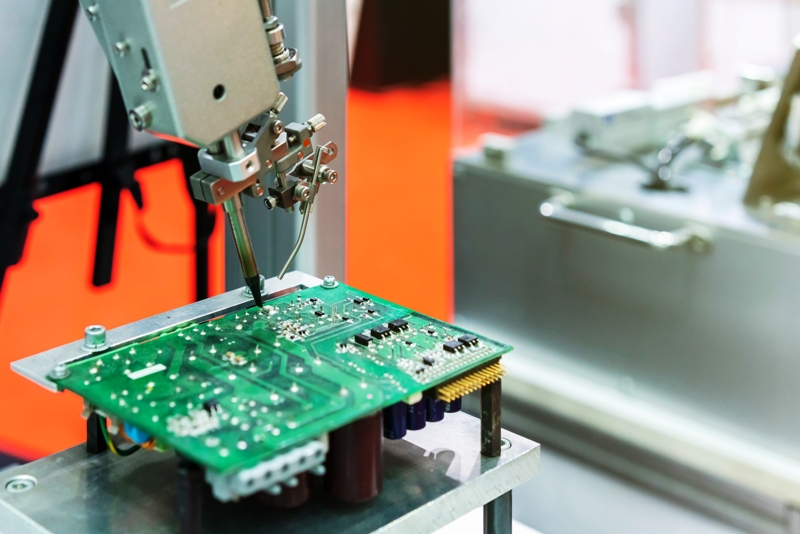
<img src="https://www.gopcba.com/wp-content/uploads/2026/05/Industrial-IOT.jpg" alt="PCBA test service station with a powered board” />
Levels of Test and What Each Proves
It helps to think in levels, because each answers a different question and each has a cost in time.
An unpowered check confirms that the assembly matches the documentation: the devices are present, correctly oriented, and the joints have formed. Optical inspection belongs here, and it is the level that catches the great majority of process faults.
A powered check confirms that the board behaves electrically. The supply rails are within their limits, the current consumption is sensible and the indicators respond. It is the first level at which a design or material problem becomes visible, and it needs nothing more than a supply and a defined set of measurements.
A functional test confirms that the product does what it is supposed to do: that the interfaces communicate, the inputs are read, the outputs act, the sensors respond and the software version is the one that was intended. This is the level that matters most to the customer, because it is closest to the way the product will be used, and it is also the level that most benefits from a written procedure.
Programming as Part of the Sequence
Where the product carries a programme, programming is part of the test sequence rather than a separate favour. The file version has to be stated, the interface defined and the result confirmed, since a board that has failed to programme will behave unpredictably under a functional test and may appear to pass.
The order of the two steps depends on the product. Some boards can be verified without a programme and programmed afterwards; others require the programme before any meaningful test can be applied. Either way, the sequence should be planned, because it determines whether the test can reach the points it needs and whether a coating or an enclosure will later block access.
Fixtures and Repeatability
A test fixture is what turns a test into a repeatable measurement. Without one, each board is connected by hand, and the time per unit grows with the number of points while the consistency falls.
The first version of a fixture does not have to be elaborate. Making the critical connections reliably, providing a defined supply and holding the board in a repeatable position is enough to remove most of the variation. What cannot be omitted is the definition of the pass limits, because a fixture built without them simply automates an opinion.
Test points belong to the layout, and the ones that are reserved during the design phase are the ones that will not have to be improvised later. Supply, ground, the programming interface, the communication lines and the critical signals are the set that covers most requirements.
Ageing, Load and Burn-In
Some faults appear only with time or temperature. A power board that is correct at switch-on may drift once it is warm; a unit that behaves at the bench may fail when it runs continuously in an enclosure.
Running a batch at load for a defined period is the step that exposes those behaviours, and it is particularly relevant to products that will operate continuously, carry significant power or be difficult to service. Where a thermal measurement accompanies the run, the result is a number that can be compared between revisions rather than an impression.
The cost of this stage is time on the bench, and it is worth stating in the order so that it can be scheduled. Where the customer’s own acceptance test exists, the supplier can perform it instead of devising an equivalent, which is usually the better arrangement.
Working With the Customer’s Own Acceptance Test
Many customers already have a way of verifying the product, developed during the prototype stage by hand. That method is the best starting point for a production test, because it encodes the knowledge of what actually matters about the design.
Turning it into something that can be applied to a batch usually involves three changes. The steps have to be ordered so that a board moves through them once rather than being connected and reconnected. The judgements have to become measurements, with a limit that a different operator can apply. And the results have to be recorded in a form that can be reported, which is often as simple as a table with a column for each measured value.
Where the customer’s method relies on equipment that only the customer owns, the alternative is to define the equivalent at the supplier and to reserve the customer’s own test for a sample or for the final product. Stating which of the two applies avoids the situation where a board is tested twice by different methods and the results disagree.
Either way, the definition belongs with the order. A test that was agreed in outline at the quotation stage and interpreted at the bench is the version that produces arguments later, and the version that produces them least often is the one written down before the first board is tested.
Records and the Delivery Document
The output of a test stage is information as well as boards. Which units were built, which were tested, what the results were, how the exceptions were handled and whether a repaired unit was retested are all part of the test record, and they are what makes the delivery describable rather than merely countable.
Where units are individually identified, the record also supports the customer’s own service function, since a returned unit can be matched to its configuration. That capability costs very little at the point of programming and is expensive to reconstruct afterwards.
The operations involved are SMT assembly for the boards, PCBA testing for the verification described here, conformal coating where protection is required and the controls that keep a batch consistent under quality management.
FAQ
Is a functional test necessary on a small batch? It is more valuable there than anywhere else, because the boards are usually the ones used for debugging and demonstration.
How much test coverage is reasonable? As much as can be applied consistently to every board. A short test performed on all units is worth more than a comprehensive one performed unevenly.
What should be sent with the order? The programming file and its version, the interfaces to be used, the steps to apply, the acceptance values and the treatment of a failed board.