Tools for Manual PCB Assembly: The Ten That Matter
Manual assembly never disappeared; it moved. Prototypes, engineering changes, repairs, and small production runs are still built by hand, and the quality of that work depends heavily on the bench rather than on the operator. A defined tool set turns manual PCB assembly from a delicate improvisation into a repeatable process, which matters most when a board has to be rebuilt three times during bring-up.
Why the tool set matters
Four things improve when the right tools are on the bench. Accuracy improves, because placement and soldering are done with support rather than freehand. Efficiency improves, because time is not lost searching for a tool or reworking a joint. Safety improves, for both the components and the operator, since heat and static are controlled. Durability improves, because tools used within their limits last longer and perform consistently.
None of that is about buying the most expensive option. It is about having one tool for each job, and having each tool in a condition that makes the job predictable.
Soldering iron
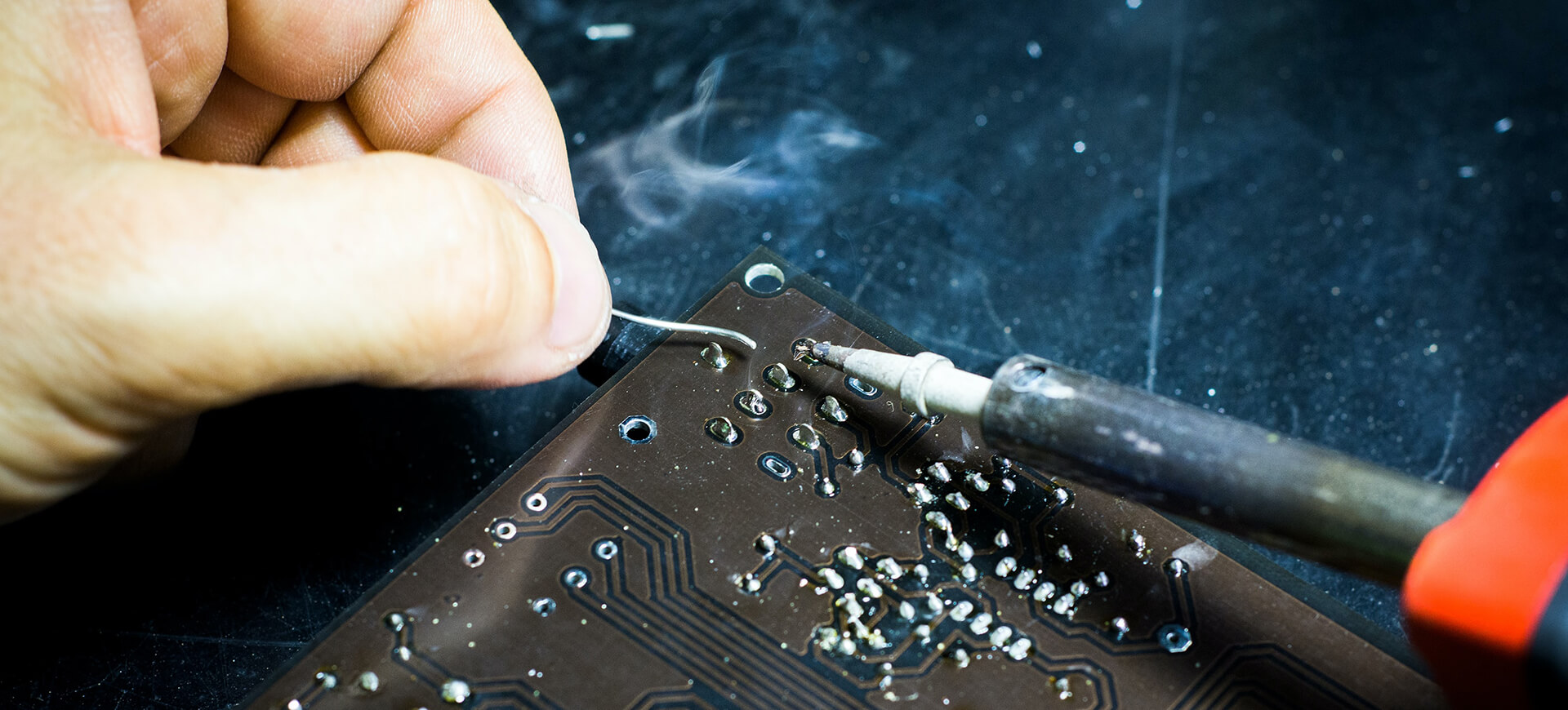
The soldering iron is the core tool. It melts the alloy and forms the joint between the component lead and the pad, and its most important feature is temperature control rather than raw power. A temperature-controlled iron lets the operator match the setting to the alloy and the thermal mass of the joint, which is what keeps joints consistent across a board.
Tip geometry is the second variable. A fine tip reaches small surface mount pads without touching neighbours, while a wider tip transfers heat into a large joint or a ground plane connection. Keeping two tips available covers most work.
Tweezers
Tweezers handle the parts that fingers cannot: chip resistors, small capacitors, and fine-pitch surface mount devices. Anti-static tweezers are the ones to specify, because a tool that holds a charge can damage a sensitive device before it is ever powered.
Fine pointed tips are what make precise placement possible, and a straight tip plus a curved tip covers both placement and removal. Magnetic tweezers are best avoided near magnetic components.
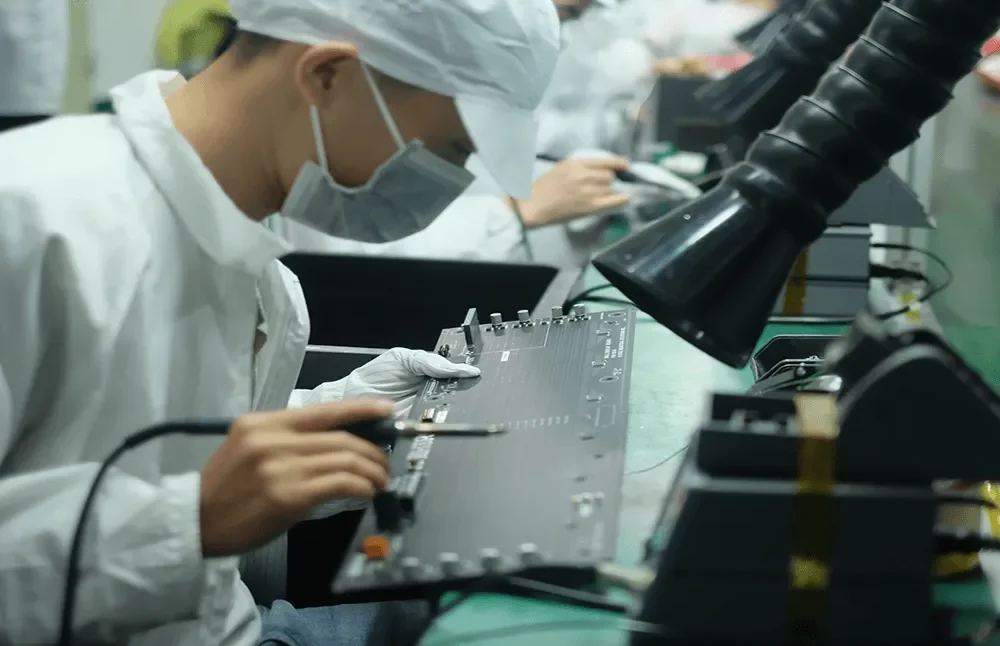
Placement accuracy on a fine-pitch part comes from support and magnification, not from a steadier hand.
Solder station
A solder station is a soldering iron with a regulated supply, a base, and usually a temperature display, and often a desoldering tool on the same platform. Its advantage is a constant tip temperature, which means the joint sees the same heat whether it is the first of the day or the hundredth.
For work that repeats, the station is the difference between a process and an improvisation. Digital temperature setting is worth the small extra cost, because it makes the setting reproducible and therefore reviewable.
Flux pen
Flux is a chemical agent that improves wetting and prevents oxidation during soldering. A flux pen applies it precisely where the joint will be formed, which is cleaner than brushing flux across a board and less wasteful than dipping.
A no-clean formulation avoids the step of washing the assembly afterwards, which is convenient for prototypes and repairs. Where residues are a concern for high-impedance circuits, the flux type has to be chosen with the cleaning process in mind; the differences between alloys and their process requirements are covered in our guide to lead-free versus leaded solder.
Desoldering pump and braid
Mistakes are part of the process, and removing solder cleanly is a skill that depends on the tool. A desoldering pump, also called a solder sucker, generates a vacuum that lifts molten solder off the joint. Used with a little fresh solder applied first, it clears a through-hole pad in one or two attempts.
Desoldering braid handles what the pump leaves behind, wicking the remaining film out of a pad or a fine-pitch joint. Having both on the bench is standard practice, because the pump is fast on bulk solder and the braid is precise on remnants.
Magnifier lamp
Inspection is where manual work is judged, and most defects are too small to see unaided. A magnifier lamp combines magnification with directed light, which makes a partially wetted joint or a shifted component visible before the board is powered.
Adjustable magnification and brightness are worth having, because the requirement changes between inspecting a coarse through-hole joint and checking the alignment of a fine-pitch package.
PCB holder
A holder secures the board and frees both hands, which is the single largest improvement available to manual work. It also stops the board from sliding while heat is applied, which is how pads get lifted.
Adjustable arms and a rotating head allow the board to be positioned square to the operator for each operation, which reduces both fatigue and the chance of touching a neighbouring joint.
Support the board before applying heat. Most damage in manual assembly comes from a board that moved, not from an iron that was too hot.
Cutters and wire strippers
Flush cutters trim the excess lead after a through-hole joint is formed, and a clean cut is what prevents a stray lead from touching a neighbouring trace. Wire strippers remove insulation without nicking the conductor, which matters for any hand-made harness or jumper.
Keeping a separate pair of cutters for component leads rather than using them on wire is a small discipline that preserves the cutting edge, and a sharp cutter needs less force, which reduces the chance of shock-loading a joint.
Multimeter
A multimeter tests continuity, measures voltage, current, and resistance, and diagnoses faults. Before power is applied, a continuity check confirms that the supply rails are not shorted and that the ground connections are real, which is the cheapest protection an assembly can be given.
Auto-ranging makes the instrument faster to use and reduces the chance of a wrong range setting. For current measurement, a clamp accessory avoids breaking the circuit, which is useful once the board is assembled.
ESD-safe workstation
Static discharge damages sensitive devices invisibly: a part can be degraded rather than destroyed, and it then fails in the field. An ESD-safe workstation consists of a dissipative mat and a wrist strap, both connected to a common ground point through a resistor.
The connection is what makes the equipment work, so the ground point should be verified rather than assumed. A mat and a strap that are not grounded provide no protection at all, which is a common finding during assembly setup.
Tool maintenance
Tools are only as good as their condition. Tips are cleaned of oxide and solder residue during use and replaced when the plating wears through, since a worn tip transfers heat poorly and forces the operator to compensate with temperature. Cutters are kept dry, instruments are stored in cases, and measuring equipment is calibrated on a schedule.
The assembly itself benefits from the same planning discipline as the bench. The sequence of placement and soldering, and the way components are positioned before heat is applied, are covered in placement order and pad positioning, while the shift failures that a hand build can hide are described under SMT component shift causes.
FAQ
Do I need an expensive soldering iron? Temperature control matters more than price. A regulated iron with a reproducible setting and two tip sizes handles most manual work, while an unregulated high-power iron is harder to control and more likely to damage a pad.
Is a magnifier lamp enough for inspection? It is enough for placement and joint quality on ordinary packages. For fine-pitch parts and for verifying solder beneath a package, a microscope or X-ray is needed.
How important is ESD protection really? It is the difference between a repair and a mystery. A damaged device often passes first inspection and fails later, which is the most expensive kind of fault to find. Background on the wider assembly flow is available in our guide to the PCBA development process.