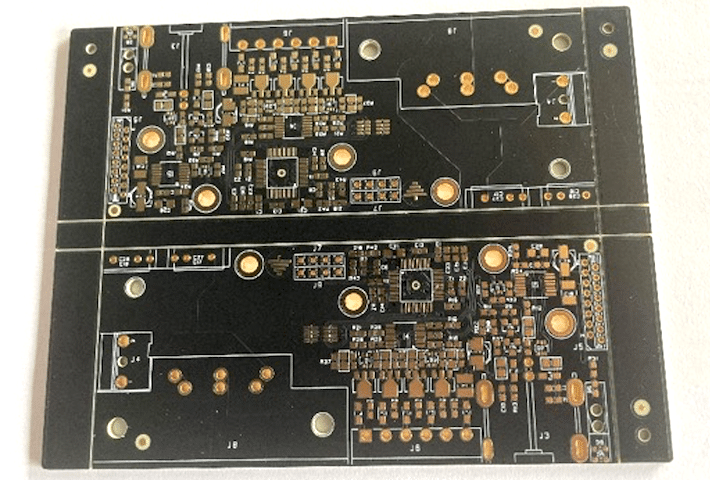
PCB V-Cut: V-Groove Panel Separation Explained
V-cutting is the cheapest way to turn a panel of finished boards into individual units, and it works so well that it is often specified without much thought. The process scores a V-shaped groove along the lines where the boards must separate, leaving a thin web of laminate at the bottom of the groove. The boards hold together through assembly and break apart cleanly when the panel is flexed. What makes it worth studying is that the depth of that groove, and the material left beneath it, decide whether the process produces a clean edge or a cracked board.
How V-Groove Scoring Works
A pair of circular blades, ground to a specific angle, is drawn along both faces of the panel simultaneously. Each blade cuts a groove whose depth is set as a fraction of the board thickness, and because the blades are paired, the two grooves meet around a web of laminate in the middle. The conventional depth is one third of the total thickness from each side, which leaves one third in the centre as the web that holds the panel together.
The angle of the blade determines how the finished edge looks. A thirty degree included angle produces a narrow edge that fits closely into a housing, while a forty five or sixty degree blade produces a wider opening that is more tolerant of panel thickness variation and easier to break cleanly. Because the blade is a fixed geometry, the angle has to be chosen before the panel is ordered, and the opening at the surface grows with the depth of the cut.
Depth, Thickness and What Goes Wrong
The groove depth is the parameter that controls the result. Cut too shallow and the boards will not separate cleanly, leaving torn laminate and protruding copper along the break line. Cut too deep and the remaining web is too thin to survive handling, so boards fall apart in the assembly line or crack along the score during reflow.
Thickness tolerance matters because the blades are set relative to the panel surface. A laminate that is thicker at one end of the panel than the other will produce a groove that is too deep at one edge and too shallow at the other, and that variation is a property of the laminate rather than of the scoring machine. Where the product requires a tight edge, the panel thickness tolerance has to be quoted tightly and the scoring depth confirmed on a sample before the run begins.
Panel Design Rules for V-Cut
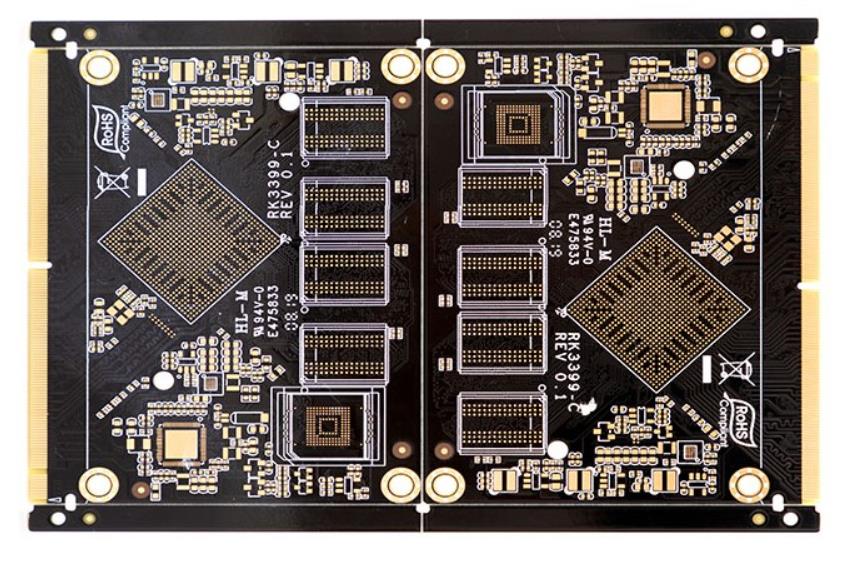
The score line must be a straight line across the panel, which means the boards have to be rectangular where they meet or must be separated by a routed contour instead. Corners, curves and internal cut-outs cannot be produced by a V-cut, so a typical panel uses routing for the shaped outline and V-cutting only for the straight separations between identical rectangular units.
Components and copper have to be kept clear of the score line. The rule of thumb is to leave at least the board thickness of clearance on each side, and more where the parts are tall or where a large component sits close to the edge, because the bending stress at separation concentrates at the score. Copper that crosses the score line will be fractured when the panel is broken, so no trace, plane or pad should cross it. Our design release checklist lists the clearance items that should be checked before the panel is released.
Depanelisation Methods
V-scored panels can be separated by hand, by a purpose-made breaker or by a machine. Breaking by hand is acceptable for small panels with no near-edge components and is the cheapest option, but it produces an uncontrolled bend and the resulting stress propagates into the board. A manual breaker applies the force along the score line through a controlled lever, which is much gentler and is the usual choice for short runs.
For volume production, a motorised depaneliser or a router is used. The router removes the material entirely rather than cracking it, so it leaves a clean edge with no residual stress, at the cost of dust generation and a slower cycle. Many panels combine the two, using routing for the outer contour and the irregular gaps and scoring only the long straight runs. Our component tolerance and reliability notes describe how the stress at separation is assessed.
V-Cut or Routing: Choosing Between Them
V-cutting wins on cost and on edge quality where the separator lines are straight. It requires no dedicated tooling beyond the blades, it adds almost nothing to the panel price, and it leaves a clean bevel that does not produce the fibrous edge that routing can. It is also fast, because the blades run along the whole panel in a single pass.
Routing wins whenever the geometry is not rectangular. Curved outlines, internal cut-outs, tabs with mouse bites and boards that must be separated without any bending stress all require a router. It also consumes more panel area, because the cutter needs a path and the tabs that hold the board in place occupy space that cannot carry components. Where a panel contains both straight separations and complex outlines, the usual answer is to use both processes on the same panel.
Inspection and Handling
Inspection of a V-scored panel is largely dimensional. The depth of the groove and the remaining web thickness are measured on samples with a depth gauge or by cross section, and the width of the opening at the surface is checked against the drawing. Visual inspection looks for chipping along the groove, for copper exposed by an over-deep cut and for laminate delamination at the score, which indicates that the blade was dull or that the panel was cut with too much pressure.
Handling matters as much as inspection. A scored panel is much weaker than an unscored one along the score lines, so it should be supported during printing, placement and reflow rather than carried by one of the units. Panels that are scored only on one side, which is done where a second pass would damage an assembled section, break with a rougher edge and must be handled accordingly.
Tooling, Cost and Panel Yield
V-scoring needs no tooling beyond the blades, which is why it adds so little to the price of a panel. The cost appears instead in the panel layout: a scored panel must provide straight separation lines for the whole length of each cut, and the clearance required around those lines prevents components from being placed right up to the board edge. Panelising a design therefore trades usable board area against simplicity of separation, and the trade is usually worth making on small rectangular boards and rarely worth making on awkward shapes. Our cost reduction notes describe how the panel arrangement affects the overall price of a build.
FAQ
How deep should a V-cut be? The conventional depth is one third of the board thickness from each face, leaving one third in the centre. Thicker boards and boards with dense near-edge components often use a shallower cut to keep the web strong.
Can V-cut lines cross each other? Not in the same pass, and not really in practice. Crossing scores remove the web at the intersection and the panel falls apart there, so panels are designed so that the score lines run either parallel or perpendicular without conflicting.
Why did my boards crack when I broke the panel? Almost always because a component, a via or a plane was too close to the score line, or because the panel was broken by hand with an uncontrolled bend and the stress travelled into the board rather than along the groove.