CEM-1 PCB: Manufacturing and Assembly Guide
CEM-1 is the laminate that sits between paper-based phenolic board and woven glass FR-4, and it exists because a large part of the electronics market does not need the mechanical performance of FR-4 but does need something better than paper. It is a composite: a woven glass cloth on one or both surfaces with a core of non-woven glass and resin between them. The result is a board that punches and drills more easily than FR-4, costs less, and still has enough mechanical strength for a single-sided product.
What CEM-1 Actually Is
The designation comes from a standard classification of composite laminates. CEM-1 uses a single ply of woven glass cloth on one surface and a core of non-woven glass fibre with epoxy resin, which distinguishes it from CEM-3, which has woven cloth on both surfaces and is closer to FR-4 in behaviour. The resin is usually epoxy, which gives it better electrical properties and better moisture resistance than the phenolic materials it replaced.
Because the core is non-woven, the material can be punched rather than routed or drilled, which is its main economic advantage. Punching is far faster than drilling for high volume production, and the tooling cost is amortised over a large number of parts. For a simple single-sided board produced in millions, that difference is the whole reason the material exists.
Properties and How They Compare
The mechanical strength is lower than FR-4 and the material is more brittle, so it does not tolerate flexing well and it is unsuitable for thin large boards. Its dielectric constant is close to that of FR-4, so it is electrically adequate for low frequency and low speed circuits, and its loss is not specified for high frequency work because it is not used there.
The glass transition temperature is lower than a standard FR-4, typically around a hundred degrees, which limits the soldering processes it can tolerate. Wave soldering is routine, but a board that will be reflowed may need a higher grade. The moisture absorption is higher than FR-4 and the material is more susceptible to the effects of humidity over time, which matters for a product that will be used in a damp environment. Our laminate material properties article describes how those figures are compared.
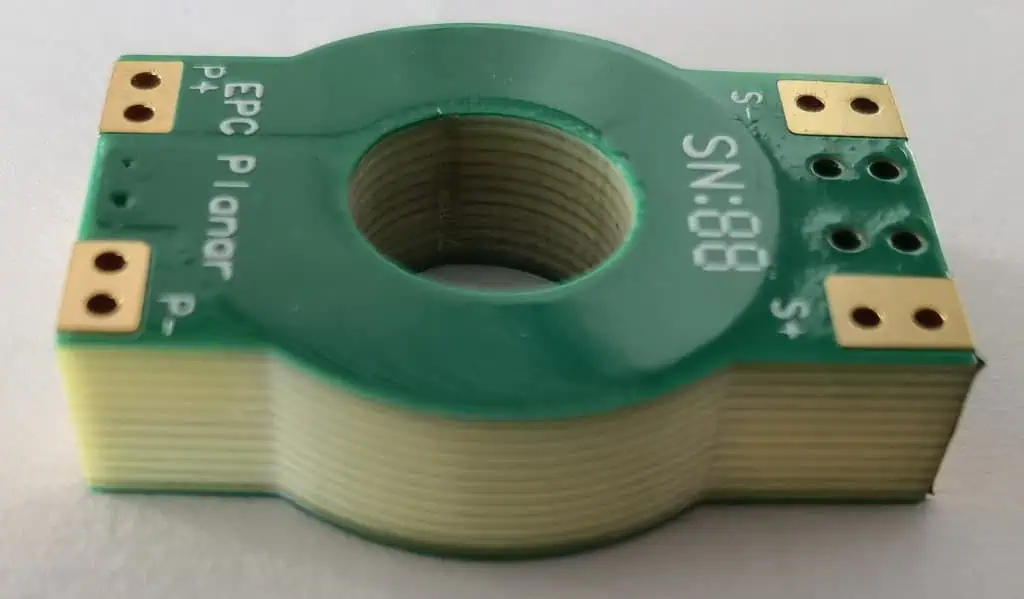
<img src="https://www.gopcba.com/wp-content/uploads/2026/08/rigid-flex-pcb-design-guidelines-1.webp" alt="CEM-1 PCB composite laminate cross section” />
Where It Is Used
The natural application is high volume, low complexity, single-sided consumer products: power supplies for small appliances, remote controls, toys, simple lighting and adapters that are sold in millions. In those products the circuit is a handful of components and the board’s job is to hold them in place and connect them, and a material that punches cleanly and costs less is exactly what is needed.
It also appears in products where the mechanical requirement is modest but the cost pressure is severe, and where a paper based board would not be reliable enough. The decision is usually made on volume and on the assembly process rather than on the electrical performance, because the electrical performance is adequate in all of these cases.
<img src="https://www.gopcba.com/wp-content/uploads/2026/08/1735553947022.jpg" alt="punched single sided CEM-1 board with components” />
Manufacturing and Assembly Considerations
Punching requires a die, which is a capital cost that only makes sense at volume. The punch produces a clean hole with no smear, so the desmear step of a plated through hole process is unnecessary, and many CEM-1 boards are single sided for that reason. Where a double sided board is required, the material can be drilled and plated, though the process window is narrower than for FR-4.
The lower glass transition temperature affects the assembly profile. The board softens at a lower temperature, so the time above the resin’s transition has to be kept short and the thermal mass of the assembly has to be considered. A design that works on FR-4 may warp on CEM-1 if it is reflowed with the same profile, and the panel support arrangements that work for a rigid FR-4 board may not be adequate. Our design release checklist places those checks in the review sequence.
Design Rules for a Punch-Friendly Product
Design for punching means keeping the hole sizes within the range the tool handles and keeping the hole positions on a grid that the die can accommodate. Small holes are more difficult to punch cleanly and the tool wears faster, so the minimum hole size is larger than it would be for a drilled board. Clearances between holes and between a hole and the board edge are also larger, because the punch exerts a mechanical force on the material around each hole.
The copper pattern follows the same logic. Since the board is usually single sided, the layout has to cope with crossovers using links or zero-ohm resistors, and the trace widths are more generous than on a dense double-sided board. That simplicity is a feature rather than a limitation in this market, because it also reduces the number of ways the design can go wrong.
Cost Structure and When to Choose It
The material costs less than FR-4, punching is cheaper than routing at volume, and the simpler process means fewer steps and less handling. Set against that is the die cost, which is only recovered at high volume, and the limited capability, which rules out fine pitch, controlled impedance and multiple layers.
The choice is therefore straightforward in practice. If the product is a simple single-sided board produced in large numbers and the assembly is wave soldered or hand soldered, CEM-1 is likely to be the cheapest material that will do the job. If any of those conditions fails, FR-4 is usually the answer, because the cost difference is small relative to the consequences of a material that cannot meet the requirement.
Reliability and Failure Modes
The failures that appear on a CEM-1 board are usually mechanical or thermal rather than electrical. A punched hole that is too close to the board edge can crack the laminate, and a board that is supported poorly during wave soldering can warp enough to move the holes relative to the components. Thermal damage appears as a discoloured or delaminated area around a component that ran hot, because the resin system has a lower tolerance for sustained heat than an FR-4 resin.
Moisture is the other long term concern. The material absorbs more water than FR-4, and in a humid environment that changes the leakage and the dielectric behaviour over time. For a low voltage, low impedance circuit that is irrelevant; for a high impedance input it can matter, and the design should avoid exposing high impedance nodes to the surface of a moisture absorbing laminate.
Quality Control for Punched Boards
Inspection concentrates on the mechanical features rather than on fine conductors. Hole diameter and position are measured against the die drawing, the edge quality is checked for cracking or delamination and the board thickness is confirmed. Because a punched board has no plated barrels in most cases, there is no cross section to measure and the acceptance criteria are dimensional.
Electrical test is usually continuity on the copper pattern rather than an exhaustive net test, since the circuits are simple and the number of nets is small. The test that adds most value is the assembly trial rather than the bare board test, because the interaction between the board and the soldering process is where a CEM-1 design usually reveals its problems. Our design release checklist covers the items to confirm before the design is released for manufacture.
FAQ
Is CEM-1 the same as FR-4? No. CEM-1 has a non-woven core and a single woven glass surface, and it is mechanically weaker with a lower glass transition temperature. FR-4 is woven glass throughout.
Can CEM-1 boards be multilayer? Technically yes, but the mechanical and thermal limitations make it unattractive. Multilayer work uses FR-4 or a higher grade material.
Why is CEM-1 cheaper than FR-4? Because the material costs less and because it can be punched rather than drilled, which is much faster at high volume. The saving depends on the volume, since the die has to be paid for.