FR4 Sheet Material: Grades, Standards and Machining Methods
FR4 is familiar as the laminate under every ordinary circuit board, but the same material has a second life as an engineering sheet. Cut, drilled and machined into parts, it becomes stiffeners, insulating spacers, drilling backup boards and test fixtures. Understanding the grade, the standard behind it and the machining options turns an anonymous yellow sheet into a specified material.
FR4 as an Engineering Material
The material is sold under many names depending on the application: epoxy glass cloth, epoxy board, glass fibre board, flame retardant insulating sheet, and in flexible circuit work simply as stiffener material. The variety of names reflects the variety of uses rather than any difference in the base product.
What makes it useful outside a circuit board is its combination of properties. It is a stable electrical insulator, it holds its dimensions, it is flat and free of pits on a properly laminated surface, and its thickness is controlled to a published tolerance. It also machines well, which is what allows it to be produced in small quantities as mechanical parts rather than only in large laminated panels.
What FR4 Actually Is
FR4 is a laminated sheet made by impregnating a dedicated electronic-grade glass cloth with epoxy and phenolic resin and consolidating it under heat and pressure. The glass cloth provides mechanical strength, while the resin binds the layers, provides the electrical insulation and carries the flame retardant chemistry that the designation implies.
The result has good mechanical and dielectric properties, reasonable heat and moisture resistance, and good machinability. Those four characteristics explain most of its applications. It performs reliably in humid conditions and in transformer oil, which is why it appears in electrical equipment as insulating structural parts as well as in electronics. It is also readily bonded and machined with ordinary tooling, which keeps the cost of short runs low.
Standards: NEMA, IEC and the 3240 Equivalent
The designation originates in a classification published by the American electrical manufacturers association, which groups industrial laminates by composition and performance, so a NEMA grade is the usual way to describe the material in North American practice. The corresponding international classification differs in detail, which is why the two are usually quoted together.
The international equivalent most often cited is EPGC202, the IEC grade for flame retardant epoxy glass cloth laminate. Neighbouring grades differ mainly in their flame retardant performance rather than in their mechanical or electrical behaviour, so substitution between them changes the fire rating rather than the strength. A similar national standard widely used in China corresponds to a different IEC grade, and the distinction between the two is again the flame retardancy requirement. In practice this means FR4 can be understood as the flame retardant variant of that family, which is exactly why it replaced earlier materials in circuit board work.
Colour, Thickness and Surface Options
The natural colour of the laminate is a pale yellow-green, and that is what most people picture. Sheets are also produced in white, black, blue and other colours, which are usually specified for identification, for appearance in a visible part, or to distinguish grades in a workshop where several materials are stored together.
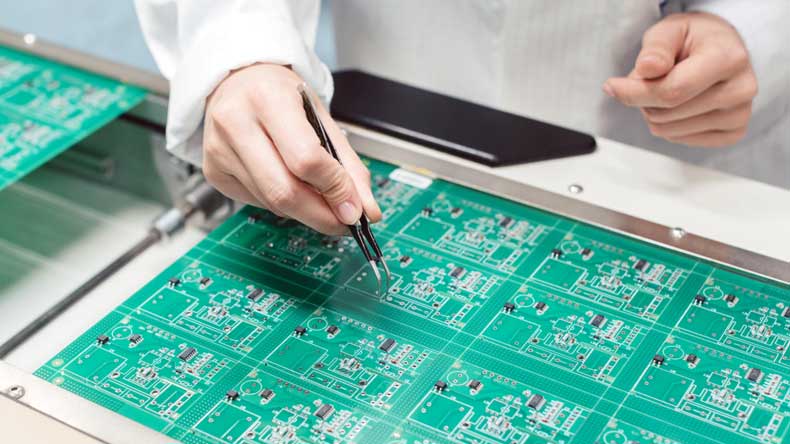
Thickness is controlled to a tolerance rather than to a single value, and the tolerance matters disproportionately in machining. A part that is assembled between two surfaces needs to be within a defined thickness band, and a sheet ordered only by nominal thickness may not satisfy it. Surface quality is the other specification: pits, scratches and resin-rich or resin-starved areas all affect both appearance and, in thin sheets, dielectric performance. Material selection for circuit boards themselves is covered in PCB material requirements.
Machining Methods: Drilling and CNC Routing
Drilling is the most common operation, and it appears in almost every process route. A fabricator machining the material typically operates a dedicated drill area with its own machines, drill bits, backing boards and consumables. The consumables dominate the cost: bits wear quickly, and the backing material beneath the sheet is consumed with every hole.
CNC routing is the most flexible method and, for flat parts, the most widely used. It cuts outlines, pockets and slots to tight tolerance and can produce curved profiles that drilling cannot. Curved or angled surfaces are also possible, though the range of work in that direction is narrower. The principal advantage is that a programme can be changed instantly, so a router handles prototypes and short runs without tooling cost. Cutting principles for board outlines are described in PCB slot and edge routing rules.
Shearing, Milling, Turning and Engraving
Shearing is the cheapest and least precise method. A guillotine or shear cuts the sheet to size, and the achievable tolerance is loose, on the order of a few millimetres. It is entirely adequate for rectangular blanks and completely unsuitable for anything with features, which is why shops that rely on it produce only simple pieces.

Milling and turning come from metalworking and are slow on laminate. They are nevertheless essential for fixtures and for thick sections where a router is not rigid enough, and for cylindrical parts such as insulating rods and spacers. Engraving machines form the last category: a computer, a controller and a machine tool combine to drive a high speed spindle along a programmed path in three axes, cutting the sheet with tooling selected for the abrasive glass reinforcement. The same setup produces flat or relief shapes and lettering, and the process is readily automated. Material and resin differences that affect machining behaviour are described in FR-4 versus G-10 laminate.
Applications: Stiffeners, Backup Boards and Fixtures
Flexible circuits rely on the material as an FPC stiffener, where a piece of laminate is bonded behind a connector or a component area to provide rigidity that the flexible film cannot. The thickness of the stiffener then becomes a mechanical design parameter, since it sets the height of the connector above the film.
Circuit board drilling uses it as a backup board beneath the stack, supporting the copper foil and the exit side of each hole to reduce burring. Test fixtures and jigs account for another large share, because the material is dimensionally stable, insulating and easy to machine into supports and locating features. Insulating parts for motors, switches and electrical equipment complete the picture, along with carbon film printing substrates and precision washers and gears where an insulating, wear-resistant, machinable material is required. The relationship of the sheet to the copper it carries in circuit work is described in prepreg versus core.
FAQ
Is FR4 sheet the same as a circuit board substrate? It is the same base laminate. Circuit boards add copper foil, a solder mask and a legend, while machined parts use the bare sheet as received.
Which machining method should be specified? CNC routing for anything with features or curves, shearing for plain rectangular blanks where tolerance is loose, and milling or turning for thick sections and cylindrical parts.
Why does thickness tolerance matter for machined parts? Because a part assembled between two surfaces must fit within a defined band. A nominal thickness with a wide tolerance can fall outside the assembly gap even though it matches the order.