Assembly Floor Contamination Control: Sources and Countermeasures
Contamination on the assembly floor is rarely dramatic. It arrives on a hand, in a cleaning cloth, from a nearby machining operation, or from an air line, and it accumulates until a batch fails a humidity test for a reason nobody can identify.
Why Contamination Matters
Ionic contamination provides the electrolyte for electrochemical migration. It also reduces the adhesion of any coating or adhesive applied afterwards, and it changes the surface energy that soldering depends on.
Non ionic contamination, including oils and silicones, does not cause migration directly. It prevents coatings and adhesives from adhering, which removes the protection that the design assumed.
Particulate contamination causes shorts when a conductive particle bridges two features, and it causes defects when a particle sits between a component and its pad. These failures are intermittent and are among the hardest to investigate.
Sources on the Floor
People are the largest source. Skin oils, salts and hair are shed continuously, and clothing that has not been selected for the environment sheds fibres that are conductive in the quantities present near a fine pitch assembly.
Equipment is the second source. Lubricants from conveyors and feeders, particles from the wear of belts and guides, and the exhaust of a soldering process that is not adequately extracted all contribute.
Materials are the third. Packaging that sheds particles, cleaning cloths that leave fibres, and adhesives and coatings that are applied nearby all add to the load. Our fabrication notes describe the handling requirements that accompany the boards.
<img src="https://www.gopcba.com/wp-content/uploads/2024/09/9-1.png" alt="Operator handling a board with gloves at a clean bench” />
Architectural and Process Controls
The strongest control is to separate the dirty operations from the clean ones, physically and with airflow. Machining, soldering and any operation that generates particles belong away from the assembly and inspection areas.
Airflow should move from the cleanest area toward the dirtiest, so that particles are carried away rather than toward the boards. This is a room design decision and it is difficult to correct later.
Where the requirement is high, a laminar flow bench over the critical operations provides local protection regardless of the room. It is cheaper than upgrading the whole room and it protects the boards that need it.

Handling Discipline
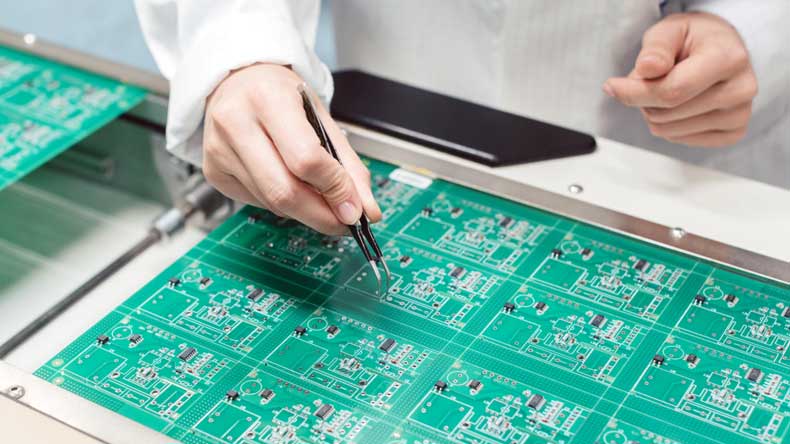
Gloves are required for any board that will be coated or stored, and the glove material must be selected so that it does not leave residue. Powdered gloves are not acceptable for electronic assembly.
Boards should be held by the edges, and a board should never be placed face down on a bench. A mat that visibly collects dust is a mat that transfers dust to the next board.
Where a board has been dropped, it should be inspected rather than returned to the flow. A dropped board is a board with an unknown history. Our quality notes describe the inspection that follows.
Cleaning Cloths, Solvents and Air
Cleaning materials should be selected for their particle and residue behaviour, not only for their solvent properties. A cloth that leaves fibres turns a cleaning operation into a contamination operation.
Compressed air used to dry a board must be filtered and dry, because an air line carries oil from the compressor and water from condensation. Both are deposited directly onto the board.
Solvent used for cleaning should be fresh and of the correct grade. A container of used solvent redistributes the contamination it has collected rather than removing it. Our solderability test notes describe how the surface condition is measured.
Monitoring
The ionic contamination test gives a quantitative measure of the accumulated ionic load, and it can be applied to a board at the end of the process and to the process itself.
Particle counters and settled dust measurements characterise the environment, and a change in either indicates that a control has failed. The measurements are most useful as trends.
Coating adhesion testing after a contamination event is the check that shows whether the surface condition was affected, and it is more sensitive than an inspection. Our coating notes describe the adhesion tests used.
When a Contamination Event Occurs
Identify the source before cleaning the boards, because the cleaning method depends on the contaminant. A water soluble residue needs water, an oil needs a solvent, and a silicone needs a specific chemistry.
Quarantine the affected units and establish whether the contamination occurred before or after the process step that mattered. Contamination that arrived before coating invalidates the coating, and one that arrived after does not.
Record the event and the corrective action. The next occurrence is then handled by referring to the previous one rather than by starting the investigation from scratch, which is what makes a mature process different from a busy one.
Process Control and Verification
On a design of this kind, handling is the item that decides how the rest of the board is arranged. The measurements that matter are the repeatable ones: conductor width and spacing, annular ring, finished hole size, plating thickness and surface finish are all verifiable on a coupon that travels with the panel. Running a first article through the same checks as the production panel confirms that the two agree, and that comparison is the cheapest form of process control available at prototype stage.
Keeping a sample from the panel turns a dispute into a measurement, because the same coupon can be re-examined by both parties without rebuilding the batch. Reviewing the design before the data is released is cheaper than correcting it after the panel is in the tank, because every step downstream inherits the decision made at the front end.
Documenting the assumption is part of the design work, and a short note on the drawing prevents a question that would otherwise arrive a day later and cost a day of schedule.
Process Control and Verification
On a design of this kind, handling is the item that decides how the rest of the board is arranged. The measurements that matter are the repeatable ones: conductor width and spacing, annular ring, finished hole size, plating thickness and surface finish are all verifiable on a coupon that travels with the panel. Running a first article through the same checks as the production panel confirms that the two agree, and that comparison is the cheapest form of process control available at prototype stage.
Keeping a sample from the panel turns a dispute into a measurement, because the same coupon can be re-examined by both parties without rebuilding the batch.
Process Control and Verification
On a design of this kind, handling is the item that decides how the rest of the board is arranged. The measurements that matter are the repeatable ones: conductor width and spacing, annular ring, finished hole size, plating thickness and surface finish are all verifiable on a coupon that travels with the panel. Running a first article through the same checks as the production panel confirms that the two agree, and that comparison is the cheapest form of process control available at prototype stage.
FAQ
Is a controlled area necessary? For a fine pitch assembly with a coating requirement, yes. For a coarse board with no coating, a clean bench and handling discipline are usually sufficient.
Does cleaning fix every contamination event? It removes what it can reach. Contamination inside a connector or under a component may not be removable, and the affected units should be assessed on that basis.
What does gopcb provide for contamination control? We provide documented handling and glove requirements, separated process areas with controlled airflow, filtered and dried air, cleaning materials selected for residue behaviour, ionic contamination testing and coating adhesion testing as verification.