Potting and Encapsulation of PCB Assemblies
Potting and encapsulation surround the assembly with a material that protects it from moisture, contamination and mechanical damage. They also change the thermal path, the serviceability and the stresses on the components, and none of those effects is reversible.
What Encapsulation Buys
The material excludes moisture and contaminants from the surface, which stops the electrochemical processes that would otherwise attack the conductors and the joints.
It also supports the components mechanically and raises the dielectric strength of the assembly, which matters where the product is used at altitude or in a polluted environment. Our corrosion notes describe the mechanisms it prevents.
Material Families
Epoxy is hard, strong and dimensionally stable, and it transfers stress into the components because it does not move. Polyurethane is softer and it absorbs more, which suits assemblies with fine wires and large parts.
Silicone is the most compliant and it holds its properties over the widest temperature range, and it is the usual choice where thermal cycling dominates. The choice follows the stress the assembly will see rather than the cost of the material. Our coating notes describe the thinner alternative.
Thermal Effects
The encapsulant changes the thermal resistance from the components to the outside. A material that conducts well spreads the heat and can reduce hot spots; one that insulates traps the heat and raises every junction temperature.
The thermal expansion of the material also matters. A hard encapsulant with a different expansion from the laminate applies stress to the solder joints at every thermal cycle, and the stress is repeated for the life of the product.
Process
The assembly must be clean and dry before it is encapsulated, because the material seals in whatever is on the surface. Moisture left under a coating becomes a defect that cannot be removed later.
The fill must reach everywhere, including under components and into connectors that are meant to be filled. Vacuum assistance and a controlled pour or injection are used where the geometry is difficult. Our conformal coating notes describe the surface preparation that precedes both processes.
Curing
The cure schedule decides the final properties. An incomplete cure leaves the material soft and permeable, and it is usually the result of a mass that is too large for the oven time or a mixing ratio that was approximate.
The cure should be verified on a sample rather than assumed from the schedule, by hardness or by a thermal measurement. Our quality notes describe how the verification is recorded.
Serviceability
Encapsulation is close to permanent. A fault found after potting usually means the assembly is scrapped, so the decision to pot should be taken knowing that repair is no longer possible.
Where repair has to remain possible, the options are a local coating, a removable material, or a design that keeps the repairable parts outside the encapsulated volume. Our repair strategy notes describe the trade.
Verification
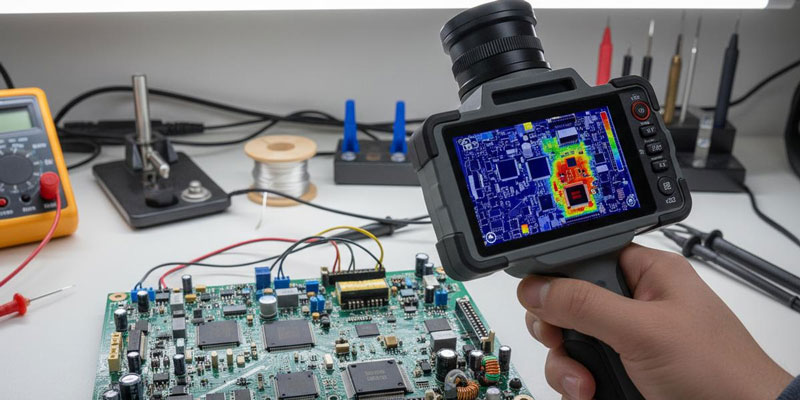
The verification is visual for voids and incomplete fill, thermal for the junction temperatures, and environmental for the protection that was the reason for the material.
A cross section of a potted sample shows the fill and the voids better than any external inspection, and it should be part of the qualification rather than an investigation after a failure.
Process Control and Verification
On a design of this kind, cure is the item that decides how the rest of the board is arranged. Documenting the assumption is part of the design work, and a short note on the drawing prevents a question that would otherwise arrive a day later and cost a day of schedule. The process window is set by the narrowest step in the flow, so an improvement anywhere else shows up as margin rather than as yield until that step is addressed.
A short note on the drawing about handling, storage or packaging is often worth more than an extra decimal place on a tolerance. Where a value sits close to a process limit, the drawing should say so, since the shop can then open the process window rather than working to a nominal figure that carries no tolerance.
A stack-up that is drawn rather than described removes most of the ambiguity from a quotation, and it lets the fabricator price the board against the dielectric and copper weights that will actually be used. Where the requirement is not written down, the shop supplies its own default, and the default is chosen for the process rather than for the design.
The measurements that matter are the repeatable ones: conductor width and spacing, annular ring, finished hole size, plating thickness and surface finish are all verifiable on a coupon that travels with the panel. Running a first article through the same checks as the production panel confirms that the two agree, and that comparison is the cheapest form of process control available at prototype stage.
Process Control and Verification
On a design of this kind, cure is the item that decides how the rest of the board is arranged. Documenting the assumption is part of the design work, and a short note on the drawing prevents a question that would otherwise arrive a day later and cost a day of schedule. The process window is set by the narrowest step in the flow, so an improvement anywhere else shows up as margin rather than as yield until that step is addressed.
A short note on the drawing about handling, storage or packaging is often worth more than an extra decimal place on a tolerance. Where a value sits close to a process limit, the drawing should say so, since the shop can then open the process window rather than working to a nominal figure that carries no tolerance.
A stack-up that is drawn rather than described removes most of the ambiguity from a quotation, and it lets the fabricator price the board against the dielectric and copper weights that will actually be used.
Process Control and Verification
On a design of this kind, cure is the item that decides how the rest of the board is arranged. Documenting the assumption is part of the design work, and a short note on the drawing prevents a question that would otherwise arrive a day later and cost a day of schedule. The process window is set by the narrowest step in the flow, so an improvement anywhere else shows up as margin rather than as yield until that step is addressed.
Process Control and Verification
On a design of this kind, cure is the item that decides how the rest of the board is arranged. Documenting the assumption is part of the design work, and a short note on the drawing prevents a question that would otherwise arrive a day later and cost a day of schedule. The process window is set by the narrowest step in the flow, so an improvement anywhere else shows up as margin rather than as yield until that step is addressed.
A first article check confirms that the process and the drawing agree on the points listed above, and that the coupon data supports the values used in the design.
Where a measurement falls outside the expected window, the sample is retained so that the cause can be established before the balance of the batch is released.
FAQ
Does potting replace a conformal coating? It provides more protection and it costs more, and it removes the ability to repair. Where a coating is sufficient, potting is a cost with no benefit.
Can a potted assembly be repaired? The material can be cut away locally, but the protection is not restored and the result should be treated as a temporary measure rather than as an equivalent assembly.
What does gopcb provide for encapsulation? We provide material selection for the thermal and mechanical environment, thermal path analysis with the encapsulant in place, cleanliness and drying before fill, vacuum or injection filling for difficult geometry, cure verification on samples, and cross section inspection of the fill.