Moisture Sensitivity Levels and Floor Life Control
A sealed bag of components carries more information than most people read. The label states a moisture sensitivity level, and that number quietly defines how long the parts may sit on the factory floor before they must be dried again. Ignore it and the failure appears at reflow, when trapped water turns to steam and splits a plastic package from the inside. Floor life control is one of the cheapest quality systems in electronics and one of the easiest to neglect.
What Floor Life Means
Floor life is the total time a component may be exposed to factory ambient conditions after the dry pack is opened, before absorbed moisture must be removed by baking. It is not a shelf life in the ordinary sense: the parts do not expire, they simply absorb water from the air, and the clock resets when they are properly dried.
The clock is defined by the manufacturer under specified ambient conditions, normally thirty degrees Celsius and sixty percent relative humidity. If the factory is hotter or more humid than that, the actual allowable exposure is shorter than the label suggests. That mismatch is one of the most common reasons a floor life system fails in practice while appearing to be followed.
How Moisture Sensitivity Levels Are Assigned
Levels run from one to six, with level one allowing unlimited exposure and level six requiring baking immediately before use. The intermediate levels define progressively shorter floor times, from a year at the loose end down to twenty-four hours and less at the tight end. The classification is established by the component manufacturer through a defined soak, reflow and inspection sequence.
Classification is based on package construction. Thinner packages with large die, and packages with a die attach that attracts moisture, tend to land in the tighter levels. Body thickness, internal volume and the mould compound chemistry all influence the result. Two electrically identical parts from different manufacturers can carry different levels for purely mechanical reasons.
Why Absorbed Moisture Causes Damage
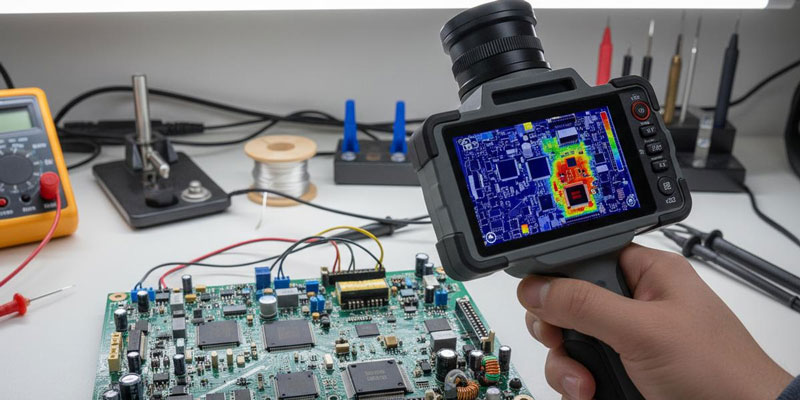
At reflow temperature, absorbed water flashes to steam. The pressure builds inside the package and, if the mould compound has softened enough, it delaminates from the die pad and deforms the plastic. Externally this appears as a bulge or a crack; internally the damage may be invisible, but the bond wires and the die attach are already compromised.
The damage threshold depends on how much moisture was absorbed and how fast the part is heated. A slow ramp gives vapour time to diffuse out before pressure builds, while a fast ramp traps it. This is why two reflow profiles with the same peak temperature can produce completely different results on the same moisture-loaded components. The resulting damage signatures are described in this overview of solder and board failures.
Reading the Label and the Dry Pack
A dry pack is a moisture barrier bag containing the parts, a desiccant and a humidity indicator card. The indicator card shows whether the desiccant has been exhausted, and it must be read at the moment the bag is opened. A card that has changed colour indicates that the parts may already be saturated regardless of how long the bag was stored.
The label also carries the bag seal date and the maximum floor life at the specified conditions. Photographing the label when a bag is opened is a simple practice that makes later reconciliation possible. Without that record, a dispute about exposure time becomes a matter of memory, and memory is not a quality record.
Baking: Methods, Temperature and Limits
Baking is the only way to reset the floor life clock. Standard ovens at around 125 degrees Celsius dry parts quickly but count against the component’s total bake budget, because high temperature accelerates intermetallic growth on terminations. Low temperature baking at 40 to 45 degrees Celsius is gentler but takes far longer, sometimes days.
The choice of method has to respect the component and the packaging. Reels, tape and carrier materials have their own temperature limits and may deform or release adhesive at high bake temperatures. Baking in the original tape is often impossible, which is why a low temperature cycle or a dedicated dry cabinet is frequently the better practical answer. The record of which method was used belongs in the build documentation, alongside the process flow described in this guide to PCB production flow.
Floor Life Tracking in Production
Effective tracking requires a physical or electronic clock attached to each lot. A simple label with an open date and a running total of exposure hours works, provided every return to storage is also logged. Electronic systems that read the label at each station remove the arithmetic error that plagues manual approaches.
The subtlety is that floor time accumulates across multiple exposures. A reel opened on Monday, returned to a dry cabinet on Tuesday and reopened on Friday has consumed both intervals. Systems that reset the counter whenever the part goes back into storage are simply wrong, and they are common. The counter must only reset after a verified bake.
Storage, Humidity and Desiccant
A dry cabinet maintained at under five percent relative humidity can hold parts almost indefinitely and is often cheaper than repeated baking over a product lifetime. The cabinet must be monitored and its desiccant regenerated on a schedule, otherwise it silently becomes an ordinary cupboard with a display.
Where a cabinet is not available, resealing parts in a moisture barrier bag with fresh desiccant is the next best option. Reused bags and exhausted desiccant are a false economy, because the parts continue to absorb moisture at a reduced but non-zero rate. Consistency of storage conditions matters more than the specific method chosen.
Rework and Partial Assembly Exposure
Once a board has been assembled, the components are no longer individually packaged, and the whole assembly becomes subject to ambient humidity. A board that sits partially built over a weekend can absorb enough moisture to matter if it then receives a second reflow. This is the exposure that floor life systems most often overlook.
Where a second thermal cycle is unavoidable, the safest practice is to bake the assembly or at least to limit its exposure before the second pass. The allowable delay depends on the components already attached, which makes the schedule a process engineering decision rather than a dispatch decision. Treating it as a scheduling detail is how popcorn damage appears in lots that had no individual part out of specification.
Auditing and Documentation
An audit of floor life control is straightforward. Pick a lot, trace the bag seal date, the open date, the exposure log and any bake records, and check that the arithmetic holds. If a company cannot reconstruct that chain for a random lot, the system is decorative rather than functional.
Documentation should record the ambient conditions in the assembly area as well, because the stated floor life assumes a defined environment. Recording temperature and humidity continuously turns an assumption into evidence. Combined with routine inspection of finished assemblies for quality defects, this closes the loop between storage practice and the quality of the product actually shipped.
FAQ
Does floor life reset when parts go back into a dry cabinet? No. Floor time accumulates across every period of exposure, and simply returning parts to storage does not restore the budget. Only a verified bake resets the clock. Systems that reset on storage are one of the most common and most damaging errors in moisture control.
Is baking always safe for the components? Not unconditionally. High temperature baking counts against a limited bake budget, because the same heat that drives out moisture also grows intermetallic layers on terminations and can degrade plating. Tape and reel materials often cannot survive a high temperature bake at all, so low temperature drying is frequently the correct choice.
How can I tell whether a part has absorbed too much moisture? The humidity indicator card in the dry pack is the first indication, and it must be read when the bag is opened. Beyond that, the answer comes from the exposure log compared with the rated floor life at the actual factory conditions. There is no reliable way to measure absorbed moisture non-destructively on the factory floor.