Burn-in and Screening Test Justification
Screening is the application of a stress to a population so that the weak units fail before they are shipped. Burn-in is the same idea applied with power and temperature, and it is expensive enough that it should be justified.
What Screening Can and Cannot Do
Screening removes units with a defect that the stress reveals. It does not improve the units that survive, and it does not find a defect that the stress does not reach.
That distinction decides whether screening is worthwhile: it pays when there is a known failure mechanism with an early life distribution and a stress that accelerates it. Our failure analysis notes describe how the mechanism is identified.
Burn-in Versus Other Screens
A temperature and power burn-in exercises the assembly thermally and electrically at the same time. A thermal shock or a vibration screen exercises one mechanism more directly.
The choice follows the mechanism rather than the habit. A mechanical defect responds to vibration, a marginal joint responds to thermal cycling, and a contaminated surface responds to humidity. Our thermal cycling notes describe the profile that suits a joint.
Defining the Stress
The stress must be high enough to precipitate the defect within a practical time and low enough not to consume a significant part of the life of a good unit.
The limit is set by the weakest component on the assembly, which is usually a polymer part or a battery. The temperature must stay inside the range that component can take. Our derating notes describe how the margin is assessed.
Duration and Monitoring
The duration follows from the acceleration that the stress provides and from the failure rate that has to be removed. It should be calculated rather than chosen, even approximately.
The units should be monitored during the screen so that a failure is recorded at the time it happened rather than discovered at the end. A failure that occurs at the start of the screen is a different finding from one that occurs at the end. Our probe notes describe a monitoring arrangement.
Cost and Justification
The cost is the equipment, the time and the handling, and the handling is not free: every insertion and removal is a risk. Burn-in is justified where the cost of a field failure exceeds the cost of screening the population.
Where the failure rate is low and the consequence is contained, screening often costs more than the failures it prevents.
Qualification and Ongoing Verification
The screen should be qualified by running known good and known weak units through it and confirming that it separates them. Without that check, the screen may be filtering nothing.
The screen should also be re-qualified after a process or design change, because the population it sees is no longer the one it was qualified against. Our fabrication notes notes list the records that should be kept.
Records
The profile, the duration, the monitoring data and the failures should be recorded against the units screened, so that a field failure can be compared with the screen result.
Where a unit passes the screen and fails in the field, the record is what shows whether the mechanism is one the screen was supposed to reach.
Process Control and Verification
On a design of this kind, burn-in is the item that decides how the rest of the board is arranged. Reviewing the design before the data is released is cheaper than correcting it after the panel is in the tank, because every step downstream inherits the decision made at the front end. Documenting the assumption is part of the design work, and a short note on the drawing prevents a question that would otherwise arrive a day later and cost a day of schedule.
The process window is set by the narrowest step in the flow, so an improvement anywhere else shows up as margin rather than as yield until that step is addressed. A short note on the drawing about handling, storage or packaging is often worth more than an extra decimal place on a tolerance.
Where a value sits close to a process limit, the drawing should say so, since the shop can then open the process window rather than working to a nominal figure that carries no tolerance. A stack-up that is drawn rather than described removes most of the ambiguity from a quotation, and it lets the fabricator price the board against the dielectric and copper weights that will actually be used.
Where the requirement is not written down, the shop supplies its own default, and the default is chosen for the process rather than for the design. The measurements that matter are the repeatable ones: conductor width and spacing, annular ring, finished hole size, plating thickness and surface finish are all verifiable on a coupon that travels with the panel.
Process Control and Verification
On a design of this kind, burn-in is the item that decides how the rest of the board is arranged. Reviewing the design before the data is released is cheaper than correcting it after the panel is in the tank, because every step downstream inherits the decision made at the front end. Documenting the assumption is part of the design work, and a short note on the drawing prevents a question that would otherwise arrive a day later and cost a day of schedule.
The process window is set by the narrowest step in the flow, so an improvement anywhere else shows up as margin rather than as yield until that step is addressed. A short note on the drawing about handling, storage or packaging is often worth more than an extra decimal place on a tolerance.
Where a value sits close to a process limit, the drawing should say so, since the shop can then open the process window rather than working to a nominal figure that carries no tolerance.
Process Control and Verification
On a design of this kind, burn-in is the item that decides how the rest of the board is arranged. Reviewing the design before the data is released is cheaper than correcting it after the panel is in the tank, because every step downstream inherits the decision made at the front end. Documenting the assumption is part of the design work, and a short note on the drawing prevents a question that would otherwise arrive a day later and cost a day of schedule.
Process Control and Verification
On a design of this kind, burn-in is the item that decides how the rest of the board is arranged. Reviewing the design before the data is released is cheaper than correcting it after the panel is in the tank, because every step downstream inherits the decision made at the front end. Documenting the assumption is part of the design work, and a short note on the drawing prevents a question that would otherwise arrive a day later and cost a day of schedule.
A first article check confirms that the process and the drawing agree on the points listed above, and that the coupon data supports the values used in the design.
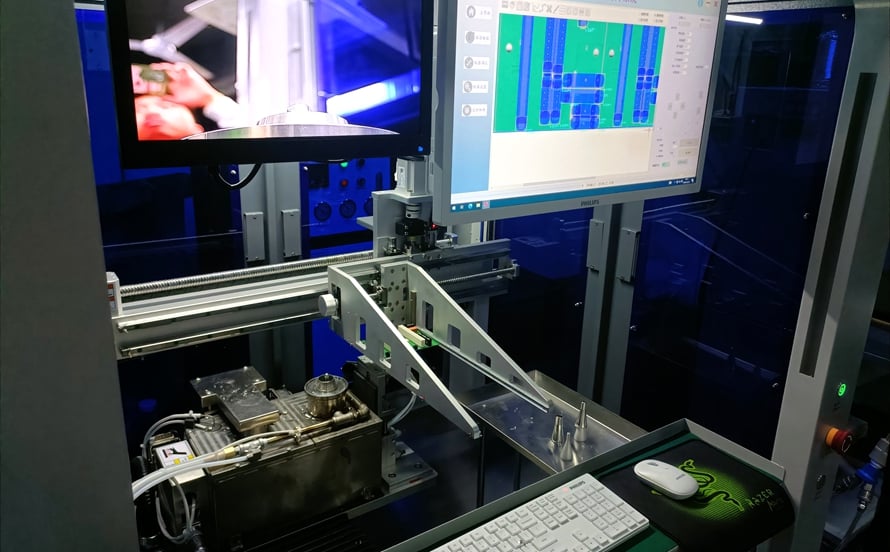
Where a measurement falls outside the expected window, the sample is retained so that the cause can be established before the balance of the batch is released.
FAQ
Does burn-in improve reliability? It removes weak units from the population that is shipped. It does not change the reliability of the units that pass.
Can burn-in replace process control? No. Screening after the fact is more expensive than controlling the process, and it does not address a defect that the screen cannot reach.
What does gopcb provide for screening? We provide mechanism based screen selection, stress limits set by the weakest component, duration derived from the required acceleration, in situ monitoring during the screen, qualification against known good and known weak units, re-qualification after change, and records that tie each unit to its screen result.