Mixed Flowing Gas Testing for Electronic Assemblies
Salt spray measures resistance to chloride. It says almost nothing about what happens in an office, a data centre or an industrial cabinet, where the aggressive species are sulfur compounds and nitrogen oxides at concentrations far too low to see. Mixed flowing gas testing reproduces that environment and has become the standard way to evaluate how a finished assembly behaves in real indoor air.
What Mixed Flowing Gas Testing Is
The test exposes samples to a controlled flowing mixture of corrosive gases at a defined temperature and humidity. The gas mixture, the concentration of each component, the flow rate and the duration are all specified, and the samples are evaluated afterwards for corrosion, contact resistance and electrical performance.
The method is a laboratory model of a real environment rather than a reproduction of one. Its value comes from the fact that it is repeatable and that it provokes the same mechanisms that occur in the field, which makes it useful for comparing finishes and for qualifying a process change.
The Gases and Their Concentrations
The typical mixture includes hydrogen sulfide, which attacks silver and copper; chlorine, which accelerates attack on aluminium and nickel; nitrogen oxides, which drive acidity; and sulfur dioxide. Each is present at concentrations measured in parts per billion, which is realistic for polluted indoor air and far below anything a person would smell.
The composition matters as much as the total concentration, because different gases attack different metals. A mixture dominated by hydrogen sulfide will ravage an immersion silver finish, while a chloride-rich mixture will attack aluminium bond pads and plated layers. Comparing results from two laboratories requires that the gas mixture, not merely the class, is the same.

Test Classes and Severity Levels
Standardised classes exist, ranging from a mild environment representative of a clean office to a harsh environment representative of heavy industrial or automotive exposure. Each class defines the concentrations, the temperature and the relative humidity, and higher classes are not simply longer tests; they are genuinely more aggressive mixtures.
Selecting the class is a judgement about the product’s actual installation. Over-testing produces unnecessary finish changes and cost, while under-testing provides false assurance. Where the installation environment is known, measured field data is a better basis for selection than a default class chosen for convenience. Recording why a class was chosen is as valuable as recording the result, because that reasoning is what allows the choice to be revisited when the product installation changes.
What the Test Provokes
The mechanisms provoked are the ones that depend on a thin surface film and a reactive gas rather than on liquid water. Pore corrosion attacks plated layers through their defects, creep corrosion spreads products across the surface, and tarnish forms on silver and copper. Contact resistance rises on connector surfaces, and insulation resistance falls where contamination is present.
Because these mechanisms are slow in the field, the test accelerates them by raising concentration. That acceleration is not linear, so a result should be read as a ranking of materials rather than as a prediction of service life in years. The value lies in identifying which of two candidate finishes will fail first.
Pore Corrosion and Plating Quality
Pore corrosion begins at a defect in the plated layer and attacks the underlying metal, producing a corrosion product that can spread across the surface. The porosity of the deposit, meaning the number and size of its pores, depends on the plating process, the thickness and the substrate condition, so the test is as much a measure of plating quality as of the finish chemistry.
Thicker deposits perform better because a pore is less likely to penetrate to the substrate. This is why a mixed flowing gas result should be reported with the measured plating thickness, since two samples of nominally the same finish can differ substantially in performance if their thicknesses differ. The measurement methods are described in this guide to plating thickness verification.
Creep Corrosion Under Gas Exposure
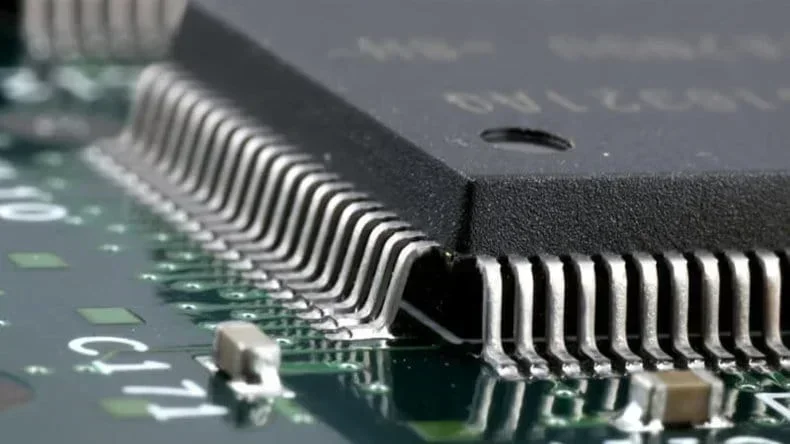
Creep is the migration of corrosion products across a surface, away from the metal that produced them. It is the most visually striking result of a mixed flowing gas test, forming a dark film that spreads over the solder mask and can bridge adjacent conductors. Immersion silver is the finish most associated with the effect.
The creep distance is the quantity normally measured. It depends on the finish, the surface cleanliness and whether a coating is present, and it grows with exposure time. Where the product has fine pitch features, the relevant comparison is the creep distance against the conductor spacing, which is what determines whether a bridge will form. The mechanism is described in more detail in the context of surface finish selection.
Sample Configuration and Coupons
Samples should represent the production assembly, including the finishes, the mask, the component terminations and the cleaning state. Coupons with fine pitch comb patterns are used to make the electrical effect measurable, and they should be built with the same processes as the product rather than prepared separately.
Contamination on the samples before the test changes the result substantially. Handling residues, flux and fingerprints all introduce additional reactive material, so a defined cleaning procedure and glove handling are part of the test method rather than optional good practice. The cleaning state should be recorded, because it is often the variable that explains a difference between two otherwise identical runs.
Evaluating and Reporting Results
Evaluation combines visual assessment with electrical measurement. The visual assessment rates the extent of creep and the degree of tarnish, while the electrical measurement records insulation resistance and contact resistance before and after exposure. Both are needed, because a sample can look heavily tarnished while remaining electrically sound.
Reporting should include the test class and gas mixture, the duration, the sample preparation, the measured plating thicknesses and the raw electrical data. A result quoted as a pass with no supporting figures cannot be compared with anything, and it provides no basis for deciding whether a proposed change is an improvement. The judgement applied to the outcome is similar to that used in PCB quality judgement.
Limitations and Field Correlation
The principal limitation is that acceleration is not linear and the correlation with field life depends on the specific installation. A product tested to a moderate class may fail in a poorly ventilated cabinet near rubber seals, and one that fails the test may perform acceptably in a clean, air conditioned room for a decade.
The second limitation is that the test does not include mechanical or thermal cycling. A finish that survives gas exposure may still fail under vibration, and a coating that protects against creep may crack under thermal cycling and lose its protection. Combining the gas test with thermal cycling on the same samples gives a much more realistic picture of whether a coating strategy will hold up. Where a coating is part of the strategy, testing it on a representative assembly rather than on a bare coupon is the only way to capture the coverage defects that matter in practice.
FAQ
How does mixed flowing gas differ from salt spray? Salt spray uses a chloride fog and is a severe test for porosity and thin plating on exposed metal. Mixed flowing gas uses low concentrations of sulfur and nitrogen compounds and targets the mechanisms that occur in indoor and industrial air, including creep corrosion and tarnish, which salt spray does not reproduce.
Which finish performs best in mixed flowing gas? Electroless nickel immersion gold generally performs best because gold is inert to sulfur compounds. Immersion silver is the most vulnerable, particularly to hydrogen sulfide, and organic solderability preservatives offer little protection because they are designed to be removed during soldering.
Can the test predict how many years a product will last? No. The acceleration factor depends on the gas mixture, the installation and the mechanism, and it is not linear. The test is best used to rank candidate finishes and to detect a process change that has degraded the surface, rather than to estimate a service life in years.