Popcorning during Reflow: Causes and Prevention
A board that looks perfect after reflow can still be internally damaged. Trapped moisture turns to steam during the thermal excursion, and the resulting pressure separates layers or cracks a plastic package from the inside. Popcorning during reflow is one of the few defects that can pass every electrical test and still reduce the life of the product by years.
What Popcorning Is
The name comes from the sound a damaged part makes when the internal pressure releases. Inside a plastic package or between laminate layers, absorbed moisture flashes to steam at reflow temperature, expanding roughly a thousand times in volume. The pressure finds the weakest interface, which is usually the interface between the mold compound and the die paddle, or between the resin and the glass fabric in the board.
The result ranges from an internal crack that is invisible from outside to a visible blister on the surface. A delaminated area under a ball grid array changes the mechanical support of the joints and can open them after a few thermal cycles, so the failure appears in the field rather than on the line.
Moisture Absorption in Laminates and Packages
Both the laminate and the components absorb moisture from the air. The rate depends on the material: polyimide and some high temperature laminates absorb more than standard FR-4, and mold compounds vary widely. The absorbed water sits in the free volume of the polymer, and the amount is a function of the relative humidity and the exposure time.
A board that has been stored in a humid warehouse for months can hold enough moisture to delaminate even if the components were handled correctly. This is why storage conditions and shelf life are specified for bare boards, as described in the guidance on bare board shelf life and storage, and why the expiry date printed on the packaging is a process instruction rather than a formality.
<img src="https://www.gopcba.com/wp-content/uploads/2026/09/266-2.jpg" alt="Delamination inside a laminate after reflow” />
The Role of the Reflow Profile
The reflow profile determines how much of the absorbed moisture is released before the material reaches its critical temperature. A slow ramp with a defined soak allows moisture to diffuse out gradually, while a fast ramp traps it until the internal pressure exceeds the strength of the interface. The peak temperature then sets the vapor pressure reached at the worst moment.
Lead free processes make this harder because the peak temperature is roughly thirty degrees higher than a tin lead profile. A material that survives a tin lead profile comfortably may delaminate in a lead free one, and the difference is often attributed to the paste when the real cause is the moisture content or the ramp rate. Reflow profiles should be recorded per product, following reflow quality control practice, so that a change can be identified when a defect appears, and the choice of lead free versus leaded solder should be reviewed together with the moisture specification of every part on the board.
Bake Schedules and Dry Storage
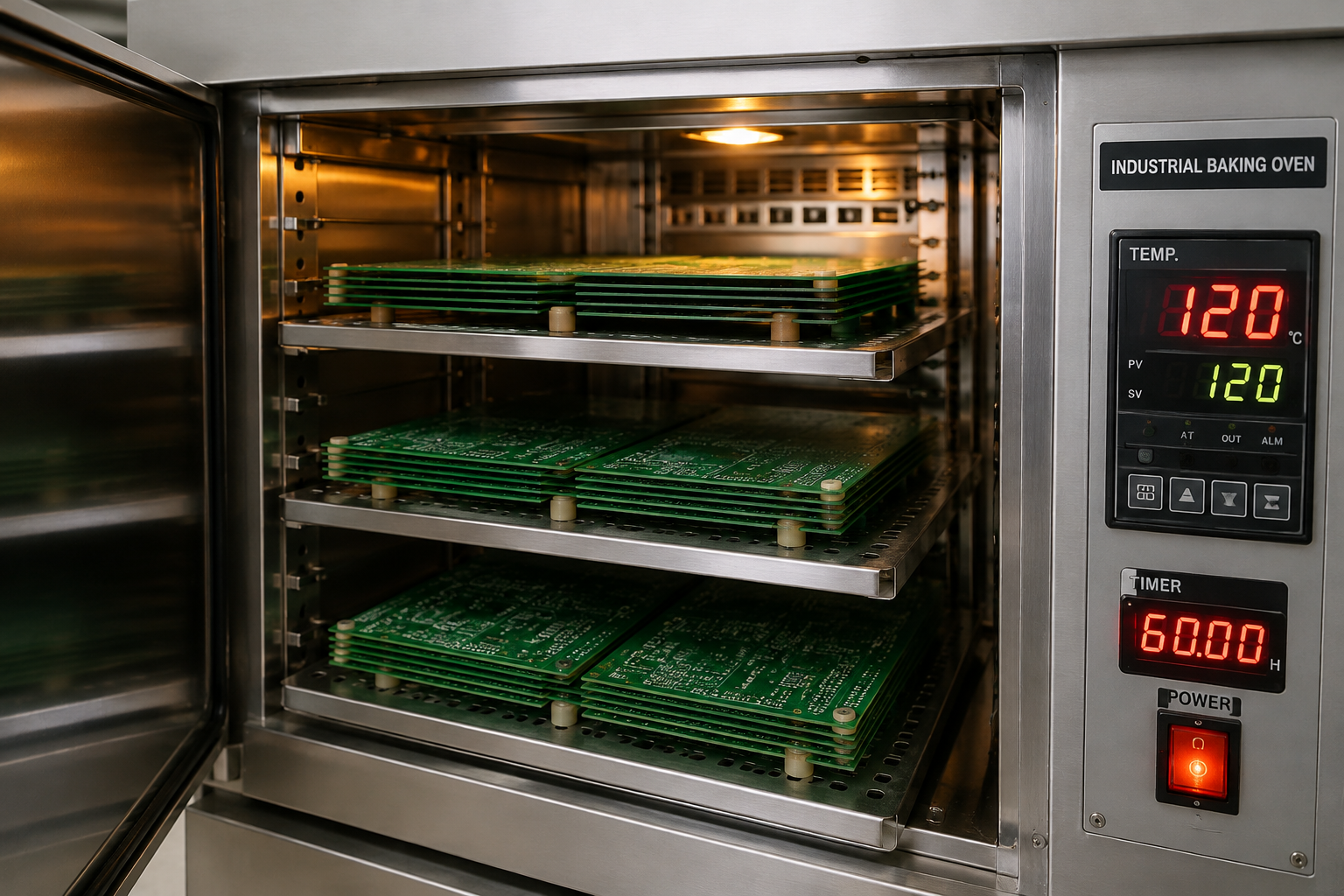
A bake before assembly removes the absorbed moisture, but the schedule must match the material and the package. Too low a temperature and the moisture stays in place; too high a temperature and the packaging, the solderability or the tape and reel carrier is damaged. Use the component manufacturer’s recommendation for packages, and the laminate supplier’s recommendation for bare boards.
Dry storage is simpler than baking. A dry cabinet with a controlled dew point keeps parts ready to use, and a humidity indicator card in each bag shows whether the desiccant is still effective. Record the time each reel spends outside the dry environment, and bake when the accumulated exposure exceeds the limit rather than when a defect has already appeared.
Laminate Selection and Material Choice
Materials differ in their resistance to delamination. Higher glass transition temperature laminates and those with a higher decomposition temperature tolerate the lead free profile better, and some grades are specifically tested for moisture sensitivity. The difference shows up in the time to delamination at a given temperature and humidity.
Selection should follow the process rather than the price list. A board that will be reflowed twice, once for the top side and once for the bottom, accumulates twice the thermal exposure, and a material that is marginal after one pass may fail after two. Where heavy copper or a thick stackup is used, the thermal mass extends the time at peak temperature and increases the risk further.
Design Factors That Increase Risk
Geometry influences where the damage appears. Large copper areas adjacent to small features create thermal gradients that stress the resin, and a plane with no relief can act as a barrier to moisture escaping from the layers beneath it. Vias and drilled holes give moisture a path out, which is why a very dense design can be more forgiving than a sparse one.
Component placement matters as well. A large package with a solid thermal pad traps moisture under the die, and the pad area concentrates the pressure. Where the design allows, provide a via pattern in the pad so the vapor can escape toward the board rather than toward the weakest interface inside the package.
Panel design contributes as well. A panel with large copper imbalance between the two sides warps during reflow, and the warpage changes the pressure distribution under large packages. Where several identical boards share a panel, arrange them so the copper density is balanced across the panel rather than concentrated in one area.
Detection and Inspection
Popcorning is difficult to detect electrically. Visual inspection catches surface blisters but misses internal cracks. Scanning acoustic microscopy shows internal delamination clearly and is the standard method for verifying that a package or a board is intact, though it requires a sample rather than the whole lot.
Cross sections reveal delamination between laminate layers and around vias, and they can be taken from a coupon processed with the production panel. Combine the two methods on the first article of a new build or after any process change, and keep the images with the lot record so a later failure can be compared with the state of the parts when they were built.
Prevention in Production
Prevention is a set of small disciplines: control the storage environment, respect the exposure limits, bake to a documented schedule, profile the oven for each product, and review the profile whenever a material or a component changes. None of these steps is expensive, and together they remove the conditions that cause the defect.
gopcb assembles boards with moisture sensitive components and tracks exposure and bake records as part of the build documentation. That record is what allows a process to be repeatable across lots, and it is also what makes a field failure analysis meaningful rather than speculative.
FAQ
How long can a board stay out of its dry pack? The limit is defined by the moisture sensitivity level of the components and by the laminate specification. Treat the printed limit as a maximum, not a target, and bake parts that have reached it rather than gambling on a short exposure.
Does a second reflow pass increase the risk? Yes, because the parts are exposed to the peak temperature twice and the absorbed moisture has less time to escape between passes. Populate the side with the most sensitive components first where the design allows.
Can popcorning be repaired? No. A delaminated board or package cannot be reworked to restore the original interface. The part must be replaced, and the process that allowed the moisture to remain in place must be corrected before the next lot.