Underfill and Corner Bond Selection for Area Array Packages
Underfill and corner bond both reinforce a solder joint, and they are not interchangeable. One fills the gap beneath the package; the other reinforces the corners only, leaving the rest of the joint to carry its own load.
What Each Material Does
Underfill flows beneath the die and surrounds every joint, so it transfers load away from the solder into the encapsulant. Corner bond holds the four corners, which reduces the peel stress where a drop or a bend concentrates it.
The choice follows the failure mode that is expected. Our vibration and shock notes describe the loading that produces each.
Matching the Expansion
An underfill with a coefficient of thermal expansion close to that of the solder performs differently from one that is much stiffer. The material data sheet figure is for the cured bulk, and the cured state depends on the schedule.
The cure therefore has to be specified with the material. Our thermal cycling notes describe the test that exposes a mismatch.
Flow and Fill Time
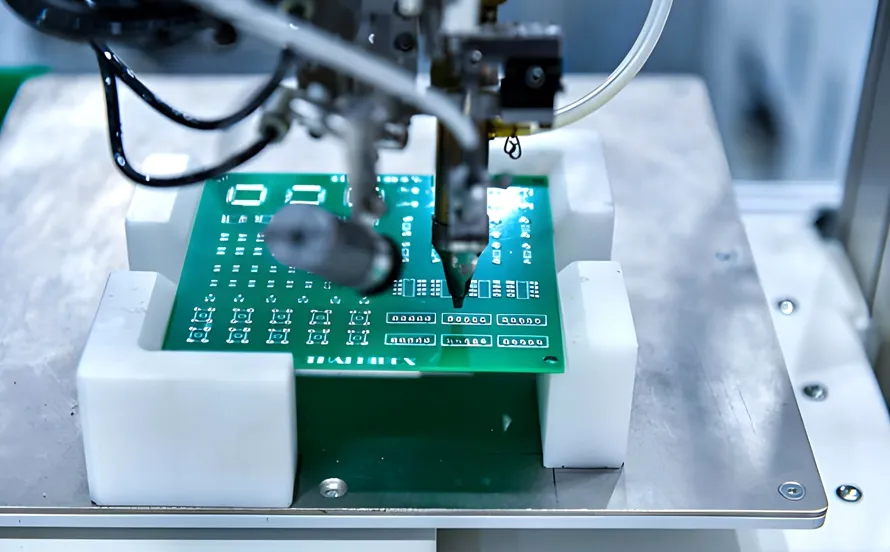
Underfill flows by capillary action, and the time it takes depends on the gap height, the joint spacing, the board temperature and the material viscosity. A package that does not fill completely has voids at the centre.
The fill pattern should be established at first article and the dispense volume recorded. Our voiding notes describe the limits.
Dispense Pattern and Volume
The dispense pattern determines how the material reaches the centre. A single line along one edge is the simplest, and an L shaped or two sided pattern is used for larger packages.
Where the volume is too high, the material climbs the package sides. Our volume notes describe the measurement discipline that applies here as well.
Cure and Inspection
The cure schedule sets the final mechanical properties, so a shortened cure gives a material that behaves differently from the one that was qualified. The cure should be recorded as a temperature profile rather than as a time.
Inspection is visual for the fillet and by scanning acoustic microscopy for the fill. Our inspection notes describe where each applies.
Rework After Underfill
A package that has been underfilled is difficult to remove and the material has to be cleared from the site before a replacement is placed. That cost should be part of the decision.
Corner bond leaves more of the board accessible. Our reballing notes describe what the site needs afterward.
Verification
The verification is a flow time measured at first article, a cured profile recorded for the oven, a fill result examined by acoustic microscopy, and a thermal cycling result for the assembly.
Our yield analysis notes describe how the data is used.
Process Control and Verification
On a design of this kind, coefficient of thermal expansion is the item that decides how the rest of the board is arranged. Keeping a sample from the panel turns a dispute into a measurement, because the same coupon can be re-examined by both parties without rebuilding the batch. Reviewing the design before the data is released is cheaper than correcting it after the panel is in the tank, because every step downstream inherits the decision made at the front end.
Documenting the assumption is part of the design work, and a short note on the drawing prevents a question that would otherwise arrive a day later and cost a day of schedule. The process window is set by the narrowest step in the flow, so an improvement anywhere else shows up as margin rather than as yield until that step is addressed.
A short note on the drawing about handling, storage or packaging is often worth more than an extra decimal place on a tolerance. Where a value sits close to a process limit, the drawing should say so, since the shop can then open the process window rather than working to a nominal figure that carries no tolerance.
A stack-up that is drawn rather than described removes most of the ambiguity from a quotation, and it lets the fabricator price the board against the dielectric and copper weights that will actually be used. Where the requirement is not written down, the shop supplies its own default, and the default is chosen for the process rather than for the design.
The measurements that matter are the repeatable ones: conductor width and spacing, annular ring, finished hole size, plating thickness and surface finish are all verifiable on a coupon that travels with the panel.
Process Control and Verification
On a design of this kind, coefficient of thermal expansion is the item that decides how the rest of the board is arranged. Keeping a sample from the panel turns a dispute into a measurement, because the same coupon can be re-examined by both parties without rebuilding the batch. Reviewing the design before the data is released is cheaper than correcting it after the panel is in the tank, because every step downstream inherits the decision made at the front end.
Documenting the assumption is part of the design work, and a short note on the drawing prevents a question that would otherwise arrive a day later and cost a day of schedule. The process window is set by the narrowest step in the flow, so an improvement anywhere else shows up as margin rather than as yield until that step is addressed.
A short note on the drawing about handling, storage or packaging is often worth more than an extra decimal place on a tolerance.
Process Control and Verification
On a design of this kind, coefficient of thermal expansion is the item that decides how the rest of the board is arranged. Keeping a sample from the panel turns a dispute into a measurement, because the same coupon can be re-examined by both parties without rebuilding the batch. Reviewing the design before the data is released is cheaper than correcting it after the panel is in the tank, because every step downstream inherits the decision made at the front end.
Documenting the assumption is part of the design work, and a short note on the drawing prevents a question that would otherwise arrive a day later and cost a day of schedule.
Process Control and Verification
On a design of this kind, coefficient of thermal expansion is the item that decides how the rest of the board is arranged. Keeping a sample from the panel turns a dispute into a measurement, because the same coupon can be re-examined by both parties without rebuilding the batch. Reviewing the design before the data is released is cheaper than correcting it after the panel is in the tank, because every step downstream inherits the decision made at the front end.
A first article check confirms that the process and the drawing agree on the points listed above, and that the coupon data supports the values used in the design.
Where a measurement falls outside the expected window, the sample is retained so that the cause can be established before the balance of the batch is released.
FAQ
Is corner bond enough on its own? It is sufficient where the loading is bending or drop rather than sustained thermal cycling, which is the case for many handheld products.
Does underfill replace a thermal pad? No. It changes the mechanical load path and it conducts heat poorly compared with a metal interface.
What does gopcb provide for underfill work? We provide a material chosen against the expected failure mode, a dispense pattern and volume established at first article, a flow time measured at production temperature, a cure recorded as a profile, and a fill result verified by acoustic microscopy.