Cleaning Equipment and Chemistry Selection
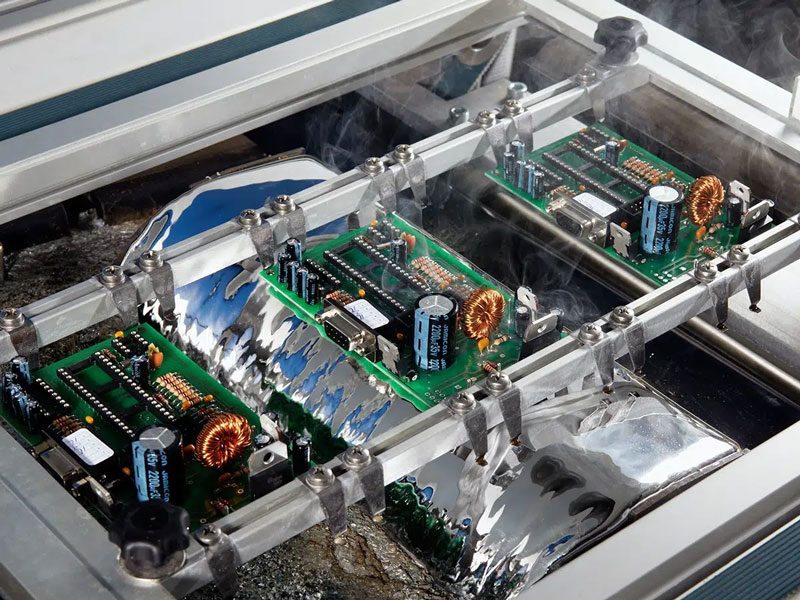
Cleaning equipment is chosen from the residue that has to be removed and from the geometry that has to be reached, and not from a general preference for one technology. Aqueous, semi aqueous and solvent systems each suit a different combination of flux and assembly.
The chemistry is chosen at the same time, because a saponifier that suits one flux can damage another and a rinse that leaves residue defeats the wash. The two are a system, and qualifying one without the other is a common mistake.
What Has to Be Removed
The residue from a rosin flux differs from that of a water soluble flux, which differs again from a no clean residue that is being removed for a specific reason. The chemistry that dissolves one may not touch another.
The residue inside a barrel or under a component is the difficult part, because it is not exposed to the wash. The cleaning requirement is therefore defined by the geometry as much as by the material.
Aqueous Cleaning
Water alone removes ionic residues such as the activators in a water soluble flux, and it does little to rosin. A saponifier is added to raise the pH so that rosin is converted into a soluble soap, at the cost of a material that can attack some platings.
The rinse quality is critical, since a saponifier left on the board is more conductive than the residue it removed. A two stage rinse with a final rinse of high purity water is the usual arrangement.
Solvent Cleaning
Solvent systems dissolve rosin without a chemical reaction, which makes them effective at low temperature and gentle on the assembly. The trade is the cost of the solvent, the disposal and the containment required.
Solvent cleaning also has to deal with the solvent that remains in a confined space, which can be a flash point issue in a poorly ventilated area. The equipment and the room should be designed for the material.
Wash Mechanics and Impingement
Cleaning is a mechanical process as much as a chemical one, and the impingement of the spray determines how much of the residue is removed. A spray that cannot reach under a component removes nothing from that region however good the chemistry is.
Nozzle arrangement, board orientation and dwell time are therefore part of the process. Boards should be oriented so that the flux drains away rather than pooling under a part.
Temperature and Time
The wash temperature affects the reaction rate and the mechanical action, and both rise with temperature. The limit is set by the components and by the chemistry, since a warm bath accelerates the attack on platings.
Time in the wash, the rinse and the dry cycle all matter, and the dry step is often the one that is shortened under pressure. Trapped water is a defect source, particularly under a package.
Rinse Purity and Measurement
The final rinse should be measured for resistivity, which is a direct indication of the ionic content it is leaving behind. A rinse that drops in purity indicates that the previous stage is carrying contamination forward.
The measurement is simple, and it should be recorded with the batch. This is the same logic that governs the verification of the process described for the cleaning process.
Verification of Cleanliness
The cleanliness of the finished board is verified by an extract test, in which a sample is washed in a measured volume of high purity water and the resistivity or the ionic content of that water is measured. The result is a number that can be compared with a limit.
The test should be applied to a board from each batch, and the sample should include the areas that are hardest to clean. A test on a bare board says nothing about a populated one.
Materials Compatibility
Labels, coatings, connector housings and component markings all react differently to a cleaning chemistry. A label that swells or a marking that fades removes traceability that the process assumed.
The assembled board should be checked for these effects during process qualification rather than after a customer complaint. A sample from each new component type is a cheap test.
Water Quality and Disposal
The incoming water has its own ionic content, so the final rinse is normally supplied through a deionising unit that is monitored. An exhausted unit passes contamination straight through to the board.
The waste water from a saponifier system requires treatment before disposal, and the chemistry choice should include the cost of that treatment.
Records
The records should list the chemistry, the concentrations, the temperatures, the times and the rinse purity for each batch. Where a defect is traced to cleaning, those records identify the affected period.
They belong with the process evidence described for manufacturing processes, and they are what allow a cleanliness claim to be supported.
Process Control and Verification
On a design of this kind, saponifier is the item that decides how the rest of the board is arranged. Where a value sits close to a process limit, the drawing should say so, since the shop can then open the process window rather than working to a nominal figure that carries no tolerance. A stack-up that is drawn rather than described removes most of the ambiguity from a quotation, and it lets the fabricator price the board against the dielectric and copper weights that will actually be used.
Where the requirement is not written down, the shop supplies its own default, and the default is chosen for the process rather than for the design. The measurements that matter are the repeatable ones: conductor width and spacing, annular ring, finished hole size, plating thickness and surface finish are all verifiable on a coupon that travels with the panel.
Running a first article through the same checks as the production panel confirms that the two agree, and that comparison is the cheapest form of process control available at prototype stage.
Related reading: our fabrication notes, board quality and design release notes cover the same ground.
Process Control and Verification
On a design of this kind, saponifier is the item that decides how the rest of the board is arranged. Where a value sits close to a process limit, the drawing should say so, since the shop can then open the process window rather than working to a nominal figure that carries no tolerance. A stack-up that is drawn rather than described removes most of the ambiguity from a quotation, and it lets the fabricator price the board against the dielectric and copper weights that will actually be used.
A first article check confirms that the process and the drawing agree on the points listed above, and that the coupon data supports the values used in the design.

Where a measurement falls outside the expected window, the sample is retained so that the cause can be established before the balance of the batch is released.
A first article check confirms that the process and the drawing agree on the points listed above, and that the coupon data supports the values used in the design.
Where a measurement falls outside the expected window, the sample is retained so that the cause can be established before the balance of the batch is released.
FAQ
Does cleaning always require a saponifier? Only for residues that water alone cannot remove, such as rosin from an activated flux.
Can a no clean board be cleaned later? It can, and the chemistry has to match the residue, since a flux formulated to be left in place may be difficult to dissolve.
How is the rinse checked? By measuring the resistivity of the final rinse water continuously and recording the result with the batch.
Is a longer wash always better? Beyond the point where the residue is removed, extra time only increases the exposure of the assembly to the chemistry.