Drilling Stack Up and Entry Material Selection Rules
Every drilled hole is produced through a sandwich of materials that includes the panel and two consumables: an entry material on top and a backup material underneath. Both are cheap, both are usually treated as an afterthought, and both have a direct effect on the burr, the hole wall and the drill life. This article explains what each layer does, how the stack height affects the drilling program and how to select the consumables for a given laminate.
What the Stack Up Consists Of
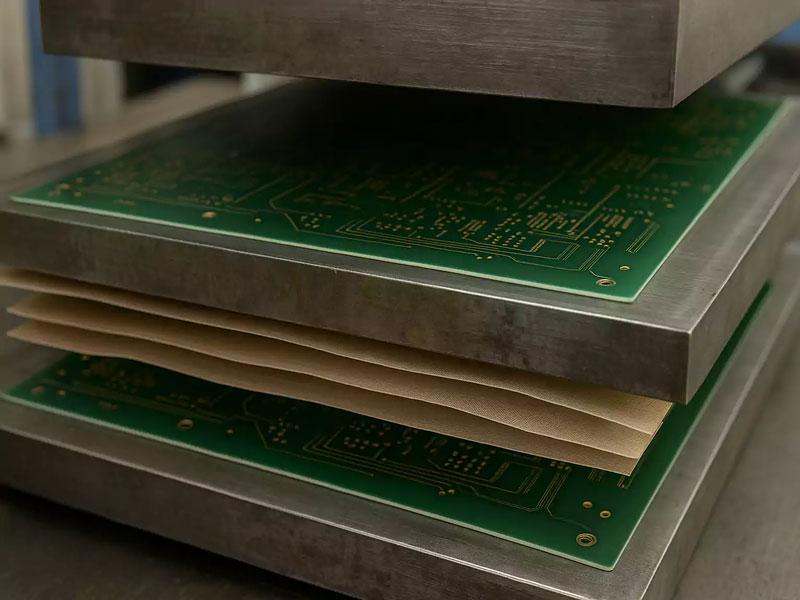
The stack is the panel or the panels being drilled, the entry material that sits on top, the backup material that sits underneath and the tooling that positions the whole assembly. The stack is clamped and drilled as one unit, and the drill passes through the entry, the panel, the backup and, on a stacked job, more than one panel.
The number of panels in the stack is a production decision that trades throughput against accuracy. A taller stack drills more holes per stroke but places more demand on the drill, the registration and the depth control. The optimum is the tallest stack that still holds the hole tolerance and the wall quality.
The Job of the Entry Material
The entry material sits between the drill and the top copper. It restrains the copper as the drill breaks through the surface, which reduces the burr that would otherwise form around the hole, and it cools and lubricates the cutting edge, which extends the drill life.
It also holds the drill steady at the moment of entry, which is when the bit is most likely to wander. On a fine pitch pattern with small drills, that centring effect is worth as much as the burr reduction, and on a small drill it is often the difference between a centred hole and a wandering one. Our hole types guide describes the different holes a stack may contain.

Entry Material Types
The common types are aluminium foil, coated aluminium, a phenolic sheet and a composite of aluminium and a lubricating layer. Aluminium is a good heat conductor and restrains the copper well, but it can leave aluminium particles on the bit and it is softer than the alternatives.
A coated or composite material combines the heat conduction of the metal with the lubrication of the coating, which reduces the wear and the adhesive transfer. The choice depends on the laminate, the hole size and the acceptable cost per hole. The entry material is a consumable, so the decision is properly made per thousand holes rather than per sheet.
The Job of the Backup Material
The backup material supports the laminate as the drill exits. Without it, the last layers of the panel are pushed out of shape, the exit burr is large and the hole wall is damaged at the exit side, which is one of the most common sources of a plating defect.
The backup also cleans the drill as it withdraws, removing the resin and the copper that would otherwise be carried to the next hole. That cleaning action is why a backup material has to be replaced on a defined frequency rather than used until it falls apart.
Stack Height and Drill Depth
The drilling program is written against the total stack height, and the depth has to be enough to pass through the backup without being so deep that the drill runs into the machine table. As the stack height changes with the number of panels and the consumables, the program has to be changed with it.
The depth control also affects the drill life. A program that leaves the drill cutting into the entry of the panel below, or into the machine surface, wears the bit faster and produces a worse hole. The stack height should be measured rather than assumed.
Burr Control at Entry and Exit
The entry burr is a raised ring of copper around the hole, and it interferes with the subsequent lamination and with the plating. The exit burr is a rough edge that traps chemistry and produces a void at the plating interface, and it is usually worse than the entry burr because the laminate is unsupported at that moment.
Both are controlled by the consumables and by the drilling parameters together. A sharper bit, a better supported stack and a correct feed rate all reduce the burr, and the consumables are the cheapest of the three to change, which makes them the first place to look when a burr problem appears. Our drill bit wear notes describe how the tool condition interacts with the stack.
Effect on Hole Quality
The stack arrangement shows up in the wall quality, the hole position and the registration to the inner layers. A stack that is not clamped uniformly produces holes that are offset in one area of the panel, which later appears as a marginal annular ring or as a breakout.
The effect is cumulative with the drill wear, which is why a change in hole quality should be investigated across the whole stack rather than in the drill alone. The stack and the tool are one system in practice. Our hole copper notes describe the barrel condition that the plating process has to produce on the wall the stack leaves behind.
Selecting for a Given Laminate
A filled or a high frequency laminate behaves differently from a standard FR-4. The filled materials are more abrasive, so the entry material has to provide more lubrication, and the ceramic filled laminates wear a bit faster than the glass reinforced ones at the same hole count. The entry material is the cheapest lever available to compensate for that.
The selection should be made from the hole quality that the combination produces, measured on a sample, rather than from a price per sheet. A cheaper entry material that shortens the drill life or raises the burr can cost more than it saves within a single lot.
Consumable Control and Cost
The consumables are a recurring cost, and the control that matters is the replacement interval. An entry material that is reused across several stacks loses its lubricating layer and stops restraining the copper, while a backup material that has been drilled through many times no longer cleans the drill. Both intervals belong in the process specification rather than in the operator discretion.

At gopcb the consumable specification is recorded with the drilling process and the result is judged in our quality documentation, so that a change in the entry or the backup material can be linked to a change in the hole quality.
FAQ
Is an entry material always necessary? For a standard panel it is, because it restrains the copper and extends the drill life. Removing it to save cost usually shows up as more burr and a shorter tool life.
How thick should the backup material be? Thick enough to support the laminate through the exit and to absorb the drill without being cut through completely. The correct figure depends on the stack height and the drill diameter.
Can the same entry material be used for every laminate? It can be used, but it is not optimal. An abrasive filled laminate needs more lubrication than a standard FR-4, and using the same material for both means one of them is working outside its best range.