Water Quality Control in PCB Wet Processes: A Guide
Water is the most used chemical in a printed circuit shop and the one that receives the least attention. It carries chemistry into the process, rinses it out again and transports it to the waste treatment plant, and its quality decides whether a rinse leaves a residue that later shows up as a plating defect or a solderability failure. Water quality is therefore a process variable with its own specification rather than a utility that can be taken for granted. Water quality is specified by the process rather than by the utility, and the specification should state the maximum conductivity and the temperature at each stage.
Why Water Quality Matters
A rinse works by dilution, so its effectiveness depends both on the volume of water and on what was already dissolved in it. If the incoming water carries hardness, chloride or silica, a rinse that looks thorough can leave a film on the surface that interferes with the next step. A rinse is a dilution step, so its performance depends on the ratio of clean water to carried over chemistry, and that ratio is a design parameter rather than a matter of opinion.
At the end of a line the same water is the last thing to touch the board before it is dried and packed. Residue left at that point affects the solderability of the finish, the adhesion of a mask and the appearance of the final product, and it does so slowly enough that the defect may not appear until the customer’s line. A board that is dried with a residue film will still pass a visual inspection, which is what makes this class of defect so difficult to contain.
What Is in Process Water
Tap water contains dissolved minerals, chloride, sulfate and organic material, and its composition varies with the season and with the supplier. Those variations are invisible in the shop until a process that was stable for months suddenly starts to fail, which is why raw water is normally analysed rather than assumed. A seasonal change in the supply can move the chloride level enough to affect a plating bath, and the change will not be visible in the finished panel until it is too late.
Process water is also contaminated by the shop itself. Airborne dust, airborne chemistry from nearby tanks, and material leached from piping and tanks all add to the load. A closed loop that recycles water without adequate treatment concentrates those contaminants over time. Piping material matters as well, because some plastics leach organic material that shows up as a carbon load in the rinse.
<img src="https://www.gopcba.com/wp-content/uploads/2024/10/op1.jpg" alt="Deionised water treatment plant on a PCB production line” />
Deionised Water and Its Production
Deionised water is produced by passing treated water through ion exchange resin, which removes dissolved ions and drops the conductivity to a low value. Reverse osmosis is often used ahead of the resin to reduce the load on it, particularly where the raw water is hard or high in dissolved solids.
The resin has a finite capacity and it has to be regenerated or replaced on a schedule. A bed that is partly exhausted still produces water that looks clean, but its conductivity rises gradually and the rinse performance falls with it, which is the reason the outlet is monitored continuously. Conductivity meters should be calibrated against a standard solution, because a drifting probe reads low and gives a false sense of security.
Conductivity as a Control Measure
Conductivity measures the ability of water to carry a current and it is a direct indicator of dissolved ions. It is cheap to measure, it responds quickly, and it can be logged continuously, which makes it the standard control for rinse water and for deionised water supply.
The measurement says nothing about uncharged contamination such as organic material or fine particles, so conductivity is a necessary but not a sufficient test. Total organic carbon and particle counts are added where a process is sensitive to those, and pH is checked where the chemistry can shift it. A full water specification therefore lists several parameters, and the list depends on what the process downstream can tolerate.
Rinse Stage Design
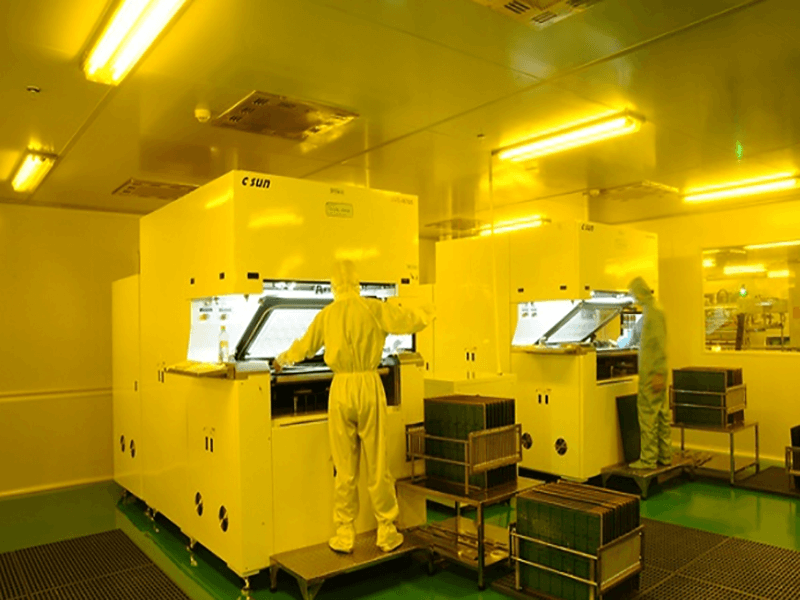
A rinse stage is designed around flow, time and agitation. Counter current flow, in which fresh water enters at the last stage and moves towards the first, uses far less water than a series of independent tanks while achieving a better final result. The number of stages and their arrangement should be matched to the surface that has to be cleaned rather than copied from another line.
Spray rinses are more effective than immersion for flat panels because they remove the boundary layer of contaminated solution that clings to the surface. Air knives and drip bars between stages reduce the volume of chemistry carried forward, which protects both the next tank and the rinse water. Nozzle condition and spray pattern should be checked on a schedule, because a partly blocked nozzle leaves a streak that a conductivity measurement will not detect. Our plating thickness guide explains how carry over affects the deposit. Where carry over is unavoidable, a pre rinse or a drag out tank recovers the chemistry and returns it to the process tank instead of losing it.
Drag Out and Carry Over
Drag out is the volume of process solution that leaves a tank on the surface of the panel and its holes, and it is the main source of contamination in the rinse stages. Reducing drag out reduces the rinse load, saves chemistry and lowers the cost of waste treatment at the same time.
Drain time above the tank, a drip bar, lower solution viscosity and better racking all reduce the volume carried out. The reduction is measurable, and a shop that records drag out will usually find that a small change in the drain time pays for itself quickly. Rack design matters too, since a rack that holds solution in a pocket will carry it forward no matter how long the panel drains.
Water in the Plating and Etch Lines
In plating, water carries the chemistry that makes the deposit possible and also the contamination that ruins it. Chloride in a nickel bath, calcium in a tin bath and organic material anywhere all change the deposit, and all of them can enter through the rinse water. Chloride is the classic example in a nickel bath, where a small and unexpected increase changes the stress and the appearance of the deposit.
In etching, the rinse after the etchant determines whether copper salts remain on the surface and continue to attack the traces. Our etching process guide covers the chemistry, and the rinse quality is what stops that chemistry from following the panel to the next step. Copper salts left in a via or under a resist edge continue to react, and the result is a stained or a weakened trace.
Water Reclaim and Discharge
Rinse water is normally treated before discharge, with the copper and other metals removed by precipitation or ion exchange so that the effluent meets the permitted limits. The treated water can often be returned to the rinse line, which reduces both the water bill and the discharge volume. The treatment plant should be sized for the peak flow of the line, not for its average, because an undersized plant will discharge out of specification during a busy shift.
Reclaim has to be designed with the process in mind, because a loop that returns water with an elevated ion content to a critical rinse stage defeats its own purpose. The usual arrangement returns reclaimed water to the early rinse stages and reserves fresh deionised water for the last one. That split gives the best use of the water without putting the critical final rinse at risk.
Process Control Points
The controls are the incoming water analysis, the deionised water conductivity, the flow and temperature at each rinse, the drain time between tanks, and the final rinse quality before drying. Each of those is measurable and each of them should be recorded against the lot. A rinse that is inside specification on every parameter is the cheapest insurance against a plating or solderability defect.
The final check is the water break test or a surface tension measurement on the panel leaving the last rinse. Our solderability guide describes the tests that confirm the surface is still in a condition to be soldered, and water quality is one of the variables that decides the answer. Taken together, the water data and the surface test tell the whole story of the last stages of the line.
FAQ
Is deionised water always required? Not for every stage, but it is required for the last rinse before drying and for any bath that is sensitive to chloride or hardness. Earlier stages can often use filtered or reclaimed water.
How is rinse water quality monitored? Conductivity is the standard continuous measurement, supported by pH, total organic carbon and particle counts where the process is sensitive to them. The final rinse should also be confirmed with a water break test.
Why does reducing drag out save money? Less solution leaves the tank, so less chemistry has to be replenished, less contamination enters the rinse stages and less waste has to be treated. The saving appears in three places at once.