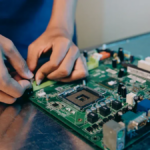
Maintenance Planning for Assembly Equipment
Assembly equipment fails in two ways: suddenly, when a part breaks, and gradually, when a parameter drifts far enough to produce defects. Planned maintenance addresses both, and it is justified by the cost of the alternative rather than by a preference for order. An unplanned stop on a line that is already committed to a delivery costs more than the maintenance that would have prevented it, and a drift that produces scrap for a week before it is noticed costs more still.

Why Planned Maintenance Pays
The economics are straightforward once the downtime is measured. A line that stops for an hour of unplanned repair loses the output, the labour and the schedule flexibility, and it usually consumes a manager’s attention as well. Planned maintenance trades a shorter, scheduled stop for that event, and it can be performed when the line is not committed. The comparison is only credible when the downtime is recorded, which is why measurement comes before scheduling.
There is also a quality argument. A printer whose squeegee has worn beyond specification, a placement head whose nozzle is partly blocked or an oven whose heater has failed all produce defects before they stop the machine. Preventive maintenance removes those gradual failures at the point where replacement is cheap, and it prevents the more expensive investigation that follows an unexplained shift in yield. Consumable management is the same discipline applied to tooling.
Building the Schedule
The schedule should be built from the equipment manual, the supplier’s recommendations and the experience of the people who run the machines. Each task needs a frequency, an owner, an estimated duration and the condition that defines completion. Frequencies are usually a mix of calendar intervals, running hours and production counts, because a machine that runs two shifts wears faster than one that runs one.
The tasks that matter most are the ones that affect the process rather than the machine’s comfort. Cleaning optical systems, checking nozzle condition, verifying the conveyor speed, testing the emergency stops and confirming the calibration of measurement devices all rank above cosmetic cleaning. Where time is limited, the schedule should protect those and defer the rest rather than distributing effort evenly. Throughput planning depends on the schedule being realistic.

Calibration and Verification
Calibration confirms that a measurement device reads correctly against a traceable standard, and verification confirms that a machine performs as expected. Both matter, and they are not the same thing. A temperature profiler can be calibrated while the oven it measures still runs cold, and a vision system can be calibrated while its lighting degrades and its recognition rate falls.
The interval should be set by the criticality of the measurement and the stability of the device. Where a measurement decides whether product is accepted, the interval should be short and the verification should include a check on the product itself. Recording the result, with the standard used and the date, is what allows the measurement to be trusted later, and it is also what a customer audit will ask to see. Document control keeps those records retrievable.
Spares Strategy
Spares are the difference between a maintenance task and a shutdown. The criticality of the part, its lead time and the cost of the downtime it causes determine how many should be held. A nozzle that can be replaced in minutes needs one spare; a servo drive with a six-week lead time and no substitute needs one on the shelf, because the alternative is six weeks of lost capacity.
The spares list should be reviewed against the actual failure history rather than compiled once. Items that have never been consumed are candidates for removal, and items that are consumed faster than expected indicate a machine problem worth investigating. Recording consumption by part and by machine turns the spares inventory into a diagnostic tool. Fixture maintenance follows the same logic on a smaller scale.
Condition Monitoring and Predictive Work
Not every failure needs to be predicted by time. Vibration, temperature, current draw and cycle time can all indicate a developing problem, and where a sensor is available the data can be trended without adding much effort. A placement head whose cycle time has lengthened by a few percent, an oven whose heating rate has slowed or a compressor that runs more often than it used to are all signals that something is changing.
Condition monitoring is most valuable where the failure is expensive and the warning is measurable. Where neither is true, a simple calendar schedule is more economical. The decision should be based on the consequence of the failure rather than on the appeal of the technology, because monitoring consumes engineering time that could be spent elsewhere.
Recording and Downtime Analysis
Every maintenance activity should be recorded: what was done, by whom, what was found, what parts were used and how long the machine was unavailable. That record is what turns maintenance from a set of habits into a managed activity, and it is the only way to answer the question of whether the programme is reducing unplanned downtime or merely adding planned downtime to it.
Downtime should be categorised, with planned maintenance separated from failures and from changeover and material waits. A line that reports ten percent downtime without that split cannot be improved, because the actions for a failed heater, a changeover and a missing component are entirely different. Plotting the categories monthly usually shows that one category dominates, and that is where the next improvement belongs. A category that is never measured is a category that is never managed.
Skills and Outsourcing
The people who maintain the equipment need training as much as the operators, and the training should be specific to the machines in use. Where the maintenance is outsourced, the contract should define the response time, the spare parts arrangement and the record that the supplier provides, because a maintenance visit that leaves no record contributes nothing to the history of the machine.
A practical arrangement for many factories is a mix: routine tasks performed in house by trained technicians, with specialist work such as calibration, laser or vision system servicing contracted to the original manufacturer. That split keeps the knowledge where it is used daily and buys expertise where it is needed occasionally, and it should be reviewed as the equipment ages and the failure patterns change.
Additional Considerations for This Build
Practical attention to maintenance planning pays for itself here, because it decides whether the finished board behaves as the drawing intended. Where the requirement is not stated on the fabrication drawing or in the assembly notes, the shop has to assume a default, and that default is rarely the value the design was simulated with. Stating maintenance planning explicitly, together with the tolerance that applies, removes the assumption and keeps the result predictable from batch to batch.
Process Control and Verification
On a design of this kind, spares is the item that decides how the rest of the board is arranged. Documenting the assumption is part of the design work, and a short note on the drawing prevents a question that would otherwise arrive a day later and cost a day of schedule. The process window is set by the narrowest step in the flow, so an improvement anywhere else shows up as margin rather than as yield until that step is addressed.
FAQ
How often should a machine be serviced? Follow the manufacturer’s interval as a baseline and shorten it where the duty cycle is heavier or the environment is harsh. Base the final interval on your own failure history.
What should be recorded after maintenance? The task, the findings, the parts used, the duration and any parameter that was changed, signed by the person who performed the work.
How many spares should be held? At least one of every part whose failure stops the line and whose lead time exceeds the acceptable downtime. Review the list annually against consumption.
Is predictive maintenance worth it? Where the failure is expensive and the warning is measurable, yes. Where it is not, a calendar schedule is cheaper and just as effective.