
Rework vs Scrap Decision
Every assembly line eventually produces a board that does not pass. The question is not whether to rework or to scrap it, but how that decision is made, by whom, and on what evidence. A line that answers those questions in advance saves money on both sides: it does not throw away repairable product, and it does not ship a repair that was never qualified.
Starting With the Specification
The customer specification and the relevant acceptance standard define what is a defect and what is a process indicator. A joint that the standard permits should not be reworked at all, because rework adds risk without removing a defect.
That distinction is the first filter. Many rework operations on a production line are performed on features that the standard accepts, and the repair is the only thing that introduces a problem. Our article on joint acceptance criteria sets out the categories.
Types of Rework and Their Risk
Touching up a fillet is low risk. Removing and replacing a fine pitch device is high risk, because the local thermal load and the handling can damage the board, the neighbouring parts and the surface finish.
The risk should be expressed in terms that can be compared: the chance of success, the number of thermal cycles added, and the effect on the remaining life. A repair that adds two reflow cycles to a board already at its limit is a scrap decision in disguise. Our article on desoldering and rework techniques covers the methods.
Cost of Rework Versus Cost of Scrap
The comparison has to include the labour, the equipment time, the replacement parts, the test time and the risk of a latent defect. The cost of the bare board is usually the smallest term.
Scrap also has a value, because the material can sometimes be recovered and because the capacity used for a difficult repair has an opportunity cost. Both sides of the comparison should be estimated with the same level of care.
When Rework Should Be Refused
Rework should be refused where the board has already been repaired at the same location, where the local laminate has been damaged, where the finish has been consumed, or where the customer specification prohibits it.
A second condition is the thermal budget. A board that has been through several assembly cycles may be outside the qualification of the laminate, and the repair would consume the remaining margin. Our article on surface finish thermal aging describes that effect.
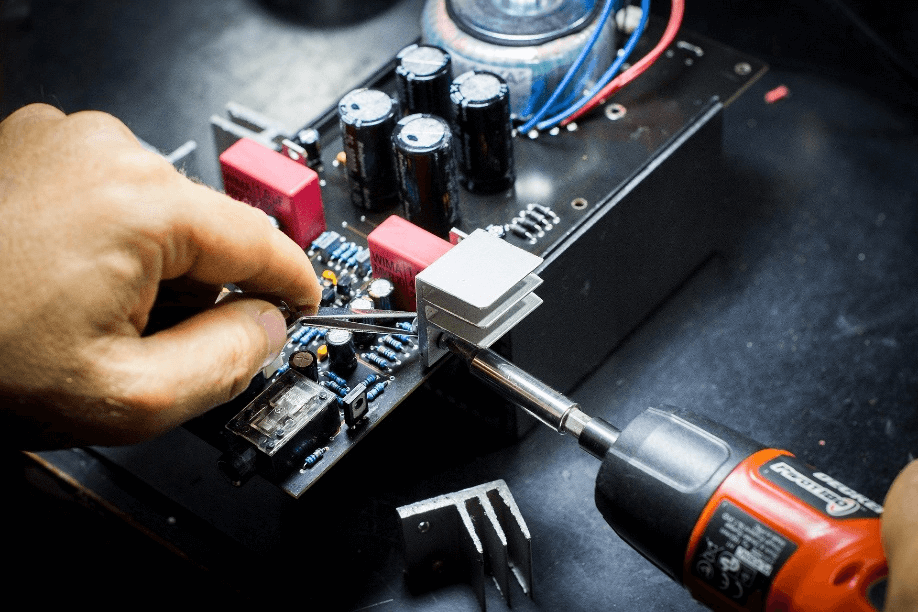
<img src="https://www.gopcba.com/wp-content/uploads/2026/05/人形机器人PCBA.png" alt="Reworked area of a board marked for traceability” />
Qualifying a Repair
A repair that is repeated should be qualified as a process: a defined method, defined tooling, defined temperature limits and a defined inspection. The qualification should include a sample that is cross sectioned, and the result should be recorded.
Where a repair is a one off, the decision should be made by the responsible engineer and recorded with the reason. A verbal decision to repair is not traceable and will be repeated by whoever is on the next shift.
Traceability of Rework
Reworked units should be marked and recorded so that they can be identified later. If a field failure occurs on a repaired board, the repair history is the first thing an investigator needs.
The record should state what was repaired, by whom, on which revision, and what test was applied afterwards. Our article on traceability labelling describes how the unit is identified.
Building the Decision Into the Process
The decision rules belong in the control plan, together with the test that follows a repair and the person authorised to deviate. Putting them there means that the shift decision does not depend on who is on duty.
The rules should also include what happens to a scrapped board: how it is marked and how it is removed from the flow. Our article on control plan development covers the broader structure.
Checks Before Release
A result that cannot be reproduced is not a result, and reproducibility should be demonstrated rather than assumed. The tooling, the material and the profile form one system, and a change to any of them should be assessed against the other two before it is released.
Handling between operations is part of the process, and the damage it causes is often attributed to the operation that preceded it. A change that is not recorded is a change that cannot be explained when the result moves, which is why the record is part of the process.
The checks that matter are the ones performed on the product rather than on a sample kept for the purpose, because a coupon that travels with the panel is the only evidence about that panel. Where an operation cannot be verified afterwards, it has to be controlled during the operation, and that control has to be visible in the record.
Consumables have a life measured in cycles, and the replacement point should come from the measurement rather than from a failure. The sequence of operations is part of the specification, because a different order produces a different result from the same steps.
Points to Confirm at First Article
The narrowest feature on the board usually sets the process window for the whole product, so it deserves the closest attention at review. Sampling is a compromise between cost and confidence, and the sample size should follow from the failure rate that has to be detected.
FAQ
Is rework always worse than scrap? No. Touching up a single joint is lower risk than building a new board. The comparison depends on the location, the number of cycles already applied and the customer requirement.
Can a repaired board be shipped as new? Only where the specification allows it and where the repair has been qualified and recorded. Many contracts require the repair to be declared.
Who should make the decision? A named role with the authority to accept the risk, supported by written criteria. Leaving it to the operator on the line produces inconsistent results.