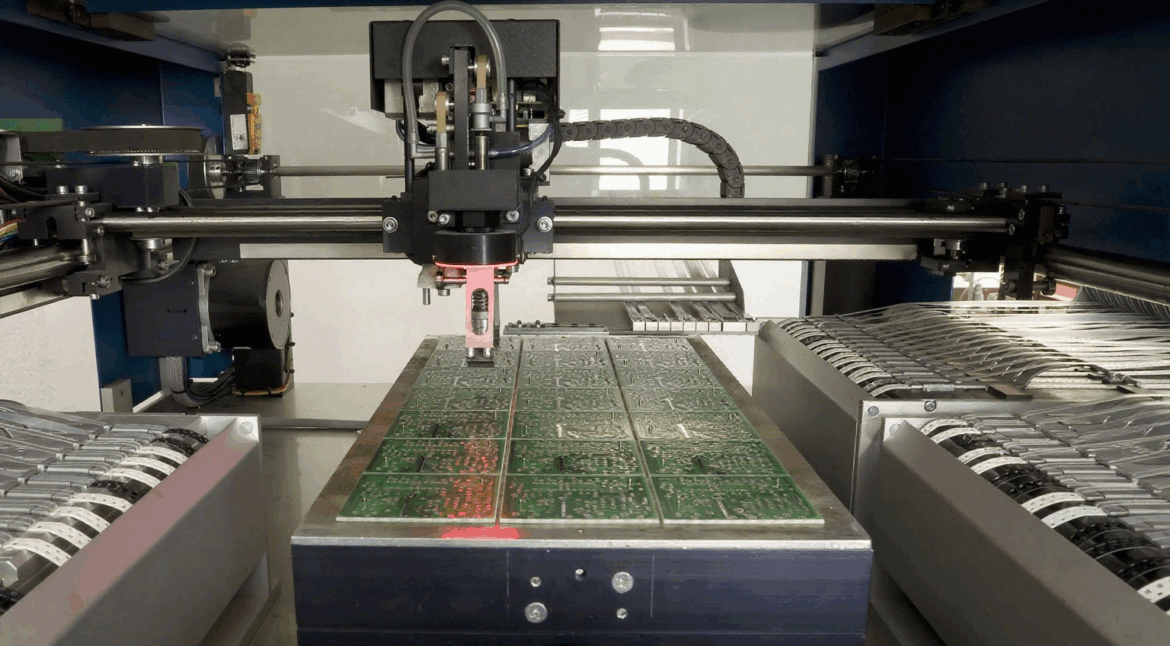
Laminate Handling: 4 Rules That Protect the Stack
Laminate handling is everything that happens to a core between the store and the press. Cutting, moving, stacking and pinning all leave their mark on the material, and the marks are easiest to see after lamination, when they have been bonded into the panel.
The damage is usually mechanical rather than chemical: a scratch on the copper, a burr on the cut edge, dust from the saw or a sheet that has been bent. None of them look serious at the time, and all of them can produce a defect that is not repairable.

Why Laminate Handling Matters
Inner layer cores arrive with imaging complete, so the copper surface carries the entire pattern of the layer. A scratch that crosses a trace is a break in the circuit, and it cannot be repaired after the stack has been pressed. The same is true of a dent, which deforms the copper without breaking it and shows up later as an impedance discontinuity.
The cut edge matters for the same reason at a smaller scale. Burrs and chips at the edge affect registration, they shed particles into the press, and on thin cores they can create a path for resin to escape during the cycle.
Dust is the third mechanism. Particles left between layers become points where the resin does not bond, and after thermal cycling they appear as small blisters or as measling in the finished board.
Cutting Methods and Edge Condition
Panels are cut by shear, by saw or by routing, and each method leaves a different edge. A shear produces a clean cut with a slight deformation, a saw leaves a rougher edge with dust, and routing gives the best edge at the cost of speed.
The state of the blade or bit matters more than the method. A dull shear tears rather than cuts, and a worn router bit burns the resin, which leaves a brittle edge that chips during handling. Cutting speed and feed should therefore be treated as process parameters rather than as a machine setting that anyone may change.
Edge quality should be checked on a sample from each setup, with attention to burrs, delamination at the edge and resin smear on the copper.
Burrs, Chips and Registration
A burr on the cut edge is a small raised lip of copper or laminate. In the stack it holds the layup apart by its own height, and the press then has to close that gap before it can consolidate the resin. Where the burr is large, the pressure is concentrated on the burr rather than distributed over the panel.
Chips remove material instead of displacing it, which changes the panel outline locally. Where the tooling holes are close to the edge, a chip can reach the hole and affect the registration of the whole layer.
Both faults are found at the first article rather than at the end of the process, and the tooling that locates the layers is covered in caul plate care.
Cleanliness and Dust Control
Cutting generates dust that clings to the panel by static as well as by contact. Brushing and vacuum extraction at the machine remove most of it, and an ionising bar helps where static is the reason it stays.
Cleaning after cutting should remove particles without polishing the surface or pushing them into the tooling holes. A solvent wipe is often used, followed by an air knife before the panel goes into the layup area. Wipes should be changed often, because a cloth that has been used on a dirty edge spreads the dust it has collected.
The layup room itself should be clean and controlled. Panels left open on a bench in a machine shop will collect more dust than any cleaning step can remove.
Stacking, Separators and Support
Panels in storage or in transit should be separated rather than stacked face to face, because two copper surfaces in contact can scratch each other. Interleaving paper or a separator sheet prevents it.
Support matters for thin cores, which sag under their own weight if they are stacked horizontally without a flat surface beneath them. A sagged core does not lie flat in the stack, and the press has to flatten it before it can bond it.
The stack itself should be built on a flat, clean surface, and the layers should be laid down without sliding, because sliding moves the pattern relative to the tooling holes.
Clamping, Pinning and Pre-Stack Checks
Pinning holds the layers in registration during handling and pressing. The pins should enter without force, and a stack that has to be pushed together is telling the operator that something is wrong with the holes or with the edges.
Before the stack is closed, the layer sequence and orientation should be checked against the drawing. That check is cheap, and it prevents the most expensive mistake in the lamination area.
The resin flow that follows depends on the stack being uniform, and the parameters are described in resin flow control.
Storage Between Cutting and Pressing
Time between cutting and pressing is a controlled interval. Cores pick up moisture from the air, and the amount depends on how they are stored rather than on how long they were in the machine.
Sealed bags, desiccant and a controlled store all slow the process, and the rules are the same ones that apply to the material itself, as described in laminate moisture control.
Handling during that interval should be minimal. Every extra move is another chance to scratch a surface that is already finished.
Symptoms of Poor Handling
Scratches and open circuits on inner layers are the most direct symptom, and they are usually found at electrical test rather than at the press. Blisters and measling appear where dust or contamination sat between layers.
Registration errors and local thickness variation point at a stack that did not close evenly, which is often the result of a burr or a bent core. Edge roughness may also appear in the finished panel as a rough or resin-starved rim.
Because the causes are spread across several steps, the symptoms usually appear together on the same lot rather than one at a time.
Records and Qualification
The record should carry the cutting method and tool condition, the cleaning step, the storage interval and the stack build for the lot, together with the first-article result.
Qualification confirms the whole chain rather than one step: edge quality, cleanliness, registration and the press result measured on the finished panel.
Where a defect appears, the record shows which of the handling steps has changed, and reference methods for the tests are published by IPC.
FAQ
Can a scratched inner layer be repaired before pressing? Sometimes, by re-imaging the layer, and never by touching the copper. The decision depends on how far the production has progressed and on the specification.
Why is interleaving recommended for stored cores? Because two copper surfaces in contact scratch each other under the smallest movement, and the damage is invisible until the layer is tested.
Does the cutting method change the registration? Indirectly. A rough or burred edge changes how the stack closes, which affects registration even when the tooling holes are correct.