



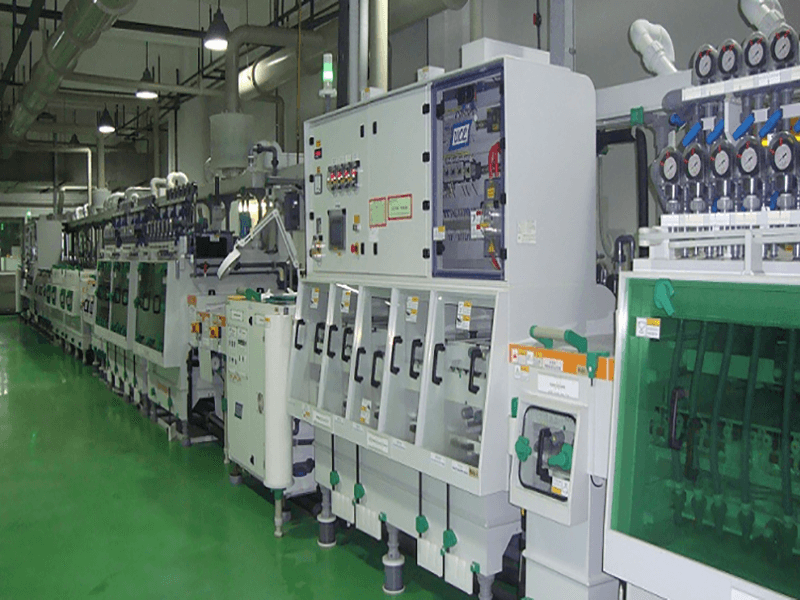
Plating Bath Agitation: 5 Methods for Even Copper Deposition
Plating bath agitation does the work that chemistry alone cannot. Copper ions reach the panel surface through a thin layer of stagnant solution called the boundary layer, and that layer is where deposition slows down and thickness spread begins. Move the solution or move the panel, and the boundary layer thins, throwing power improves and holes plate more evenly. Five methods cover nearly every agitation system used in a PCB plating line.
<img src="https://www.gopcba.com/wp-content/uploads/2025/05/未标题-11.jpg" alt="Air sparging in plating tank during copper electroplating of PCB panels” />
Why Plating Bath Agitation Decides Thickness Spread
Electroplating consumes metal ions at the cathode faster than diffusion can replace them in still solution. The result is a depleted zone right at the panel surface, thicker at the edges than in the center of the panel and worse inside holes. Agitation refreshes that zone and keeps ion concentration closer to the bulk value.
Good agitation also sweeps away hydrogen bubbles that would otherwise cling to the surface and create pinholes. That is why agitation and copper plating uniformity are treated as a single subject in most plating shops, and why a change in racking often shows up as a change in thickness distribution. Uniform agitation matters most on panels with mixed feature sizes, where small pads and large planes would otherwise plate at noticeably different rates.
Air Sparging in Plating Tank Layout
Air sparging in plating tank design uses a perforated pipe along the bottom of the tank, usually offset from the panel center line so bubbles sweep past the work instead of rising straight through it. Air volume should be enough to keep solution moving without creating turbulence at the surface that entrains air or splashes chemistry.
Holes in the sparger clog over time, and when they do, agitation becomes uneven along the tank. Remove and clean spargers on a maintenance schedule, and check the pattern by watching the surface with the rectifier off. Rows of bubbles that appear only on one side of the tank indicate a partially blocked pipe. Compare the pattern against a photograph taken after the last rebuild so slow changes are easier to spot.
Cathode Movement Plating: Stroke, Speed and Dwell
Cathode movement plating moves the rack back and forth through the solution, which thins the boundary layer more effectively than air alone in deep tanks. Stroke length, speed and the pause at each end of the travel all affect the result. A longer stroke with a moderate speed usually beats a short, fast oscillation.
Keep the movement consistent between shifts. Operators sometimes reduce stroke on heavy racks to avoid splashing, which quietly changes thickness distribution for those parts. Set the parameters in the recipe, lock the controller, and record the values on the traveler so a deviation is visible. Dry runs before the first production rack help confirm that the movement hardware is working, especially after a weekend stop.
Eductor, Pump and Solution Flow Options
Solution circulation through eductors or a pump and manifold gives strong, directed flow that can be aimed at the panel face. This is the preferred approach for high aspect ratio work, where air cannot reach deep into small holes. Flow must be balanced across the manifold so panels at the ends of the tank see the same condition as those in the middle.
Pump selection and filtration are part of the same system. A pump that delivers enough flow also puts shear on the solution and the additives it carries, so choose a low-shear design and place the return line so it does not blast directly onto the nearest panel. Our guide to plating filter pump selection covers the trade-offs.
Bath Agitation Rate and Boundary Layer Thickness
Bath agitation rate is not a number you read from a gauge; it is a condition you establish and then reproduce. Increasing rate beyond the point where the boundary layer is fully refreshed adds no thickness benefit and does add risk of turbulence, oxidation and contamination from the air supply.
Find the point of diminishing return with a thickness profile coupon. Use fresh solution at the correct temperature for the test, because cold or depleted baths exaggerate the effect of agitation and lead to settings that are too high. Plate a test panel at several agitation settings, measure copper thickness at edge, center and hole, and pick the setting where the spread stops improving. That setting becomes the standard, and it is usually lower than operators assume.
Copper Plating Uniformity on High Aspect Ratio Holes
Deep holes depend on flow more than on current. Without solution exchange inside the hole, copper deposits heavily at the board surface and thinly in the barrel, which leads to voids and plating cracks after thermal stress. Eductor flow directed at the panel face, combined with gentle cathode movement, gives the best results.
Confirm the benefit with a cross section from the worst case hole on the panel. Measure barrel thickness at the top, middle and bottom of the hole rather than averaging. Those three numbers show whether agitation is reaching the center of the board, which is where copper thickness targets are usually missed. Minimum copper thickness requirements for different product classes are defined in specifications from IPC, and they are the right benchmark when a customer asks what the process must deliver.
Agitation Effects on Anode Dissolution
Agitation affects the anode side of the tank as well. Good flow carries dissolved copper away from the anode surface and keeps the anode from passivating, which would otherwise raise voltage and unbalance the current distribution. Poor flow around the anode leads to rough deposits and a rising cell voltage that operators compensate for by increasing current.
Check anode area and spacing as part of the same review. Anode to cathode area relationships are covered in our note on anode area ratio, and anodes that are oversized, undersized or unevenly spaced all distort the flow pattern that agitation is supposed to create. Rotating anodes on a schedule keeps their surface condition even and prevents one side of the tank from doing most of the work.
Measuring and Documenting Agitation
Measure what you can: air flow at the sparger with a rotameter, pump discharge pressure, stroke length and speed from the controller, and tank level. Keep those values in a log with the tank number so a change is detected before it reaches the panels.
Add a periodic film test or a flow visualization check with dye to confirm the flow pattern still matches the original layout. Hardware ages, holes clog and pumps wear, so a system that was correct a year ago may not be delivering the same agitation today.
Troubleshooting Streaks, Burn Marks and Voids
Streaks that follow the direction of travel usually mean the boundary layer is not being refreshed evenly. Burn marks at the panel edges often mean current density is too high for the available agitation, so either increase flow or reduce current. Voids in hole barrels point to poor solution exchange inside the hole itself.
Before changing chemistry, repeat the plating run with the agitation system cleaned and verified. Comparing a test panel plated before and after cleaning the spargers is a fast way to prove whether the problem is mechanical. When it is not, move on to bath analysis and current waveform.

FAQ
How much air should a plating tank sparger deliver? Set the airflow to the volume that keeps solution moving past the panels without splashing, and confirm it with a dyed flow check. Higher airflow adds oxidation and evaporative losses without improving thickness distribution.
Is cathode movement necessary if the tank has strong air agitation? Not always, but the two work well together. Air reaches open surfaces, while rack movement helps push fresh solution into recesses. Test both settings and choose the combination that gives the flattest thickness profile.
What is the fastest way to check plating bath agitation? Watch bubble distribution with the rectifier off, then plate a coupon and measure edge, center and barrel thickness. Comparing those three readings against the last known-good panel shows whether agitation has changed.



1 Comment
Hull Cell Test In Plating: Reading The Panel And Acting On It
[…] fresh solution to the surface. The agitation side of that question is described in the notes on plating bath agitation. Deposits that are missing altogether suggest a contact problem or a very low metal […]