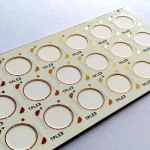
Water Spot Defect: 5 Causes After the Final Rinse
A water spot defect is one of the few cosmetic faults that customers reject without argument, because a marked surface suggests a process that is not under control. The spot itself is usually harmless chemistry left behind when a drop of water evaporated. Five causes account for most of them.
What a Water Spot Actually Is
A water spot is the residue of everything that was dissolved in the drop. As the water evaporates the salts concentrate and then dry in place, leaving a ring or a solid mark that follows the outline of the droplet. The mark can also be a corrosion product. Surface staining is the term customers use when the mark covers a wider area than a single droplet.
That distinction decides the remedy. A ring of dried salts can be rinsed away, while a spot caused by corrosion has already attacked the surface and may only be removed by reworking the panel. A deionised water rinse removes the dissolved solids that would otherwise dry on the surface.
Final Rinse Quality and Conductivity
Final rinse quality sets the ceiling on how clean the water is when the panel leaves the line. Conductivity or resistivity readings tell you what the rinse is carrying, and a reading that drifts upwards points to a rinse that is no longer doing its job.
The measurement point matters as much as the number. A probe sitting in the tank can read well while the water arriving at the panel is worse, so the reading should be taken where the panel actually meets the water.
Air Knives, Dryers and Water Removal
Dryers remove water rather than clean it, so any salt in the incoming water stays on the panel. Air knives that leave a film of water along the edges or under a connector leave a spot exactly where the flow was weakest. A knife set too close to the panel can also drive water into a connector or a slot.
Check the knives at the same interval as the rinse. Blocked slots, a knife set at the wrong angle and a pressure that has dropped all produce the same result, and all are corrected without touching the chemistry. Air flow, angle and pressure should be checked together, since one can compensate for another.
Racking and Drainage Before the Dryer
Racking decides where water collects. Panels hung flat drain quickly, while panels stacked or hung in a pocket hold a pool at the lowest point. The dryer then bakes that pool in place and the mark is fixed. A drain zone of a few seconds costs a little throughput and saves a batch of marked panels.
A short drain zone with a defined drip time prevents most of it. The habit of moving panels straight from the rinse to the dryer, which is common on a busy line, is usually the moment the defect is created. Water that is hard enough to leave a chalky ring will do so on every panel of the run.
Water Chemistry, Hardness and Silica
Water chemistry explains the stubborn spots. Hardness ions leave a chalky mark, and silica leaves a deposit that ordinary rinsing will not shift once it has dried. Both point to a treatment plant that is not performing as designed. A reading that drifts from the baseline should trigger a resin check rather than a rinse adjustment.
Treatment performance belongs on the daily check. Ion exchange, reverse osmosis and the resin changes behind them are covered in ion exchange water treatment, and the readings should be recorded with the rinse data. Warm rinses also dry faster, which reduces the volume of water the dryer has to remove.
Rinse Temperature and Flow
Rinse temperature affects both cleaning and drying. Warm water removes residues faster but evaporates sooner on the way to the dryer, and cold water can leave a film that the dryer then fixes in place. Drying after rinse should be specified with a temperature, a time and an airflow figure.
Flow matters for the same reason. A rinse that is starved of flow carries a higher concentration of salts by the end of the shift, so the last panels of a run are usually the ones with the worst marks. Flow control is described in rinse flow rate control. Matte finishes hide marks better than glossy ones, but the rinse still sets the limit.
Spots on Solder Mask and Final Finish
Solder mask shows spots more readily than bare copper because the surface is smooth and light coloured. A mark that would pass on copper is obvious on a green surface, so the mask line often needs tighter rinse control than the rest of the process. A finish line that plates and dries in one pass needs the same rinse discipline as the mask line.
Final finishes are more sensitive still, particularly where a thin immersion layer is involved. Water left on the surface can drive a local reaction, so drying after the finish deserves its own specification and its own check. Gloves should be changed when they are wet, since a damp glove transfers water to the panel.
Handling and Storage After Drying
Handling can create a spot after the panel is dry. Bare hands leave salts and oils, and a wet glove or a damp bench introduces water that was never part of the process. Clean, dry gloves and a defined storage area prevent both. Panels stored in a humid room can show marks from condensation alone, without any rinse fault.
Storage conditions matter for the same reason. A humid room places a film of water on every panel, and when that film dries unevenly it leaves the marks that the line worked hard to avoid. A photographed limit sample belongs with the rinse records, and the checks that keep that water clean are covered in rinse water temperature control.
Verification and Records
Verification should combine a visual standard with the process numbers. A photographed limit sample tells the operators what is acceptable, and the rinse readings explain why a shift drifted outside it. The record should allow a marked panel to be traced back to a shift, a line and a rinse stage.
Records should carry conductivity, temperature, flow, drip time and dryer settings. When a customer asks what changed, those values answer the question. General inspection practice is published by IPC. Water left under a component or in a slot is the hardest to remove and the first place a mark appears.
FAQ
Can water spots be removed after drying? Light salt rings can be rinsed off, but a mark caused by corrosion has already changed the surface and may not come back to specification. Rinsing the panel again and drying it properly is usually enough to remove a salt ring.
Does filtered water prevent spotting? It reduces the risk because it removes dissolved solids, but it will not compensate for poor drainage or a dryer that leaves water on the panel. A conductivity log reviewed each shift catches that drift before the panels show it.
Why do spots appear only at the end of a shift? Because the rinse bath loads up with dissolved solids as the shift runs, so the water reaching the panel is dirtier than it was at the start. The mask line and the finish line should both be reviewed, because either can be the source.