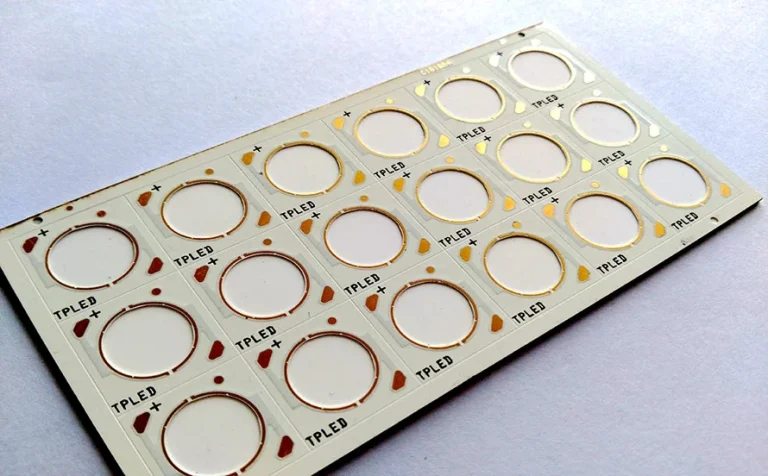
Bow and Twist Control: 5 Steps to Keep Panels Flat
Bow and twist control decides whether a panel reaches assembly flat enough to be handled, printed and placed. Warpage is built into the panel by lamination and then partly released by the processes that follow, so the fault rarely appears at the station that caused it. Five steps keep the geometry inside the limit.

What Bow and Twist Mean in Practice
Bow and twist describe the shape a panel takes when it is placed on a flat surface. Bow is a curvature along one axis, like a shallow dome, while twist is a helical deformation in which opposite corners lift. Both are measured as a percentage of the longest dimension. The limit is stated as a ratio, so a longer panel is not given more room.
The difference matters because they have different causes. Bow usually follows an imbalance through the stack, while twist is more often released by asymmetric cooling or by routing that removes material from one side of a panel only.
Where Lamination Stress Comes From
Lamination stress is built in whenever the layers of a stack want to change size by different amounts and are prevented from doing so. Resin shrinks as it cures, copper does not shrink with it, and the press holds the panel flat while the difference is locked into the laminate.
Everything afterwards can release that stress. Drilling heat, baking, a second lamination cycle and even the soldering operation in assembly can move the panel, which is why a board that measured flat at final inspection can still warp on a customer line. Panel flatness is therefore a moving target through the whole flow.
Copper Balance and Layer Stacking
Copper balance is the first lever. A stack with heavy copper on one side of the centreline and thin copper on the other behaves like a bimetallic strip, because the two sides respond differently to the same temperature change. Copper balance is a design decision, but its effect is a fabrication result.
Balance is a design and engineering matter, but the fabrication shop can still control how the stack is built. Symmetrical build-ups, matched prepreg types around the centre and consistent foil weight all reduce the stress that the press has to hold. Lamination stress is lowest when the stack is symmetric about its centreline.
Press Temperature, Pressure and Cooling
Press temperature and pressure decide how the resin flows and cures. A ramp that is too fast cures the outside of the stack while the centre is still soft, and the panel then cools with a different degree of cure through its thickness. A slow ramp costs press time and saves warped lots, which is a trade worth making.
Cooling is the step most often rushed. A panel that is removed hot, or cooled without pressure while the resin is still above its glass transition, is free to move as it contracts. Platen control and the ramp profile are described in press platen temperature control. Cooling rate should be specified as a ramp rather than as a single temperature.
Cooling Under Pressure and Flat Stacking
Cooling under pressure holds the stack flat while it stiffens, which is why the hold is usually specified as a temperature rather than as a time. Releasing the press early leaves the panel free to bow while it is still soft enough to move. The release temperature is the parameter to watch.
What happens immediately after the press matters as well. Panels stacked flat while warm and left to cool slowly keep their shape better than panels stood on edge or left in a tall pile. The practice follows the same logic as press cooling under pressure. A flat pallet with even support stops a set from forming.
Baking and Heat Treatment of Panels
Heat treatment of panels relieves stress and also dries the laminate, which is why bakes appear before drilling and before final finish. A bake that is too short leaves moisture in the stack and stress in the resin, and both are released later in a solder operation. Heat treatment of panels should be specified by laminate type.
The bake must also be uniform. Panels loaded tightly in an oven, or placed where the airflow is poor, dry differently from those at the door, and the difference in moisture content shows up as warpage after the next thermal step. Baking practice is covered in panel baking control. Oven loading should be recorded with the temperature profile.
Measuring Panel Flatness the Same Way
Measurement has to be defined before it can be controlled. The panel should rest on a flat surface, be measured over the longest dimension, and be read after a defined settling time at a known temperature, because a panel that is still cooling is still moving.
The same fixture, the same settling time and the same measuring points should be used for every check. When the method changes between operators, the readings change with it and the process appears unstable when it is not. A written method makes the measurement defensible to a customer.
Storage, Humidity and Stacking
Storage conditions change the reading without changing the panel. A humid room adds moisture to the laminate, and moisture expands the resin and softens it, so panels measured after a humid weekend read differently from panels measured on a dry afternoon.
Stacking matters too. Panels stored flat on a rigid pallet stay flat, while panels kept on edge in a bin or in a tall pile take a set from their own weight. Storage rules should be written as clearly as any process parameter. Humidity in the stores should be logged alongside the temperature, because a panel that has taken a set will not recover on the line.
Rework, Scrap or Use as Is
When a lot measures outside the limit, the first question is whether the panel can be flattened. A second bake under pressure can recover some lots, but the treatment is only worthwhile when the stack has the copper balance to hold the new shape. A recovered lot should be re-measured after it has cooled.
Where the panels cannot be recovered, the decision should be made early rather than at the end of the process. Passing warped panels forward costs more than scrapping them, because the deformation shows up later in printing, placement or reflow. Inspection practice is published by IPC. The cost of passing a warped panel forward is always higher than the cost of scrapping it early.
FAQ
Does routing cause warp? It can release it. Removing material from one side of a panel changes the balance, so the same stack can measure flat before routing and outside the limit after it. A flat panel before routing usually stays flat after it, and a stressed one does not.
Can a warped panel be flattened? Some lots can, by baking and pressing flat, but the result depends on the copper balance. Rework that cannot hold the shape should not be released. A second bake is worth a trial before scrapping a whole lot.
Why do panels warp only after assembly? Because the soldering operation is another thermal cycle. Moisture and built-in stress left in the panel are released then, not during fabrication. Moisture content before assembly is the variable most often missed, and it is the easiest one to control.