Consumer Robot PCB: What a 399 Dollar Biped Demands
On 27 August 2026 Pollen Robotics, part of Hugging Face, released a bipedal robot called Microduck at a price of 399 dollars. Within twenty four hours of opening preorders the order value passed 2.6 million dollars, roughly six thousand five hundred units, with a peak rate reported at one sale every four seconds and delivery quoted four to six months out. The machine is twenty five centimetres tall and weighs about eight hundred grams, runs a Rockchip RK3566 processor, was manufactured with a Shenzhen hardware partner, and depends on a consumer robot PCB that carries motion control, sensing, radio and power in a very small volume, and carries fifteen motors, a camera, a time of flight lidar, two inertial measurement units, and Wi-Fi, Bluetooth and NFC radios.
For a consumer robot PCB the interesting part is the combination rather than any single figure. Embodied hardware has until now lived in laboratories, developer platforms and expensive machines. A four hundred dollar product moves the design target from maximum capability to a balance between performance, volume, power, reliability and bill of materials cost, and that balance is decided largely on the boards inside the shell.
Why Price Changes the Engineering Target
At research prices, a designer adds boards and connectors until the function is complete. At consumer prices, every board, cable and assembly step has a cost, and every millimetre of internal space has to earn its place. The number of motors matters less than how their control electronics are distributed and how many connections are needed to tie them together.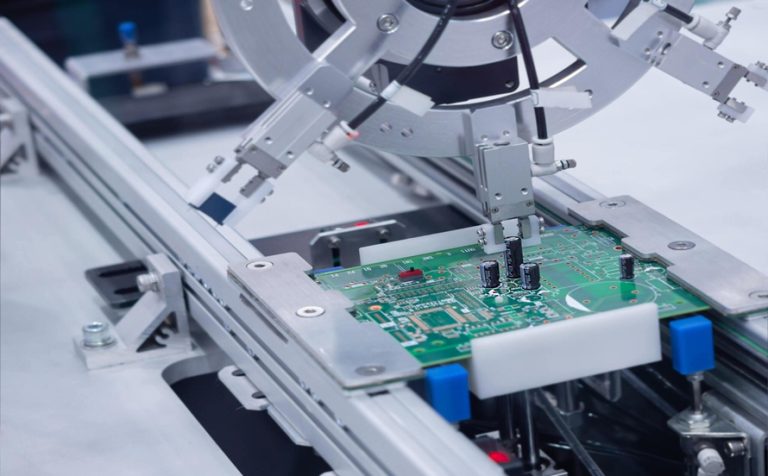
This is the same transition that development boards went through. When a platform becomes cheap enough, developers adopt it, algorithms and sensor ecosystems mature, and the hardware standardises. Robotics appears to be following that path, and the electronics inside become a packaging problem as much as a computing problem.
Fifteen Motors, Fifteen Control Problems
Each motor needs a driver, current sensing, position feedback and a communication path, and the controller has to coordinate them within a control loop fast enough to keep the machine balanced. Distributing that across several boards is the conventional answer, but it multiplies connectors and harnesses in a body only twenty five centimetres tall.
The alternative is to concentrate the motor drive electronics on fewer, denser boards placed close to the mechanism, and to use flexible interconnect to reach the joints. That reduces assembly steps and removes failure points, at the cost of routing density and thermal load on the remaining board area. On a small biped, that trade is usually worth taking.
Sensor Fusion in a Very Small Package
A camera, a time of flight sensor and two inertial units produce continuous data that has to reach the processor with low latency and stable timing, because the fusion algorithms depend on knowing when each measurement was taken. Intermittent delays that a larger machine would absorb become control errors when the machine is small and light.
That places requirements on trace routing that are usually associated with communications equipment: controlled impedance where differential interfaces are used, short and well referenced paths, and clock distribution that keeps sampling coherent. On a price constrained product the temptation is to simplify this, and the consequence appears later as behaviour that is difficult to debug.
HDI and Any-Layer Construction in a Consumer Product
When a body is this small, routing density is the limiting factor rather than component count. Multiple functional blocks have to share a board area measured in a few square centimetres, and the escape routing from a processor with hundreds of balls consumes the surface quickly. HDI allows laser drilled microvias to reach inner layers and frees the surface for components.
Any-layer construction goes further, allowing vias between any two layers so that routing channels are not blocked by layer pairing rules. That flexibility is worth its cost on a product where the alternative is a larger enclosure, and it is the reason consumer robotics is becoming a volume application for high density interconnect capability rather than a niche one.
Flex and Rigid Flex Where the Body Moves
A walking robot bends at every joint, and cables that tolerate installation rarely tolerate motion. Flexible circuits built into the limbs carry power and signals across the moving sections and eliminate the connectors that would otherwise sit at each articulation.
Rigid flex combines the control electronics and the interconnect in one structure, which saves both space and assembly time. The design rules are the same as in any dynamic flex: conductors parallel to the bend, no vias in the flexing region, coverlay openings aligned to the mechanical bend, and a bend radius that the limb design can actually provide. A supplier who builds flexible circuits and assemblies should be involved before the mechanical design is frozen.
Power, Heat and Battery Life
Fifteen motors in a small body draw current in bursts, and the battery has to supply those bursts while the electronics stay within a temperature that does not distort the shell or degrade the cells. Power distribution therefore needs thick enough copper to keep voltage drop low, and decoupling close enough to the drivers to absorb switching transients.
Heat has nowhere to go. A consumer robot has no fan, and the surface area available for spreading is limited by the product design. That makes efficiency a design requirement rather than an optimisation: drivers chosen for low loss, power paths kept short, and thermal vias used to move heat into whatever metal the structure provides.
Wireless Coexistence in a Metal Lined Body
Wi-Fi, Bluetooth and NFC share a small enclosure with motors and switching regulators, which is an unfriendly environment for radio. Antenna clearance must be preserved, ground planes have to be arranged so they do not detune the radiators, and noisy switching paths need to be kept away from the receive chain.
Because the product is assembled at low cost and high volume, the antenna solution also has to be repeatable. A design that works on one prototype and loses several decibels when the shell tolerance changes will fail in production, and mechanical variation in a moulded plastic body is larger than in a machined enclosure.
Manufacturability at Consumer Volumes
Six thousand five hundred units is a pilot, but the price point assumes much larger volumes eventually. Assembly cost depends on the number of boards, the number of connectors and the number of steps, so a design that reduces parts will scale better even if the individual board is more complex.
The practical preparation is to keep the assembly line in mind from the start: components placed for automated placement, test points that allow functional verification without disassembly, and a test program that exercises motors, sensors and radios together. Bringing board and assembly processes into one flow makes that verification far easier to iterate.
Test and Bring-Up for a Mass Market Robot
A robot sold at four hundred dollars has to be testable in minutes on a production line, which means the board design has to expose the interfaces that verification needs. Motor channels, sensor buses and radio links all require a test access point, and the test program has to be able to distinguish a board fault from a mechanical or firmware problem.
Building that capability early is cheaper than adding it later. Designing test points into the layout, keeping a diagnostic interface available on production boards, and defining the sequence in which subsystems are verified all reduce the time spent investigating a returned unit, which is where the cost of poor test coverage accumulates in a consumer product.
Supply Chain and Second Sources
Consumer products live or die on component availability. A processor, sensors and wireless module chosen for a four hundred dollar robot may have long lead times, and a single part that cannot be supplied stops the whole line. Second sources have to be identified during design, not during a shortage.
Where alternatives exist, the board should accommodate them without a redesign: compatible footprints, supply rails with enough margin, and firmware that can adapt to a different sensor. That flexibility costs little in layout and prevents a supply problem from becoming a product delay, which is a lesson consumer electronics learned long before robotics arrived.
How the Bill of Materials Shapes the Board
Robotics teams often start from the mechanical design and the control algorithm, and treat the electronics as a consequence. On a price constrained product the opposite discipline is more effective: decide the component set and the number of boards early, then design the enclosure around them, because each additional board and connector carries cost and assembly time.
That approach also clarifies where density is genuinely required. A small number of densely routed boards with flexible interconnect between them usually beats a larger number of simpler boards, provided the thermal and mechanical constraints can be managed. Getting that decision right at the concept stage is the cheapest engineering work in the whole programme.
What the Developer Ecosystem Will Push Next
If the platform follows the pattern of development boards, the next generation will add sensors and capabilities without changing the price. Each addition raises routing density and thermal load again, and each one makes rigid flex integration more attractive than conventional cabling.
Suppliers serving this market will be judged on how tightly they can package function, and on how consistently they can reproduce it. A robot that costs four hundred dollars cannot afford a board that requires manual rework, so the manufacturing discipline that consumer electronics demands applies here from the first production run, and it is the reason controlled fabrication matters more than a headline specification.