Robot PCB Supply Chain: What a Five Thousand Unit Order Really Tests
A reported order of roughly five thousand humanoid units, with a supply chain asked to prepare for up to a thousand units per week, changes the questions a buyer asks. Instead of whether a prototype board can be produced quickly, the robot PCB supply chain is judged on whether dozens of different boards can be delivered, in step, at a steady rate.
The first orders in this range arrived during 2026 and were still climbing a yield curve when they were placed. That detail is more important than the quantity. A ramp that has not yet stabilised puts pressure on every supplier that touches the program, because capacity has to be committed before the process is fully proven.
The Order Size That Changes the Conversation
Below a few hundred units, buying boards is a negotiation about speed. Samples are requested, revisions are expected, and a supplier who can turn a panel in three days wins the work. Nothing about that process prepares a factory for a program that needs the same board every week for a year.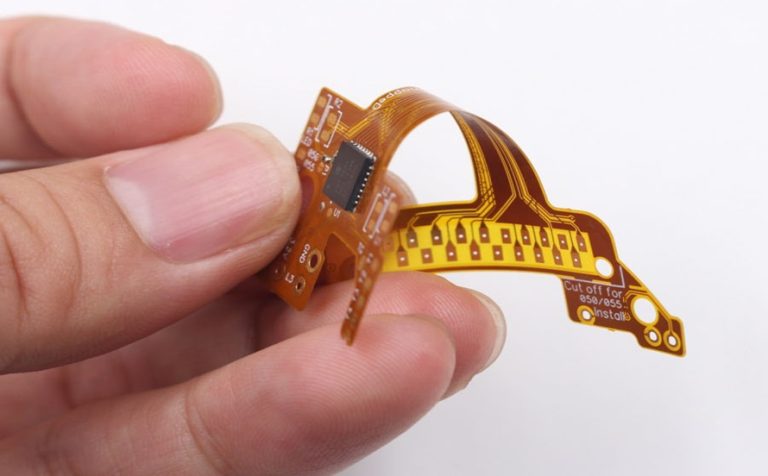
Above a few thousand units, the conversation becomes about repeatability. The buyer wants to know what happens when a panel is rejected, how quickly a process drift is detected, and whether the supplier can hold a specification without an engineer watching every lot. Those are process questions, not design questions.
Flexible Interconnect Faces Its Real Test
Joint assemblies are where flexible circuits earn their place, and also where they fail first. A design that survives a few hundred bends in a prototype may not survive continuous motion for years. The variables are well known: copper type, coverlay construction, stiffener geometry and the angle at which conductors cross the bend zone.
Volume production turns those variables into acceptance criteria. The supplier has to demonstrate that flexible circuit assembly is controlled lot by lot, and that a change of laminate or adhesive source does not quietly alter bend life. That is a documentation discipline as much as a manufacturing one.
Main Control and Drive Boards Pull in Opposite Directions
The control board wants density. Processors, memory and high speed interfaces sit close together, ball grid array pitches shrink, and the routing escapes into microvia layers because through holes will not fit. Yield on that board depends on alignment, plating fill and fine line etching rather than on material cost.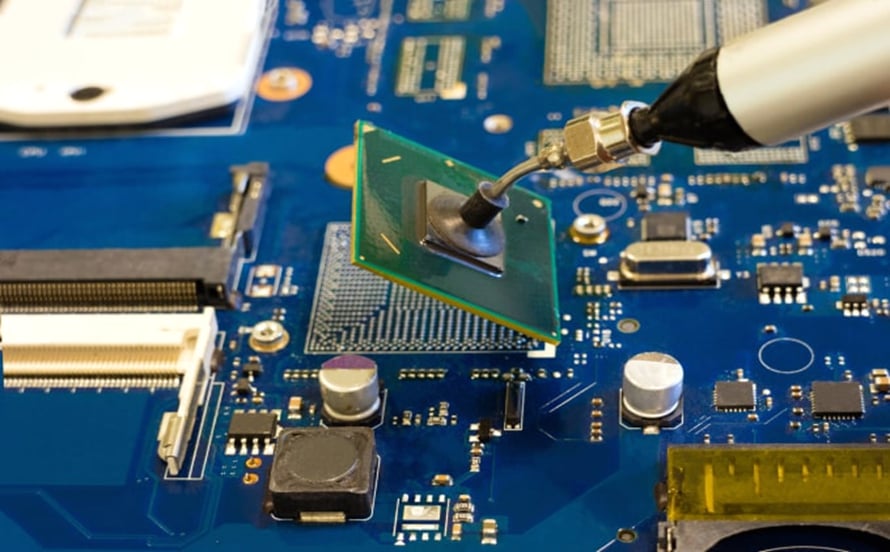
The drive board wants copper. Current flows through the board rather than across its surface, so heavy copper, plated barrel quality and thermal spreading dominate. Because both board types sit inside the same machine, a supplier needs genuine high density interconnect capability alongside heavy copper experience.
Heavy Copper and Heat in the Actuator
Actuator electronics live next to a motor, in an enclosure with almost no airflow. Conduction is the main cooling path, which makes the copper plane part of the thermal design. Designers who route heat into the housing through thermal vias and wide pours usually avoid the derating problems that appear later in the field.
Manufacturing must then hold copper thickness and hole wall quality within tight limits. Thin plating in a heavy copper board is a latent failure, not an immediate one, and latent failures are the most expensive kind in a program that ships thousands of units per week.
What a Bend Zone Failure Costs at Volume
A single cracked conductor in a joint circuit is a ten minute repair on a prototype. In a shipped unit it becomes a service event, and the cost is carried by the brand rather than the board supplier. That asymmetry explains why robot programs spend more on validation than their early volumes seem to justify.
Bend testing, thermal cycling and vibration screening on production lots are therefore not optional extras. Suppliers that can run process control and reliability testing on the same floor give their customers a shorter path from a process change to a verified result.
Batch Consistency Across Dozens of Part Numbers
A humanoid platform can involve thirty or more distinct board designs, from a large control assembly to a small sensor circuit. Each one has its own stack up, surface finish and tolerance. The risk is not that one board is difficult, but that the combination drifts apart over months of production.
Consistency comes from standardising what can be standardised: common finishes, common laminate families, common panel sizes and shared process recipes. The more of that a supplier can unify, the fewer variables remain to explain a yield change when one appears.
Solder Joint Reliability Under Constant Motion
Robots vibrate, accelerate and stop abruptly. Every one of those events loads the solder joints on the board, and the joints that fail first are the large ones at connectors and heavy components. Pad geometry, thermal relief design and stencil apertures all influence how those joints behave.
The manufacturing answer is unglamorous. Good paste volume control, a well profiled reflow curve and inspection that actually sees the joint are more effective than any exotic material. Programs that treat assembly as a process to be measured rather than a step to be completed see fewer field returns.
Inspection as a Production Function
When volume rises, inspection stops being a final gate and becomes a production function. Paste inspection feeds back to the printer, optical inspection feeds back to placement, and X-ray reveals voiding beneath packages that optical systems cannot see. The data only helps if it is used during the run, not after it.
Functional testing closes the loop by confirming behaviour rather than appearance. Combining fabrication and board level test in one supplier shortens that loop considerably, because the electrical signature of a known good board is available to the team investigating a failure.
Traceability From Panel to Robot
Traceability sounds bureaucratic until a program has to isolate a batch. Knowing which laminate lot, which plating line and which reflow oven produced a specific board is the difference between a contained issue and a full recall. At a thousand units per week, that containment capability protects the whole schedule.
Practical traceability requires marking at panel level, records linked to serial numbers at assembly, and a database that survives a supplier change. Buyers evaluating a partner for a robot program should ask to see a worked example rather than a certificate.
Sourcing Questions That Predict Delivery Risk
Most delivery failures in a ramp can be predicted from three questions. How many board types is the supplier qualified to run in parallel? Which critical processes are in house? How is a process change communicated when it affects form, fit or reliability? Weak answers to any of them signal a future delay.
A partner that covers fabrication, component sourcing and high volume assembly reduces the number of interfaces that must be coordinated. Fewer interfaces mean fewer places for a schedule to slip when a demand forecast doubles within a quarter.
Cycle Time Matters More Than Unit Price
At a thousand units per week, the cost of a delay usually exceeds the cost of the boards themselves. A line that stops waiting for a panel loses far more value than a few percent of purchase price. Buyers who understand this negotiate on responsiveness, buffer strategy and escalation paths rather than on price per square metre.
Suppliers can support that shift by quoting a production cycle rather than a sample lead time. When a factory publishes realistic cycle times and holds them, the customer can plan inventory around the number instead of building safety stock purely to cover uncertainty.
Managing Change Once Production Has Started
Change does not stop when a ramp begins. A driver component goes obsolete, a connector is redesigned, a laminate supplier discontinues a grade. Each of those events has to be absorbed without restarting qualification of the whole assembly, which requires a documented process for evaluating change rather than ad hoc decisions.
The practical tool is a controlled change note that links the revision to the affected panels, boards and assemblies. Without it, a small substitution can quietly alter impedance, solderability or bend life, and the effect appears months later as an unexplained field failure.
What Comes After the Ramp
Programs rarely stay at one volume. A design that ships a thousand units a week this year may be asked for three thousand next year, or may shift to a second model that reuses most of the electronics. Suppliers who kept their process records intact can move with that change instead of starting over.
That continuity is the real prize in robot manufacturing. The first large order proves a supply chain can deliver, but the second and third orders are where a partnership becomes durable. Manufacturers organised for repetition, rather than for the launch itself, are the ones still present when volumes grow.
Why Capacity Alone Does Not Win the Business
Humanoid programs will not be won by the largest factory. They will be won by the supplier whose yield curve is flat, whose documentation is current and whose engineering team answers questions before they become complaints. Capacity can be purchased; those habits cannot.
For the electronics supply chain, the significance of a five thousand unit order is therefore not the revenue it represents. It is the proof that the industry has started to select partners on manufacturing discipline. That standard, once set, tends to spread to every program that follows.