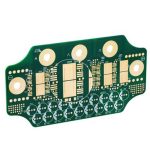
Printed circuit boards (PCBs) are fundamental to almost every modern electronic device. A PCB provides the electrical interconnection platform on which carefully selected components are mounted to perform specific functions such as signal processing, power conversion, sensing, communication, switching, and control.
As artificial intelligence (AI), digital electronics, automotive electronics, industrial automation, and connected devices continue to develop, electronic products are becoming smaller, more powerful, and more functionally integrated. This trend increases the complexity of the PCB Components used in modern circuit boards.
Selecting the right components is not only an electrical design decision. Engineers and procurement teams must also consider package size, electrical specifications, thermal performance, availability, lifecycle status, compliance requirements, cost, and compatibility with the PCB assembly process.
What Are the Different Types of PCB Components?
A PCB bill of materials (BOM) normally contains a complete list of the components and materials required to manufacture a particular board. A well-structured BOM may include:
- Manufacturer part number
- Internal part number
- Manufacturer name
- Approved supplier
- Quantity per board
- Unit of measure
- Package type
- Component value
- Tolerance
- Lifecycle status
- Approved alternatives
- Procurement information
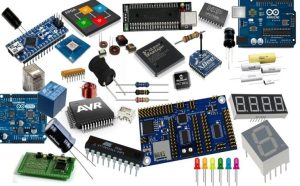
From an electrical perspective, Electronic Components on a PCB are commonly divided into active and passive components.
Active Components
Active Components generally require an external power source and can control, amplify, switch, or otherwise influence electrical signals.
Common examples include:
- Integrated circuits (ICs)
- Microcontrollers
- Microprocessors
- Transistors
- Operational amplifiers
- Voltage regulators
- Power management ICs
- Memory devices
An integrated circuit contains a large number of semiconductor devices and interconnections within a small package, allowing complex functions to be performed in a compact area.
Passive Components
Passive Components do not provide power gain. They generally store, dissipate, or transfer energy and can modify electrical characteristics without actively amplifying a signal.
The most common passive components are:
- Resistors
- Capacitors
- Inductors
- Transformers
For example, a resistor can limit current and establish voltage relationships, while a capacitor can store electrical energy, filter signals, or provide local power decoupling.
Passive components are often identified by package dimensions. For example, an imperial 0603 package is approximately 0.06 × 0.03 inches, while metric package designations use a different numerical convention.
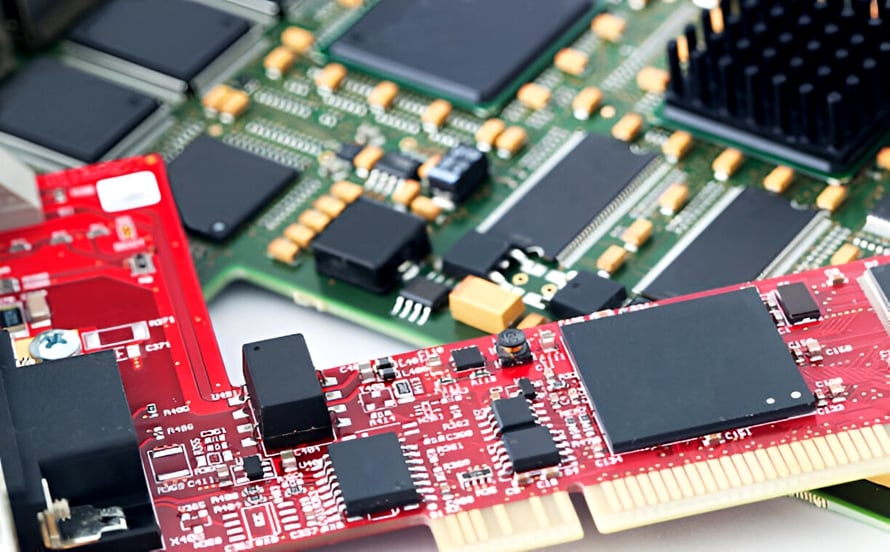
Basic Electronic Components Used on PCBs
A typical PCB may contain dozens or thousands of individual components, depending on its complexity.
Resistors
A resistor limits current and creates a specified resistance within a circuit.
Common applications include:
- Current limiting
- Voltage division
- Signal termination
- Biasing
- Pull-up and pull-down networks
- Sensing circuits
Resistors are available in different resistance values, tolerances, power ratings, and package sizes.
Capacitors
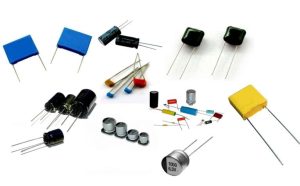
A capacitor stores electrical energy in an electric field.
On a PCB, capacitors are frequently used for:
- Power-supply filtering
- Decoupling
- Signal coupling
- Noise suppression
- Timing circuits
- Energy storage
Different capacitor technologies, such as ceramic, aluminum electrolytic, tantalum, and film capacitors, have different electrical and environmental characteristics.
Diodes
A diode is a semiconductor device with two terminals that primarily allows current to flow in one direction.
Different types of diodes are used for different purposes, including:
- Rectification
- Reverse-polarity protection
- Voltage regulation
- Signal detection
- Switching
- Transient-voltage protection
- Light emission
Examples include rectifier diodes, Schottky diodes, Zener diodes, TVS diodes, and LEDs.
Integrated Circuits
An integrated circuit (IC) is a semiconductor device containing many interconnected electronic elements within a single package.
ICs can perform functions such as:
- Data processing
- Memory
- Power management
- Signal amplification
- Communication
- Motor control
- Sensor processing
- Logic operations
Modern IC packages include QFP, QFN, BGA, LGA, SOIC, and many other package formats.
Transistors
Transistors are semiconductor devices commonly used for switching and amplification.
They are fundamental to:
- Digital logic
- Power switching
- Signal amplification
- Motor control
- Voltage regulation
- Oscillation circuits
Common transistor families include bipolar junction transistors (BJTs), MOSFETs, and insulated-gate bipolar transistors (IGBTs).
Connectors
Connectors provide removable electrical and mechanical interfaces between PCBs, cables, modules, and external equipment.
Connector selection should consider:
- Number of contacts
- Current rating
- Voltage rating
- Contact resistance
- Mating cycles
- Mechanical dimensions
- Locking mechanism
- Environmental conditions
Oscillators and Timing Devices
Oscillators generate periodic electrical signals that can be used as timing references.
Quartz crystals, crystal oscillators, MEMS oscillators, and clock-generator ICs are commonly used in electronic systems.
They provide timing references for microcontrollers, processors, communication interfaces, and other digital circuits.
Relays
A relay is an electrically controlled switching device that can allow a relatively low-power control circuit to switch another circuit.
Relays can provide electrical isolation between control and load circuits and are widely used in industrial control, automotive systems, power equipment, and automation.
Transformers
Transformers transfer electrical energy between circuits through electromagnetic induction.
They can be used for:
- Voltage conversion
- Electrical isolation
- Impedance matching
- Signal coupling
- Power conversion
Transformer design depends on operating frequency, power level, insulation requirements, core material, and electrical specifications.
PCB Component Sourcing and BOM Management
Component procurement is an important part of PCB manufacturing. A technically correct PCB design can still face production delays if critical components are unavailable.
Maintain an Accurate BOM
BOM Management should begin during the design stage and continue throughout the product lifecycle.
A controlled BOM should clearly identify the exact components approved for production. Engineering and procurement teams should coordinate closely when changes are made.
Important BOM information can include:
- Manufacturer
- Manufacturer part number
- Description
- Value
- Package
- Quantity
- Approved alternatives
- Lifecycle status
- Compliance information
- Procurement status
Revision control is particularly important because even a small component change can affect PCB layout, electrical performance, thermal behavior, or assembly processes.
Identify Alternative Components
Using qualified alternative components can help reduce supply-chain risks.
However, an alternative part should not be selected solely because its electrical specifications appear similar.
Engineers should also verify:
- Package dimensions
- Pin configuration
- Electrical characteristics
- Thermal performance
- Operating temperature
- Tolerance
- Reliability
- PCB footprint
- Assembly compatibility
- Regulatory compliance
For critical ICs, power devices, connectors, and other specialized components, substitution may require formal engineering approval.
Monitor Component Lifecycle Status
Electronic components can move through several lifecycle stages, including introduction, active production, mature production, last-time-buy status, and discontinuation.
Procurement teams should monitor:
- End-of-life announcements
- Last-time-buy notices
- Product changes
- Manufacturer notifications
- Availability
- Lead-time changes
Early identification of lifecycle risks allows engineers to redesign the product or qualify alternatives before production is affected.
Key Challenges in Electronic Component Sourcing
Environmental and Regulatory Requirements
Many electronic products must comply with environmental and product regulations applicable to their target markets.
Depending on the product and market, requirements may include restrictions on certain hazardous substances, chemical substance regulations, material declarations, and other compliance obligations.
Compliance should be considered during component selection rather than after the PCB has already entered production.
Rapid Technology Changes
The electronics industry evolves quickly.
New semiconductor processes, package technologies, communication standards, power devices, sensors, and passive components are continuously introduced.
Procurement and engineering teams therefore need to monitor technology changes while ensuring that new components are properly evaluated before being introduced into production.
Supply and Demand Fluctuations
Component availability and pricing can change because of:
- Demand fluctuations
- Production capacity
- Raw-material availability
- Manufacturer allocation
- Product lifecycle changes
- Transportation disruptions
- Regional supply-chain conditions
A component shortage can affect the entire production schedule, particularly when the unavailable component is essential to the product.
PCB Design Requirements
Component selection must match the physical and electrical requirements of the PCB.
For example, a high-density PCB may require very small packages, while a high-power design may require components with larger thermal pads, higher current ratings, or stronger heat dissipation capabilities.
Engineers should also consider:
- Component height
- PCB footprint
- Pad geometry
- Creepage and clearance
- Thermal requirements
- Signal integrity
- Power distribution
- Assembly technology
Close cooperation between PCB designers, component engineers, and procurement teams can prevent component-selection problems from reaching production.
Factors to Consider When Selecting PCB Components
Electrical Performance
The component must satisfy the electrical requirements of the circuit.
Important parameters may include:
- Voltage rating
- Current rating
- Resistance
- Capacitance
- Inductance
- Frequency response
- Tolerance
- Power rating
- Switching characteristics
Engineers should evaluate actual operating conditions rather than relying only on nominal values.
Package and Mechanical Compatibility
The physical package must match the PCB footprint and available board space.
For dense boards, component height can also affect:
- Enclosure clearance
- Heat dissipation
- Connector placement
- Mechanical assembly
- Adjacent component spacing
Thermal Performance
Power components may generate significant heat during operation.
Engineers should evaluate:
- Power dissipation
- Junction temperature
- Thermal resistance
- PCB copper area
- Thermal vias
- Heat sinks
- Airflow
Thermal considerations become especially important for power supplies, motor-control boards, automotive electronics, LED systems, and industrial equipment.
Reliability
Component reliability depends on the component itself as well as its electrical, thermal, mechanical, and environmental operating conditions.
For demanding applications, engineers may need to consider:
- Operating temperature
- Humidity
- Vibration
- Shock
- Electrical stress
- Thermal cycling
- Expected service life
The component should be selected according to the actual application environment.
PCB Components and PCB Assembly
Component selection directly affects the PCB Assembly process.
The package type, component dimensions, pad design, component orientation, and thermal characteristics can all influence assembly performance.
For SMT assembly, important factors include:
- Component package
- Stencil aperture design
- Solder paste selection
- Placement accuracy
- Reflow profile
- Pad geometry
- Component spacing
For through-hole components, lead dimensions, hole sizes, insertion requirements, and soldering processes must also be considered.
Components that are technically suitable but difficult to assemble can increase manufacturing complexity and inspection requirements.
Common PCB Component Selection Mistakes
Several common mistakes can create unnecessary design and production problems.
Selecting Only by Price
The lowest component price does not necessarily provide the lowest total product cost.
A cheaper component may have longer lead times, lower availability, limited lifecycle support, or additional qualification requirements.
Ignoring Component Lifecycle
Selecting a component without checking its lifecycle status can create problems later when the manufacturer announces discontinuation.
Using Unverified Alternatives
A substitute component should be evaluated before being introduced into production.
Electrical compatibility alone may not be sufficient.
Overlooking Package Differences
Two components may have similar electrical specifications but different package dimensions or pin configurations.
Such differences can make the substitute incompatible with the existing PCB layout.
Failing to Consider Thermal Requirements
A component may meet its electrical specification but exceed its allowable temperature under actual operating conditions.
Thermal analysis should therefore be included when necessary.
Quality Control for PCB Components
Component quality control begins before the parts reach the assembly line.
A suitable incoming inspection process may verify:
- Part number
- Manufacturer
- Quantity
- Packaging
- Date or lot code
- Physical condition
- Label information
- Moisture-sensitive-device status when applicable
- Documentation
- Compliance information
For certain high-risk or counterfeit-sensitive components, additional verification methods may be appropriate.
Proper storage is also important. Moisture-sensitive devices, electrostatic-sensitive devices, and components with specific storage requirements should be handled according to their manufacturer’s recommendations.
Choosing a PCB Component Supplier
A reliable Component Sourcing strategy requires more than comparing unit prices.
Supplier Quality
Evaluate the supplier’s quality-control procedures, traceability practices, material verification, and nonconformance management.
Availability
A supplier should be able to provide realistic information about stock, lead times, and component lifecycle status.
Technical Support
Technical support can be valuable when evaluating alternative components, package compatibility, electrical specifications, and manufacturing requirements.
Supply Chain Resilience
For critical components, it may be useful to evaluate multiple qualified sources where technically and commercially appropriate.
Documentation
Accurate manufacturer documentation, datasheets, certificates, lot information, and compliance records help maintain component traceability.
Kingda PCB Component and Manufacturing Support
Kingda can support customers with PCB manufacturing and assembly projects that require coordinated component sourcing and production planning.
Depending on project requirements, Kingda can work with customer BOMs, approved component lists, PCB design files, and manufacturing specifications.
The manufacturing workflow can include component verification, PCB assembly, inspection, testing, and production coordination. When alternative components are considered, their electrical, mechanical, thermal, and assembly compatibility should be evaluated before approval.
For projects with complex or long-lifecycle requirements, component availability and lifecycle status can also be incorporated into manufacturing planning.
Best Practices for PCB Component Management
To improve component availability and manufacturing stability, manufacturers should:
- Maintain a complete and revision-controlled BOM.
- Verify manufacturer part numbers carefully.
- Monitor component lifecycle status.
- Qualify suitable alternatives in advance when appropriate.
- Check package and footprint compatibility.
- Evaluate thermal and electrical requirements.
- Consider PCB assembly requirements during component selection.
- Maintain component traceability.
- Store components according to manufacturer requirements.
- Monitor supply, lead time, and pricing changes.
- Coordinate engineering and procurement decisions.
- Review component changes through formal change-control procedures.
Conclusion
PCB Components are fundamental building blocks of modern electronic products. Resistors, capacitors, diodes, transistors, ICs, connectors, oscillators, relays, transformers, and other devices work together to provide the electrical functions required by a PCB.
Effective component selection requires more than matching electrical specifications. Package compatibility, thermal performance, reliability, availability, lifecycle status, regulatory requirements, cost, and PCB Assembly compatibility should all be evaluated.
Strong BOM Management and a well-planned Component Sourcing strategy can help reduce production interruptions and improve manufacturing stability. By coordinating engineering, procurement, quality, and manufacturing teams from the beginning of the project, companies can establish a more reliable path from PCB design through assembly and final production.